Stop overspending on ads to grow. Instead, use conversion rate optimization (CRO) to squeeze more revenue from the traffic you already have. By focusing on user experience and customer journey optimization, you naturally turn more visitors into buyers.
CRO isn’t just about small tweaks; it’s a conversion optimization process that applies to your website, product, and emails. It helps you:
- Increase online sales by making your offer more trustworthy.
- Improve customer retention by refining the product experience.
- Improve email open rates through data-driven testing.
Ultimately, website conversion optimization replaces guessing with the scientific method, creating a culture of experimentation that drives long-term growth.
What is Conversion Rate Optimization?
So, what is conversion rate optimization exactly? Let’s look at the meaning of CRO. It is a process of modifying elements across a number of website pages to increase your conversion rate. It is about effectively helping website visitors achieve their goals. When your visitors win, your business wins. This is the heart of digital marketing optimization and data-driven marketing.
What tools can we use for Conversion Rate Optimization?
Several conversion rate optimization tools can help you implement and track your efforts effectively. These CRO tools take the mystery out of customer behavior analysis and user interaction tracking. Using the right website optimization tools allows you to see exactly where your users get stuck. Here are some popular A/B testing tools and website SEO analytics tools:
- Google Analytics: This provides deep insights into user behavior and conversion metrics. It is the foundation for any website performance improvement.
- Hotjar: This offers heatmap, session recording, and survey tools to understand user interactions. You can see where people click and where they move.
- Optimizely: A comprehensive platform for A/B testing tools and personalization. It helps you optimize user flow by testing different page versions.
- Crazy Egg: It helps you see how visitors actually use your website with simple heatmaps and scroll tracking.
- VWO (Visual Website Optimizer): Ithelps you test different versions of your website, run A/B and multivariate tests, and collect real user feedback to improve conversions.
Why Should You Care? (The Benefits of Conversion Rate Optimization)
Many CRO benefits can transform your business. Instead of just guessing what your customers want, you use data-driven marketing to make real improvements. This approach leads to smarter online business growth strategies and better website performance. Here are the primary reasons why conversion rate optimization is a game-changer for any digital brand:
- Increasing Sales Without Spending More on Acquisition: In marketing and ecommerce, saying “We want to increase sales” usually means “We plan on paying more for ads.” But CRO improves what happens after the acquisition stage. By focusing on website conversion optimization, you can generate more revenue from the same traffic. This is the most effective way to increase sales without ads and simultaneously improve marketing ROI.
- Learning More About Your Customers: The more experiments you run, the more you understand your audience. You learn what matters to them, what they dislike, and how they think through customer behavior through constant analysis. These insights help you create products and services that perfectly fit their needs, leading to a much stronger product-market fit.
- Increasing Customer Lifetime Value (CLTV): You can apply conversion rate optimization to every stage of the journey, not just the first sale. By testing and improving customer retention strategies, you ensure users stay longer. Using CLTV optimization techniques means you provide more value over time, which naturally leads to increased ecommerce sales from your existing base.
- Improving User Experience: Most tests aim to remove friction. Whether you call it user experience optimization or UX improvement strategies, the goal is a smoother ride. By using conversion-focused design and website usability improvements, you make it easier for people to navigate your site, which helps reduce bounce rate and improve engagement.
- Improving Risk-Management in the Organization: Instead of relying on “gut feelings” or leaps of faith, you can test if a change actually works. If a new landing page optimization has a positive effect, it stays. If the effect is negative, you stick with the previous version. This experiment-driven marketing significantly reduces the risks that the organization takes with every new update.
- Creating a Culture of Experimentation: CRO is about more than just numbers; it is about a mindset. It encourages testing every change—in marketing, in product, and even in logistics. When you choose the variation that is proven to be more effective, you improve website performance across the board. The wider this culture spreads across your company, the faster you will grow.
6 Important Website Elements for Conversion Rate Optimization (CRO)
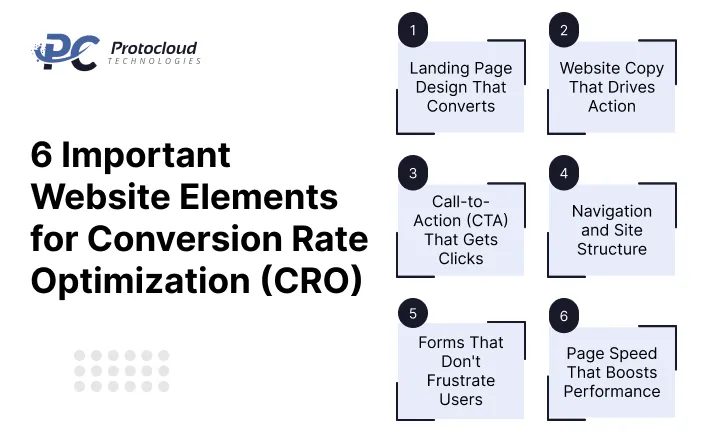
Want to increase website conversions without extra traffic? Then focus on the right website elements for CRO. These small changes can drive big results.
In conversion rate optimization (CRO), success comes from improving user flow, clarity, and trust. When you fix the right areas, you improve website conversions, boost engagement, and grow faster.
These important website elements for conversion rate optimization directly impact your results. They improve website usability, support conversion funnel optimization, and help you increase online sales with less effort.
1. Landing Page Design That Converts
Your landing page design is the first thing users notice. It decides whether they stay or leave. Strong landing page optimization improves trust and drives action.
Take the Amazon product page design as a real example. Their layout is simple and powerful. The “Add to Cart” button stands out. The color grabs attention. The placement feels natural.
This is a smart conversion-focused design. It guides users without confusion. Large images, clean spacing, and clear sections improve user experience optimization.
Follow these landing page design best practices:
- Use bold CTAs and clear buttons
- Keep the layout clean for better website usability improvement
- Highlight benefits, not just features
- Use visuals to build trust
Strong website design for conversions helps you reduce bounce rate, improve engagement rate, and drive more clicks.
2. Website Copy That Drives Action
Design brings users in. But website copy converts them. Without strong website copywriting, users leave without action. Your high-converting website copy should feel simple, clear, and useful. It should guide users through the page and support customer journey optimization.
Headline Optimization Matters
Your headline is your first impression. It shapes how users feel. Good headline optimization can instantly improve results.
Use proven website headline examples:
- Ask a question
- Add numbers
- Speak directly to users
- Focus on benefits
Body Content That Converts
Your body content writing should answer one thing: “What’s in it for me?”
To create strong content for conversions:
- Keep paragraphs short
- Use a clear website content structure
- Match tone with the audience
- Focus on value
A great example is the Slack website. Their content is simple, clear, and benefit-driven. This is how engaging website content supports content optimization strategies and improves results.
3. Call-to-Action (CTA) That Gets Clicks
A call to action tells users what to do next. Without it, users get confused. With it, they act.Strong CTA optimization improves conversions fast. A high-converting CTA is clear, direct, and benefit-focused.
The famous ADT CTA example proves this. Changing one line increased conversions by 60%. That’s the power of simple words.
To improve CTA conversions:
- Use action words
- Add urgency
- Keep it short
- Make it visible
These call-to-action examples show how small tweaks can deliver big CRO benefits.
4. Navigation and Site Structure
Good navigation and site structure keep users on your site. Poor structure makes them leave. Your website navigation optimization should feel smooth. Users should quickly find what they’re looking for within seconds. This supports optimizing user flow and improving experience.
A strong, user-friendly website structure follows a simple path:
Homepage → Category → Subcategory → Product
This improves site structure for SEO and supports customer journey optimization. When navigation is clear, users stay longer. You reduce bounce rate and improve conversions.
5. Forms That Don’t Frustrate Users
Forms are key in conversion rate optimization (CRO). They directly impact leads and sales. Smart forms optimization helps you increase form submissions and improve results.
Your lead generation forms should feel easy and quick to use. Good form UX optimization improves trust and user experience.
Follow these form design best practices:
- Keep forms simple and clean
- Use clear labels and helpful hints
- Focus on important fields only
To improve form conversions, apply these tips:
- Use user-friendly forms with a clear design
- Enable one-click signup options
- Simplify password creation
The goal is simple. Balance quality and quantity. That’s how you improve ROI and results.
6. Page Speed That Boosts Performance
Speed matters. A slow site kills conversions. Fast sites win.
Page speed optimization improves everything. It improves website performance, enhances UX, and increases rankings. A fast-loading website keeps users engaged.
Even a 1-second delay can lower your conversions by 7%. That’s huge. Faster loading speeds mean better website optimization and higher revenue.
To improve page speed:
- Reduce heavy images
- Use caching
- Optimize code
This helps reduce page load time, improve the experience, and support digital marketing optimization.
5 Conversion Rate Optimization (CRO) Steps: Understanding the Process
The conversion rate optimization process is simple. But the impact is powerful. When you follow the right CRO process steps, you can increase website conversions without increasing traffic.
A strong CRO strategy focuses on data, testing, and improvement. These conversion optimization steps help you understand users, fix weak points, and grow faster. This is how modern businesses win with data-driven marketing and experiment-driven marketing.
Let’s break down the website conversion optimization process step by step.
Step 1: Research Phase – Find What Needs Improvement
The research phase CRO is the foundation of the entire conversion rate optimization process. Many businesses copy others. But every audience is different.
Start with quantitative data analysis. This includes bounce rate analysis, traffic source analysis, and user demographics analysis. These insights come from website analytics tools and help you track real user behavior.
Next, move to qualitative data analysis. Use heatmap tools, session recording tools, and user surveys analysis. This helps you understand why users behave the way they do.
This combined user behavior analysis and customer behavior analysis gives you clarity. It helps you optimize user flow, reduce bounce rate, and improve website usability.
Step 2: Hypothesis Phase – Build Smart Ideas
The hypothesis phase of CRO is where strategy begins. You don’t guess. You create a data-driven hypothesis based on research.
A strong hypothesis in CRO has three parts:
- A specific change based on insights
- A clear goal (like conversion metrics optimization)
- A reason behind the expected result
For example, adding social proof can improve trust. This can help improve conversion rate and increase website conversions. This step is key to building a solid CRO testing roadmap. It keeps your CRO strategy focused and aligned with goals.
Step 3: Prioritization Phase – Focus on What Matters
Not all ideas are equal. The prioritization phase of CRO helps you choose what to test first. A popular CRO prioritization framework is the P.I.E framework CRO by Chris Goward. It stands for Potential, Importance, and Ease.
This method helps test prioritization in CRO. It ensures you focus on high-impact changes first.With proper prioritization, you can optimize the conversion funnel, improve engagement rates, and drive better results faster.
Step 4: Testing Phase – Run Experiments That Work
The testing phase CRO is where ideas turn into action. This is where CRO testing methods come into play.
Before testing, understand these basics:
- Statistical significance in CRO ensures results are reliable
- Test duration calculation helps avoid early conclusions
- Choose the right method: A/B testing, split testing, or multivariate testing
Using the right A/B testing tools, you can validate your changes. For example, if a test shows 93% significance, the results are likely real. This step supports conversion rate improvement strategies, improves user interaction tracking, and enhances digital marketing optimization.
Step 5: Learning Phase – Turn Data into Growth
The learning phase CRO completes the loop. This is where you analyze A/B test results and extract real insights. Don’t stop at winners or losers. Go deeper. Study patterns. Find reasons. Build strong conversion insights and optimization insights.
If a test wins, check if it improves ROI marketing and supports business growth strategies online. If it fails, refine your approach and test again.
This continuous CRO analysis process improves user experience optimization, strengthens UX improvement strategies, and boosts website performance.
Industry-Specific Conversion Rate Optimization: How to Win in Any Niche
When you focus on website conversion strategies, you stop guessing. You start using data-driven marketing to see what your users actually want. This is how you improve website conversions without just buying more traffic. It is the smartest way to ensure a total website performance improvement. Let’s dive into how different sectors use these conversion rate improvement strategies.
CRO for B2B and SaaS Companies
For a SaaS business, the main goal is lead generation. B2B lead generation strategies focus on capturing your customers’ interest. You engage them on your site and gather their info through forms or surveys. Then, you turn them into loyal, recurring users. In SaaS conversion optimization, your duty is to help customers find what they need. You must support their buying decisions at every step.
Case Study: How Continuous Testing Helped POSist.
A continuous-testing program on POSist’s homepage and contact page changed everything. They added laser-focused copy around value drivers and tightened their demo form. This is a prime example of demo request optimization. The results were massive: they saw a 52% increase in demo requests. Their site-wide conversion rate rose to 3.4%, a 25% lift. This CRO case study for SaaS proves that lead generation optimization is a game-changer for improving B2B conversions.
CRO for an eCommerce Business
Ecommerce conversion rate optimization faces a huge challenge: shopping cart abandonment. This costs businesses billions every year. According to the Baymard Institute, 69% of visitors abandon their carts. To reduce cart abandonment, you must create a user-friendly e-commerce website. This means clear shipping costs and a simple layout. You have to fix complex payment steps to improve ecommerce conversions.
Case Study: PearlsOnly Boosts Revenue by 12%
PearlsOnly, an online jewelry store, found that a cluttered checkout page was hurting its sales. Visitors were getting confused and leaving. With VWO’s help, they used checkout page optimization and ecommerce CRO strategies. They highlighted key selling points and cleaned up the design. This led to a 10% increase in revenue. It shows that ecommerce UX optimization is the best way to increase ecommerce revenue and increase online sales.
CRO for Media and Publishing Houses
For media agencies, reaching a large audience is key. You need to improve audience engagement website metrics to grow. CRO for media companies helps test site elements such as email signup and social sharing optimization. You can also test content recommendation optimization to keep readers on the page. The goal is to increase website engagement so your content gets the attention it deserves.
Case Study: BluTV Increases Mobile Conversions by 42%
BluTV, an OTT service, wanted to convert visitors into paid-trial subscribers. Their partner found that mobile conversions were too low. They used homepage optimization CRO to remove distractions and added an FAQ section. A 19-day split test resulted in a 42% increase in conversions. This mobile conversion rate optimization success shows how media website optimization can quickly reduce bounce rate and improve engagement rate.
9 Common Conversion Rate Optimization Mistakes to Avoid
Many beginners waste time on common CRO errors. To get the best conversion rate optimization benefits, you must avoid these conversion rate optimization mistakes:
- Making changes based on opinion, not data: Don’t assume a design works just because it looks “clean.” Always use data-driven decisions in CRO. What works for one site might fail on yours. Use experiment-driven marketing to be sure.
- Writing copy that doesn’t align with goals: Avoid pretty words that don’t sell. Your website copy optimization must be simple and clear. It should follow conversion-focused design principles to guide the user.
- Going for small tests before the big ones: Changing a button color won’t save a bad business. Focus on large tests with multiple UX improvement strategies. This is how you drive a real website performance improvement.
- Running too many tests at once: Overloading visitors with pop-ups will confuse them. It skews your results and ruins your user experience optimization. Stick to a clean, optimized user flow.
- Neglecting basic design elements: Avoid image sliders and cheesy stock photos. These distract from your message. Instead, use product videos with clear CTAs to improve website conversions.
- Undermining CTA buttons: This is one of the biggest CTA optimization mistakes. Don’t use weak colors or vague words. Your buttons should be bold and easy to find to improve CTA conversions.
- Not creating a sense of urgency: If people don’t feel a need to act, they won’t. Use urgency in marketing, such as countdown timers, to prevent visitors from delaying. It is a classic conversion rate improvement strategy.
- Not building trust: If you don’t show testimonials or security badges, people won’t trust you. Use trust-building strategies that website owners rely on to build customer trust.
- Complicating the conversion funnel: A long, multi-step funnel will turn people away. You must simplify conversion funnel steps. This makes the conversion funnel optimization process much more effective.
Conclusion: The Power of the CRO Learning Phase
Conversion Rate Optimization is the key to turning your existing traffic into real business results. Instead of focusing only on bringing more visitors, CRO ensures that the visitors you already have take meaningful action. With the right strategy, testing, and insights, businesses can significantly improve ROI without increasing marketing spend. As part of result-driven digital marketing services, CRO plays a crucial role in maximizing performance and conversions. Protocloud Technologies helps you identify gaps, optimize user journeys, and build a conversion-focused digital experience that drives measurable growth.