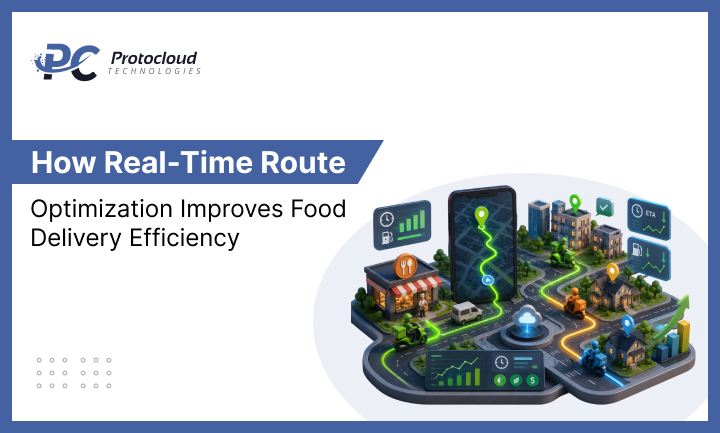
Your pizza left the restaurant 22 minutes ago. Right now, the driver isn’t just following a static map. The system routes the driver who is watching a traffic slowdown on the usual road, spots a faster side street, and recalculates the path all while simultaneously managing four other deliveries across the same neighborhood.
By the time the pizza reaches your door, it’s still hot. You leave a five-star review. You’ll order again next week. That entire experience lives or dies on one piece of technology: real-time route optimization.
It’s not visible. Most customers never think about it. But it’s the single biggest driver of efficiency in food delivery and the gap between companies that invest in it and those that don’t is growing wider every year.
First, What Does “Route Optimization” Actually Mean?
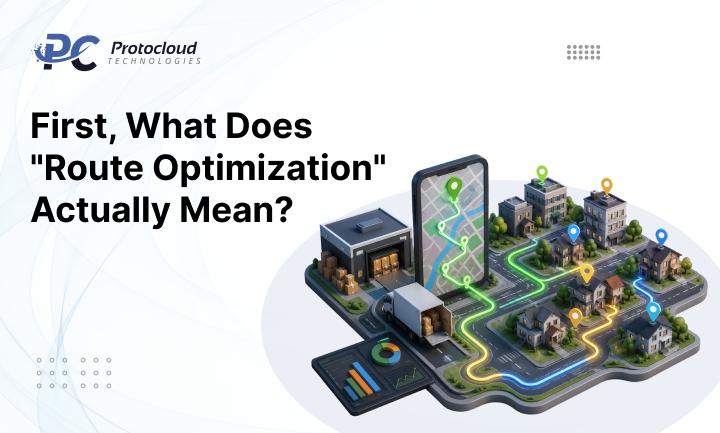
People assume route optimization means “find the shortest road.” That’s like saying a surgeon’s job is “to cut things.” Real route optimization especially in real time is far more complex. It means calculating the most efficient possible path for a delivery by weighing dozens of variables at once:
- Live traffic and predicted congestion patterns
- Kitchen preparation time for each order
- Driver location, speed, and current workload
- Multiple simultaneous deliveries in the same area
- Customer delivery time windows
- Road restrictions, weather, and vehicle type
- Order batching when two orders can share one driver’s route
And it does all of that continuously. Not once at the start of a trip. Every few seconds, the route is re-evaluated and updated based on what’s happening right now.
That’s what separates real-time route optimization from old-school delivery planning. It doesn’t just plan the trip. It manages the trip from start to finish.
Why This Matters More Than Ever
The online food delivery market is growing at a compound annual growth rate of 10.7%, with revenue expected to rise from $156.75 billion in 2024 to $173.57 billion in 2025. Online food ordering has expanded three times faster than dine-in traffic.
That growth sounds like good news. And it is for operators who are ready for it. For everyone else, it creates a serious problem. More orders mean more complexity. More drivers on the road. More restaurants to coordinate pickups from. More customers are expecting their food in under 30 minutes. Higher chances of mistakes.
Without sophisticated routing, volume growth doesn’t improve profitability. It amplifies chaos. Fuel costs rise. Drivers burn out. Cold food leads to unhappy customers and poor reviews. Margins shrink.
34% of consumers spend $50 or more per order and they expect that order to arrive on time, every time. Late deliveries lead directly to lost customers. Route optimization is how delivery businesses meet that bar consistently, at scale.
The Real-Time Difference: Why “Set and Forget” Routing Fails
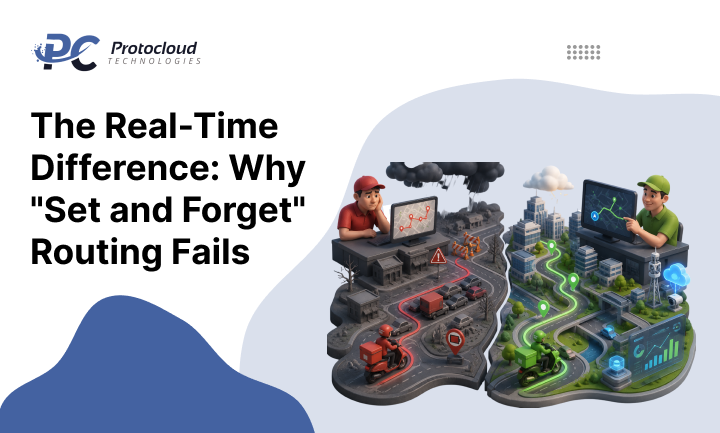
Here’s a problem that many people don’t appreciate until they’ve seen it up close. A static routing system one that plans a route once and doesn’t update it looks fine on paper. It calculates a path based on the information available at order placement and sends the driver on their way.
But food delivery doesn’t happen on paper. This is a common problem many restaurants face:
- A road gets blocked by an accident 10 minutes into a delivery
- The restaurant runs 8 minutes behind on prep, so the driver arrives too early and waits
- A new order drops in from a customer who lives 200 meters from the driver’s current position
- Rain slows traffic across a whole section of the city
A static system ignores all of that. A real-time system reacts to all of it instantly. Dynamic rerouting is one of the most valuable capabilities in modern food delivery operations. If a road gets blocked or the kitchen is slow, the route updates automatically. The driver gets a new instruction before they’ve wasted time going the wrong way. The customer’s ETA gets updated. The business avoids the complaint before it happens.
This responsiveness is why real-time optimization isn’t just a nice upgrade over static planning. For high-volume delivery operations, it’s the difference between a system that works and one that constantly breaks down.
What Happens After You Place an Order?
Most people imagine the process is simple. A driver gets a ping, opens a map, and goes. The actual process is much more sophisticated. Here’s what happens in the seconds after you tap “Confirm Order”:
Order intake and analysis. The system reads your order, identifies the restaurant, estimates prep time based on the menu items and current kitchen load, and locks your delivery address.
Driver scoring. Every available driver is scored in real time not just by distance, but by current route, pending orders, idle time, and how well your order fits into their existing path. The closest driver isn’t always the right driver.
Route generation. AI-powered algorithms pull in live traffic data, map your location relative to the restaurant, and generate an optimized pickup and delivery path. Tools like Google Maps API and proprietary routing engines work together to build that path.
Order batching decision. The system checks whether your order can be intelligently combined with another nearby delivery saving a trip without meaningfully adding to your wait time.
Continuous re-optimization. From the moment the driver is assigned to the moment they reach your door, the system is running in the background. Traffic updates, kitchen delays, new nearby orders everything gets processed, and the route adjusts accordingly.
That entire process runs in seconds. And it runs for thousands of orders simultaneously.
7 Ways Real-Time Route Optimization Improves Food Delivery Efficiency
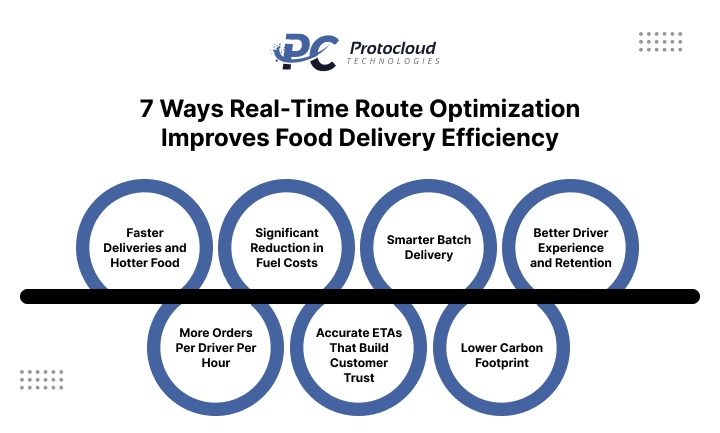
01. Faster Deliveries and Hotter Food
This is the most immediate benefit and the one customers care about most.
Optimized routes reduce the time drivers spend on the road per delivery. Shorter travel time means food arrives before it loses quality. That matters enormously for customer satisfaction and for reorder rates.
Most leading delivery platforms have set the industry benchmark at under 30 minutes. Consistently hitting that window at scale is only possible with real-time routing intelligence behind every dispatch decision.
02. More Orders Per Driver Per Hour
Efficient routing doesn’t just move drivers faster it helps them handle more volume in the same time.
When routes eliminate unnecessary backtracking and idle time, drivers can complete more deliveries per shift without working harder. That’s direct revenue growth without additional headcount or infrastructure.
Advanced routing systems can generate optimized routes for thousands of orders in minutes enabling faster dispatch decisions and scaling seamlessly during peak periods like Friday evenings or major sporting events.
03. Significant Reduction in Fuel Costs
Every kilometer a driver travels unnecessarily is money lost. Fuel costs are one of the most controllable line items in delivery operations but only if routing is tight.
Real-time optimization finds the shortest practical path, avoids congestion that adds idle engine time, and reduces total distance traveled across the fleet. Multiply those savings across hundreds of drivers and thousands of daily deliveries, and the financial impact is substantial.
Reduced mileage also means less vehicle wear and lower maintenance costs savings that compound over time.
04. Accurate ETAs That Build Customer Trust
An ETA that turns out to be wrong is more damaging than a slow delivery. When a customer expects their food in 20 minutes, and it arrives in 40, the frustration is doubled once from the wait, and once from the broken expectation. When they expect it in 35 minutes, and it arrives in 33, they feel good about the experience.
Route optimization systems provide remarkably accurate delivery time predictions by integrating real-time location data and traffic patterns. Customers who know when to expect their order tend to be more satisfied, more forgiving of minor delays, and more likely to reorder.
Accurate ETAs are a customer experience feature powered entirely by routing intelligence.
05. Smarter Batch Delivery
One of the most powerful efficiency gains in food delivery comes from batch routing assigning multiple orders to a single driver’s trip intelligently.
When two customers order from the same restaurant or from nearby restaurants, a smart routing system detects that and assigns both orders to one driver with a sequenced route. The driver picks up both orders in a coordinated window, delivers to the closer address first, then continues to the second.
Done right, the second customer barely notices maybe an extra five minutes. But the operation has just served two customers at the cost of one driver trip.
Done wrong with poor sequencing or ignoring prep times the first customer’s food goes cold while the driver waits for the second order. The difference is entirely in how sophisticated the batching algorithm is.
06. Lower Carbon Footprint
Fewer kilometers driven mean fewer emissions produced. For food delivery businesses, this is increasingly important both for regulatory compliance in cities that are tightening emissions rules and for customers who factor sustainability into their choices.
Route optimization is one of the most direct sustainability levers available to delivery operators. It doesn’t require new vehicles or infrastructure investment. It just makes the existing fleet more efficient.
As electric vehicle adoption grows in delivery fleets, routing systems are also beginning to factor in charging station locations, battery range, and charging schedules adding another layer of optimization that wasn’t relevant five years ago.
07. Better Driver Experience and Retention
This one is underrated. Driver satisfaction is a direct operational metric. Drivers who follow chaotic, inefficient routes spend more time frustrated, cover more ground unnecessarily, and end shifts exhausted. High driver turnover is expensive recruiting, onboarding, and training new drivers cost real money.
Modern routing systems distribute workload fairly, keep drivers within manageable zones, account for break schedules, and avoid assigning orders that make delivery windows impossible. Drivers who have clearer, more manageable routes stay longer, perform better, and deliver a more consistent customer experience.
The Technology Stack Making It All Work
Real-time route optimization isn’t a single tool. It’s a combination of technologies working in concert.
AI and Machine Learning sit at the core. Algorithms trained on millions of delivery data points learn which routes perform best under which conditions and improve continuously as they process more data. These models don’t just react to current conditions; they anticipate what’s coming.
GPS and Real-Time Location Tracking provide a continuous stream of driver, restaurant, and customer location data that every routing decision depends on. Without precise, live location data, optimization becomes guesswork.
Predictive Traffic Modeling goes beyond showing where traffic is now. It forecasts where congestion will be in 15, 20, or 30 minutes allowing the system to route around problems before they impact delivery times, not after.
Multi-Constraint Planning Engines handle the complexity of balancing every variable simultaneously driver capacity, order timing, vehicle type, customer time windows, kitchen readiness, and batching opportunities to produce routes that work in the real world.
Driver Mobile Apps close the loop. Even the best route is useless if the driver can’t see it clearly and act on it. Purpose-built delivery apps surface the right instruction at the right moment, update automatically when routes change, and give drivers the visibility they need to operate efficiently.
Practical Tips for Optimizing Your Food Delivery Routes
Whether you’re running a restaurant with your own drivers or managing a multi-location delivery operation, these principles apply:
Match driver assignment to route fit, not just proximity. The nearest driver isn’t always the best choice. A driver who’s about to finish a delivery nearby may be a better fit than someone idle but farther away.
Build prep time into dispatch timing. Sending a driver to pick up before the food is ready creates idle wait time at the restaurant. Coordinate dispatch with kitchen readiness to minimize that gap.
Use zone-based routing during peak hours. Assigning drivers to specific delivery zones rather than city-wide dispatch reduces travel distances and improves response times when order volume is highest.
Monitor and act on ETA exceptions. When a delivery is trending late, intervene early notify the customer, update the ETA, and flag the driver. Proactive communication defuses most customer frustration before it becomes a complaint.
Review route efficiency data regularly. The best routing systems generate analytics that show where time is being lost. Use that data to adjust zone boundaries, staffing levels, and dispatch rules over time.
Design menus with delivery in mind. Routing can’t fix food that doesn’t travel well. Items that lose quality quickly on the road create unavoidable quality problems regardless of how efficient the route is.
The Future of Route Optimization in Food Delivery
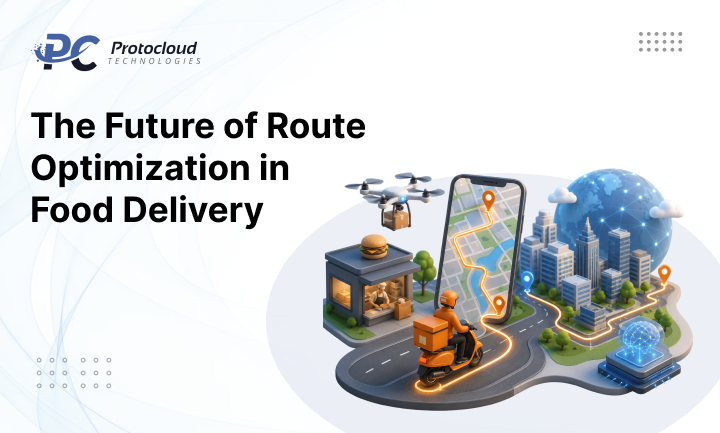
The technology is moving fast. Here’s where it’s heading.
Autonomous and drone delivery will require fundamentally new routing logic managing airspace alongside ground-level delivery, with new constraints around building access, no-fly zones, and landing areas. Industry projections suggest autonomous aerial deliveries could handle 8% of total food delivery orders by the end of 2025.
Sustainability-optimized routing will become a standard feature rather than a byproduct letting operators actively choose lower-emission routes and track their environmental impact at the fleet level.
Predictive demand routing will pre-position drivers in neighborhoods before order spikes happen using historical patterns and real-time signals like weather, local events, and time of day to get drivers in the right place ahead of demand, not in response to it.
Integration with kitchen management systems will allow routing engines to coordinate dispatch timing with actual food preparation in real time eliminating the gap between “order ready” and “driver arrives.”
Frequently Asked Questions
What is real-time route optimization in food delivery?
It’s the use of AI, GPS, and live traffic data to continuously calculate and update the most efficient delivery path for every driver adjusting automatically as conditions change throughout the delivery.
How does route optimization reduce food delivery costs?
It reduces fuel consumption by minimizing unnecessary mileage, lowers labor costs by allowing drivers to complete more orders per shift, and reduces failed deliveries by improving ETA accuracy and route reliability.
What factors does a route optimization system consider?
Modern systems factor in live traffic conditions, kitchen prep times, driver location and workload, customer delivery windows, order batching opportunities, weather, road restrictions, and vehicle type all simultaneously and in real time.
Can small restaurants benefit from route optimization software?
Yes. Route optimization tools are available at a range of price points and scales. Even a small restaurant running its own delivery can reduce fuel costs and delivery times by using a basic routing app rather than manual planning.
How does real-time rerouting work during unexpected delays?
When the system detects a disruption a traffic incident, a kitchen delay, a road closure it immediately recalculates the affected route, sends the updated path to the driver’s app, and adjusts the customer’s ETA. This happens automatically, without manual intervention.
What’s the ROI of investing in route optimization?
The returns come from multiple directions: lower fuel costs, more deliveries per driver hour, reduced customer complaints, better driver retention, and higher reorder rates driven by consistent, on-time delivery. For high-volume operations, these gains compound significantly.
The Bottom Line
Fast delivery feels effortless from the outside. Behind it is a continuous stream of algorithmic decisions every route recalculated, every variable weighed, every driver matched to every order with precision that no human dispatcher could replicate at scale.
Real-time route optimization is what makes that possible. It’s not part of a food delivery operation. It’s the operational backbone that determines whether every other investment kitchen capacity, driver hiring, marketing spend actually pays off.
The platforms winning the food delivery race aren’t always the ones with the most restaurants on their app or the lowest delivery fees. They’re the ones whose food consistently arrives fast, fresh, and exactly when expected.
That reliability is built on routing intelligence. And as the technology advances, the gap between optimized and unoptimized operations will only keep growing.