You’ve built a great digital product that works beautifully. Naturally, you’re proud of it, and you’re happily looking at new users signing up. Everything’s going smoothly, and your next move is scaling.
After all, why not have thousands or even millions more users?
Some people look at scaling as a technical challenge. They figure they’ll add more servers and maybe rewrite the code for speed. And while those steps are absolutely important, it’s not where scaling starts to have hiccups.
Scaling isn’t just a matter of handling more traffic; it’s also a huge, slap-in-the-face reality check. When you start scaling, all those early assumptions that you baked into your product are no longer true.
So the question isn’t whether the code can process a million transactions (which would be the technical part) but whether the reasoning behind those transactions still holds up.
Scaling Shows What Early Success Can Hide
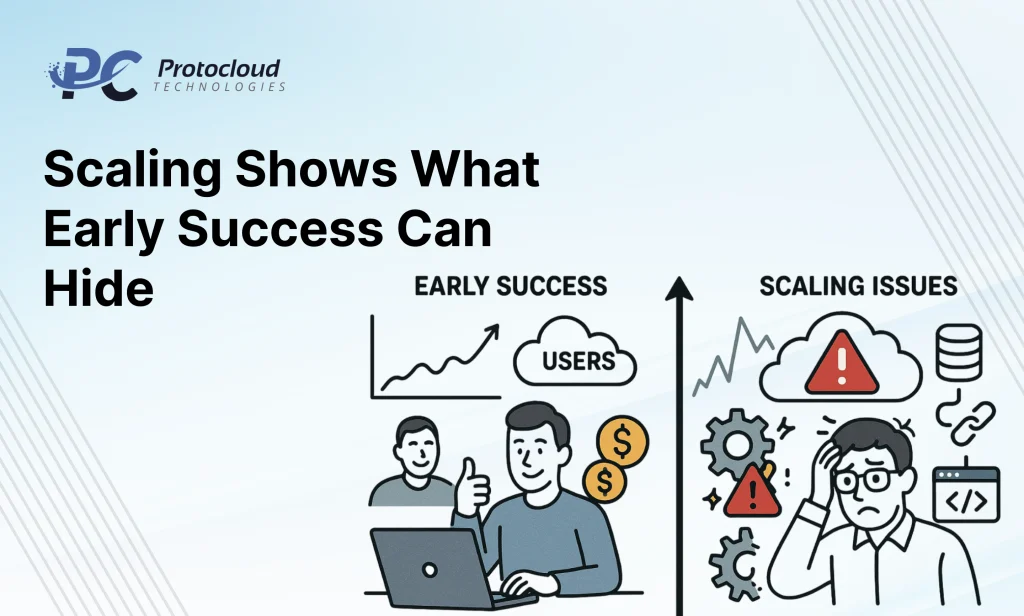
When you become successful early on, everything feels great.
Your product works, customers are happy, you’re fixing bugs as they come, and you’re counting your money.
You’ve got this, right?
But once you start to scale, everything changes. Scaling takes all the little things you never had to worry about and turns them into big problems that need to be handled, like… Yesterday.
When your group of users is small, things are predictable. At scale, nothing is predictable. People will use your product in all kinds of ways and create traffic spikes at the weirdest times. You might not be ready for all the attention you’ll get and, as you can imagine, that’s a problem.
It’s not just about your code; it’s about all the other services your product leans on.
In the early days, it wouldn’t be that big of a deal if your payment processor was a bit slow here and there. No one really noticed. But at a massive scale, hiccups would happen all the time, so your payment processing solutions would go from a backend detail to something that’s front and centre.
And here’s the real kicker. Not only will these problems add up as you grow, but they’ll also multiply. You might have thought that you took a smart shortcut early on, but now it’s causing failure after failure. Scaling will test every assumption you ever made and even the ones you didn’t know you were making.
Early success has let you get away with a lot, and scaling will show all of it.
Technical Blindspots
When you think about scaling, you can’t help but focus on the big stuff because it’s so obvious. But this is really risky because you’re setting yourself up for trouble.
Let’s go over a couple of these blind spots that can (easily) cause a disaster.
Infrastructure That Wasn’t Designed for Stress
Your current setup has no issue with handling a normal Tuesday. But once you start to scale, you’ll have a Thursday when the traffic spikes 5000% and then what? If your plan is to add more servers when that happens, then you’re already in trouble.
If you keep putting off all those backups/duplicates and you solely count on that one server that has a copy of your entire main database, then you’re taking a huge gamble.
If someone told you to run a business based on a coin flip, would you? Of course not.
This is the reason why everything needs to be automatic at scale.
Performance Metrics That Look Good But Don’t Mean a Lot
Your dashboard is green, so everything is healthy, right? Not necessarily. Yes, your ‘average response number’ looks good, but you should know that that figure is misleading. It makes things look smooth, but it hides the fact that your product is slow for a small group of users.
Now imagine what happens when that small group turns into hundreds of users. Now imagine that same thing in terms of millions. That’s a full-blown crisis right there. You probably ignored those problems early on, but scale has a way of turning every weird problem that happens once in a blue Moon into a daily event.
Treating Transaction Flows as a Feature Instead of as a System
Your checkout process works, and it’s a great feature to have. No doubt about it.
But think about it for a second – what happens when the credit charge goes through? And then you realize the email confirmation wasn’t sent. Or what do you think happens when two people click ‘buy’ on the same last item at the same time?
At a small scale, these are glitches that you can fix yourself. At a massive scale, they’re systemic failures that happen all the time. There’s no way to fix all of this manually, which is why you need a system, not a feature. And if you don’t already have one, scaling will force you to build it.
Conclusion
As you can clearly see, your tech isn’t the only thing that needs scaling.
You need to scale your thinking, too.
Every shortcut, every decision that used to be ‘good enough’ used to be okay, but now? Now you need to redo all of it because none of it works anymore.
You’ll rarely build something that’s considered perfect on day one. You try to get it as close to perfect as you can. And then, if it’s good, then comes scaling.
So take a good breather, realign your focus, make a plan, and start building.