AI is growing fast. Almost every business wants to use it. Some companies want AI to reduce costs. Others want faster growth, better customer service, or smarter operations.
But here’s the truth:
Most businesses don’t fail because they run out of AI ideas. They fail because they choose the wrong AI opportunities. That’s why many AI projects never produce real ROI.
The meetings happen. The workshops happen. The AI plans get rebuilt again and again. But results still feel weak. Why?
Because many businesses focus on exciting AI trends instead of real business problems. And that creates problems. The companies getting the best results from AI do something different.
They focus on fixing slow and repetitive work first. They improve workflows.
They reduce manual tasks. They save employee time. That’s where the biggest high ROI AI opportunities exist.
In this guide, you’ll learn:
- How to Find the Best AI Use Cases
- Which workflows are best for AI automation
- How to prioritize AI opportunities
- How to build an AI implementation roadmap
- How to measure AI investment ROI
- Common mistakes businesses should avoid
Let’s get started.
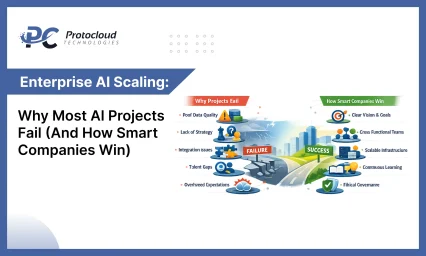
Why Most AI Projects Fail

Many businesses think AI success depends on technology. It doesn’t. Technology matters. But choosing the right problem matters more. Here’s what happens in many companies.
Employees spend hours doing repetitive work. They:
- Update spreadsheets
- Copy data manually
- Search for files
- Move information between systems
- Reformat reports
- Organize documents
This work takes time. And most of it adds little business value. That’s where AI workflow automation helps the most. Businesses that succeed with AI focus on removing repetitive work first.
They don’t begin with complicated AI systems. They begin with operational problems. That’s the difference.
The Clearest Sign of a Strong AI Opportunity
Most businesses ask the wrong questions. They ask:
“Do we have enough technology?”
Or:
“Do we have enough data?”
Those things matter. But there’s a better question. How much time do employees spend gathering information before they can actually work?
This is one of the clearest signs of a strong AI opportunity. In many successful AI projects, employees spend almost 70% of their time:
- Collecting data
- Combining reports
- Updating systems
- Formatting spreadsheets
- Searching for information
That creates major inefficiency. And AI can solve it.
For example:
A finance team may spend hours collecting data before analysis even starts. An HR team may manually screen resumes every day. A support team may manually route tickets.
These are excellent AI automation use cases because they are repetitive and time-consuming.
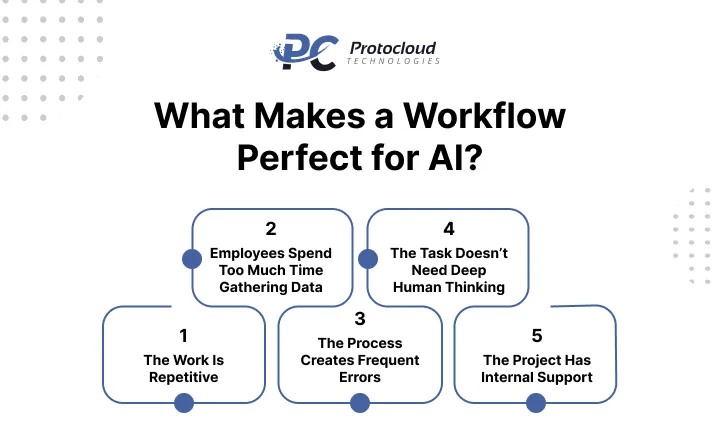
What Makes a Workflow Perfect for AI?
Not every task needs AI. Some work still needs human thinking and creativity. But many workflows are perfect for AI business automation. Here are the biggest signs.
01. The Work Is Repetitive
This is the easiest place to start. If employees repeat the same task every day, AI can probably help. Examples include:
- Data entry
- Invoice processing
- Ticket routing
- Report creation
- Lead qualification
- Document management
These are common AI process automation opportunities. And they often create a fast ROI.
02. Employees Spend Too Much Time Gathering Data
This is one of the biggest business problems today. Before employees can make decisions, they spend hours collecting information.
For example: A sales team may pull data from:
- CRM software
- Emails
- Excel sheets
- Marketing tools
- Customer databases
This slows productivity. AI-powered automation reduces this manual work. That improves AI operational efficiency.
03. The Process Creates Frequent Errors
Manual work creates mistakes. Especially under pressure. Even small mistakes can become expensive. AI workflow optimization helps reduce errors.
For example: AI systems can:
- Detect missing information
- Reduce duplicate entries
- Standardize reports
- Validate data automatically
This improves accuracy and consistency.
04. The Task Doesn’t Need Deep Human Thinking
Some tasks are necessary. But they don’t need strategic thinking.
For example: A sales manager should spend time closing deals. Not updating spreadsheets. A finance analyst should focus on insights. Not formatting reports for hours.
AI business automation eliminates repetitive work, allowing employees to focus on valuable tasks.
05. The Project Has Internal Support
This part matters a lot. Even strong AI projects fail without internal support. Successful AI adoption usually happens when someone inside the company actively supports the project.
A strong internal champion helps:
- Improve adoption
- Test workflows
- Solve issues
- Push implementation forward
Technology alone is not enough. People matter too.
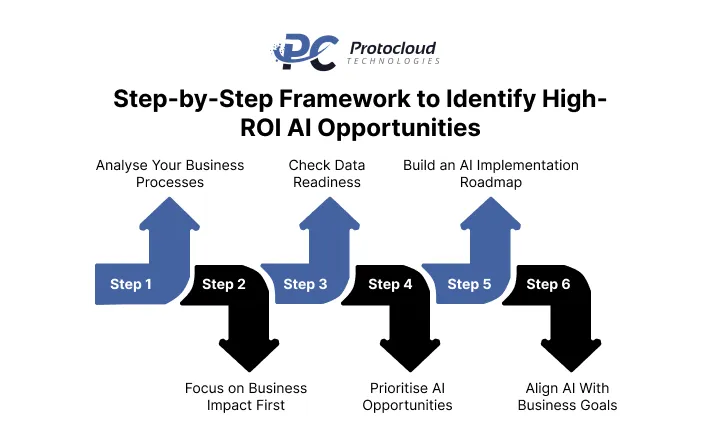
Step-by-Step Framework to Identify High-ROI AI Opportunities
Now, let’s look at a simple framework businesses can follow. This helps companies identify AI opportunities that create real business value.
Step 1: Analyse Your Business Processes
Start by understanding how work gets done in your business. Go department by department. Look closely at:
- Sales
- Marketing
- Customer support
- Operations
- Finance
- HR
Then ask simple questions. Where do employees spend most of their time? Which tasks feel repetitive? Where do delays happen? Which workflows create mistakes? What work depends heavily on manual effort? These answers reveal strong use cases for AI.
For example:
Manual document handling can be automated with AI. Customer support tickets can become AI-powered customer support systems. Lead qualification can become AI lead scoring.
Report generation can become automated reporting. The goal is simple. Find workflows where effort is high but business value is low. These areas often deliver the fastest ROI for AI investments.
Step 2: Focus on Business Impact First
Many businesses focus only on automation. That’s a mistake. Automation alone doesn’t guarantee ROI. AI should improve business outcomes. Every AI opportunity should improve at least one of these areas:
- Reduce costs
- Increase revenue
- Improve efficiency
- Improve customer experience
Let’s break them down.
Cost Reduction
AI reduces repetitive work. That lowers operational costs. Examples include:
- Invoice automation
- AI-driven document management
- Workflow automation
- AI process optimization
These systems save time and reduce manual effort.
Revenue Growth
AI can help businesses increase sales. Examples include:
- Recommendation engines
- Predictive sales analytics
- Dynamic pricing
- AI customer personalization
These tools improve customer targeting and engagement. That leads to higher revenue.
Efficiency and Productivity
AI speeds up workflows. Examples include:
- Automated reporting
- AI-powered insights
- Real-time analytics
- AI-powered decision support
This improves productivity across departments.
Step 3: Check Data Readiness
AI depends on data quality. Without good data, even strong AI systems fail. Before implementation, businesses should carefully review their data.
Ask questions like:
- Is the data accurate?
- Is the data accessible?
- Are systems connected properly?
- Is the data updated regularly?
- Are departments sharing information?
For example:
CRM data supports predictive analytics. Support tickets train AI chatbots for business. Transaction history improves demand forecasting. Poor data quality is one of the biggest reasons AI projects fail. That’s why AI data integration matters so much.
Step 4: Prioritise AI Opportunities
Most businesses quickly find many AI opportunities. But trying to automate everything at once creates confusion. Instead, prioritize carefully. Use a simple scoring framework. Evaluate every AI opportunity using four factors.
Business Impact: Will the project reduce costs or increase revenue?
Implementation Complexity: How difficult is implementation?
Data Availability: Do you already have reliable data?
Time to Value: How quickly will results appear?
The best AI quick wins usually have:
- High impact
- Moderate complexity
- Strong data availability
- Fast implementation
These projects build momentum quickly.
Step 5: Build an AI Implementation Roadmap
One of the biggest AI implementation mistakes is trying to transform the entire company immediately. That creates unnecessary risk. Instead, businesses should follow a phased approach.
Phase 1: Pilot
Start small. Choose one or two high-impact AI use cases. Build a simple solution first. Measure results carefully.
Phase 2: Optimization
Improve workflows and system accuracy. Focus on:
- Better integration
- Employee adoption
- Workflow improvements
- Performance optimization
Phase 3: Scaling
Expand successful AI-powered workflows across departments. This improves AI scalability while reducing risk.
Step 6: Align AI With Business Goals
AI should support long-term company strategy. Do not become a disconnected experiment. For example:
If customer retention matters most, focus on:
- AI customer engagement
- Personalization
- AI-powered customer support
If operational efficiency matters most, prioritize:
- AI workflow automation
- AI process efficiency
- Operational optimization
If innovation matters most, invest in:
- Predictive analytics
- AI-powered insights
- AI-driven analytics
This alignment improves long-term AI business growth.
Which Businesses Benefit Most From AI?

AI works across many industries. But some businesses see faster ROI. Companies benefit most when they have:
- Large amounts of data
- Repetitive workflows
- Customer-facing operations
- Manual processes
- Complex decision-making
Here are some industries leading AI adoption.
E-Commerce
AI improves:
- Product recommendations
- Customer personalization
- Dynamic pricing
- Inventory forecasting
These improvements directly increase sales.
Healthcare
AI supports:
- Diagnostics
- Patient management
- Clinical workflows
- Scheduling systems
This improves operational efficiency and patient experiences.
Finance
AI helps with:
- Fraud detection
- Financial forecasting
- Risk assessment
- Expense management
This improves accuracy while reducing risk.
Logistics
AI improves:
- Route optimization
- Inventory planning
- Demand forecasting
- Delivery management
This reduces delays and operational costs.
SaaS Companies
AI supports:
- Customer insights
- Churn prediction
- Workflow automation
- AI-powered analytics
These improvements strengthen customer retention and business growth.
How to Measure AI Investment ROI
Businesses should always measure AI performance. Without measurement, companies cannot improve results. Track metrics like:
- Cost savings
- Revenue growth
- Workflow speed
- Error reduction
- Productivity improvement
- Customer satisfaction
For example:
AI-powered customer service automation can significantly reduce support costs. Predictive analytics can improve sales conversions. Workflow automation can reduce processing time by nearly 50%. The best companies continuously improve AI systems over time.
Common Mistakes That Reduce AI ROI
Many businesses make avoidable mistakes during AI adoption. Here are the biggest ones.
Starting With Complex Projects
Large AI projects create a higher risk. Businesses should start with smaller AI quick wins first.
Ignoring Employee Training
Employees need proper support. Without training, adoption stays low.
Poor AI System Integration
Disconnected tools create workflow problems. Strong AI integration improves usability and performance.
Expecting Instant Results
AI requires testing and optimization. Results improve gradually over time.
Treating AI Like a One-Time Project
AI is always evolving. Businesses must continuously improve systems and workflows. That drives long-term ROI.
The Future of AI in Business
AI is becoming a core business capability. Not just a support tool. Businesses now use AI to:
- Improve efficiency
- Reduce costs
- Increase revenue
- Improve customer experiences
- Make faster decisions
- Scale operations intelligently
Companies that identify high ROI AI opportunities early will gain a strong competitive advantage. And that advantage will continue growing.
Conclusion
Identifying the right AI opportunities is not about following trends. It’s about solving real business problems. The best AI use cases improve repetitive and time-consuming workflows that reduce productivity.
Businesses that succeed with AI:
- Analyse workflows deeply
- Focus on measurable outcomes
- Prioritise high-impact opportunities
- Improve data readiness
- Start with small projects
- Scale gradually over time
That’s how successful AI business transformation happens. Start small. Focus on quick wins. Measure results carefully. Then scale what works. Because AI is no longer just a technology investment. It’s becoming a long-term business advantage.
FAQs
01. What are the best AI opportunities for businesses?
The best AI opportunities usually involve repetitive workflows, customer support automation, predictive analytics, reporting, and operational optimization.
02. Why do many AI projects fail?
Most AI projects fail because of poor data quality, unclear goals, weak integration, and low employee adoption.
03. How can businesses identify high ROI AI use cases?
Businesses should analyze workflows, identify repetitive tasks, assess data readiness, and prioritize projects with measurable business impact.
04. Which industries benefit most from AI?
E-commerce, healthcare, finance, logistics, and SaaS companies often see strong ROI from AI investments because they manage large volumes of operational data.
05. Can small businesses use AI effectively?
Yes. Small businesses can use affordable AI tools for chatbots, reporting automation, customer insights, lead scoring, and workflow automation.