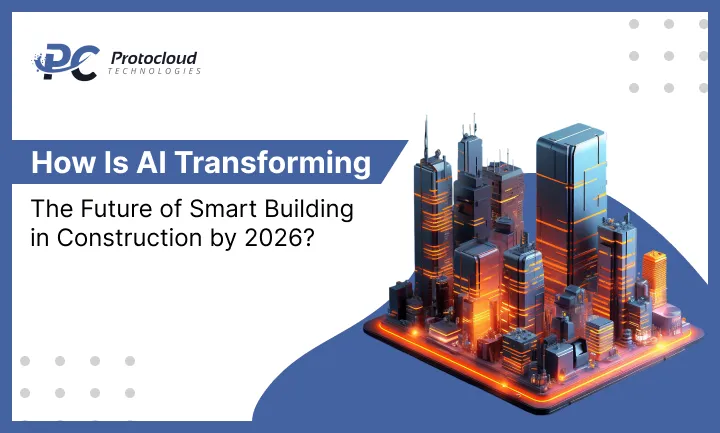
The construction industry has a problem. Projects go over budget. Workers get injured. Productivity barely moves.
In fact, large-scale construction projects run an average of 28% over their initial budget. That is a massive problem for developers, contractors, and investors alike.
But here is the deal:
AI in construction is changing everything.
From AI-driven smart building management to robots that lay bricks, artificial intelligence is transforming how we design, build, and manage structures.
In this guide, you will learn exactly how AI in construction works, why it matters, and what the future looks like for smart building systems.
Let us dive in.
What Is AI-Driven Smart Building Management?
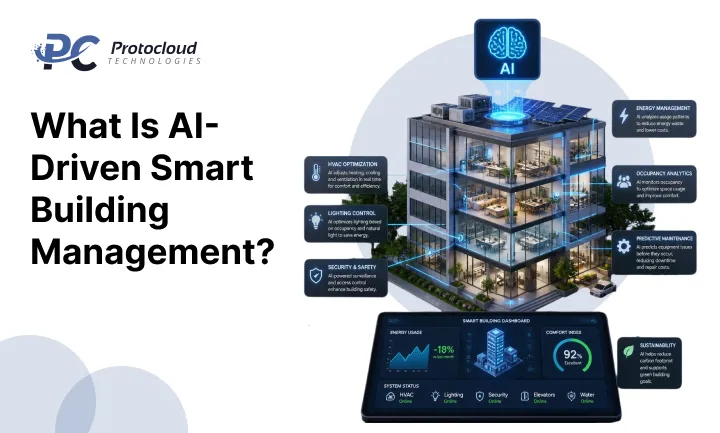
Smart building management means using technology to control and automate building systems. Think HVAC, lighting, security, elevators, and energy use, all working together intelligently.
When you layer AI into building management systems, something powerful happens. Traditional automation follows fixed rules. It does what you program it to do.
AI is different. It learns from real data. It spots patterns. It predicts what will happen next and adjusts automatically, without anyone pressing a button.
That is what makes AI-driven smart building management so much more powerful than anything we have had before.
The Core Components of AI-Powered Smart Building Systems
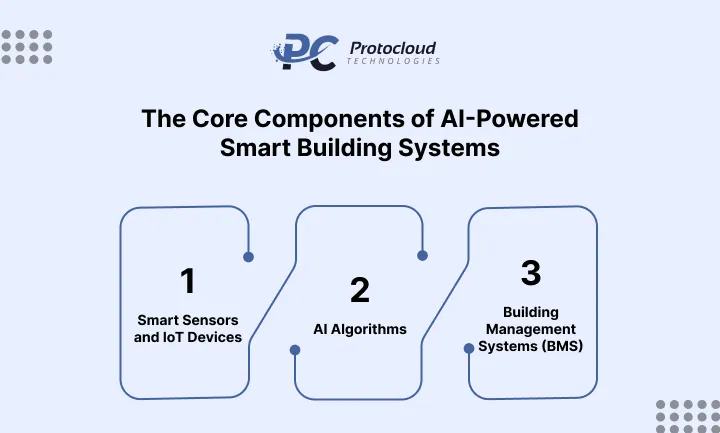
There are three key building blocks behind every intelligent building system.
01. Smart Sensors and IoT Devices
These tiny devices capture real-time data. Temperature. Humidity. Occupancy. Air quality. Energy use. They are the eyes and ears of the entire system.
02. AI Algorithms
These analyze all the incoming sensor data. They recognize patterns, forecast future needs, and automatically adjust building operations.
03. Building Management Systems (BMS)
Think of this as the brain. It integrates everything into a single central platform where AI can coordinate and optimize all functions simultaneously.
Together, these three components create something truly powerful: a building that manages itself.
5 Major Benefits of AI in Construction
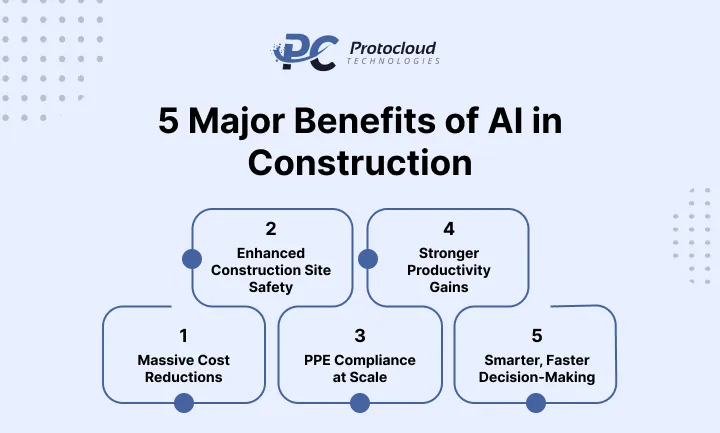
Now, let us look at the real-world impact. Here is how AI construction technology is delivering measurable results right now.
01. Massive Cost Reductions
Budget overruns are one of the biggest problems in construction. The root causes are almost always the same, inaccurate cost estimates, design errors, and poor scheduling.
AI tackles all three.
By combining deep learning with big data analytics, AI systems can identify risks early, produce more accurate cost estimates, and streamline project timelines.
Natural language processing (NLP) can also digitize and process mountains of construction paperwork faster than any human team.
A great real-world example is the Sydney Metro West project. Their autonomous tunnel boring machine used AI to automate repetitive underground tasks. The result? Lower labor costs, higher accuracy, and faster completion times.
02. Enhanced Construction Site Safety
Construction is one of the most dangerous jobs in the world. Workers face falls, electrocutions, equipment collisions, and more every single day.
Here is the good news: AI-enhanced construction safety is already saving lives.
Using computer vision and image recognition, AI can monitor workers and machines across entire job sites. It compares live footage against historical accident records to flag risks before they become injuries.
Practical AI safety applications in construction include:
- Alerting supervisors when workers are missing safety gear
- Detecting early signs of equipment malfunction
- Identifying dangerous human-machine interaction zones
- Using AI-powered wearables to warn workers of nearby hazards in real time
- Preventing unauthorized access to restricted areas
- Stopping on-site vehicle collisions before they happen
Wipro is a company doing exactly this. Their AI system tracks machine movement and speed in real time. Since deployment, on-site collision accidents have dropped to nearly zero.
03. PPE Compliance at Scale
Here is a stat that should get every site manager’s attention. Proper use of Personal Protective Equipment (PPE) can prevent 37.2% of all occupational injuries and diseases. Yet between 12% and 14% of disabling injuries happen because PPE was worn incorrectly.
Monitoring PPE compliance on a large site used to mean walking the floor with a clipboard. AI changes that completely.
Companies like Protex AI use computer vision to automatically monitor PPE compliance across every corner of a job site. The system uses object detection, image analysis, and motion tracking to instantly identify workers with missing or incorrectly worn safety gear. No clipboards. No delays. No blind spots.
04. Stronger Productivity Gains
Construction productivity has been stuck below 1% annual growth for years. That is far behind industries like manufacturing and warehousing.
AI has the potential to push that growth rate to 1.4% and, over time, that compound advantage can be massive.
One of the biggest opportunities is combining AI with Building Information Modeling (BIM). BIM creates detailed digital models of buildings. But many BIM workflows are still manual and time-consuming.
When AI is integrated, tasks like building performance analysis, design checks, and event log mining can be automated. That frees up engineers and architects to focus on higher-value work.
ALICE Technologies is a great example. Their AI-powered platform helps construction teams optimize resource allocation across the entire project lifecycle, from design through to completion.
05. Smarter, Faster Decision-Making
Data in construction grows fast. A BIM file for a three-story building can easily reach 50 GB. Add sensor feeds, drone footage, and camera data, and you are drowning in information.
AI-powered analytics cuts through all of that noise. Platforms like Procore leverage AI-powered insights to provide construction managers with real-time visibility into costs, risks, and resource allocation.
AI-powered drones can fly over a site, capture high-resolution images, and flag potential issues before they become costly problems.
The bottom line: better data leads to faster decisions and fewer expensive mistakes.
Top Applications of AI in Construction
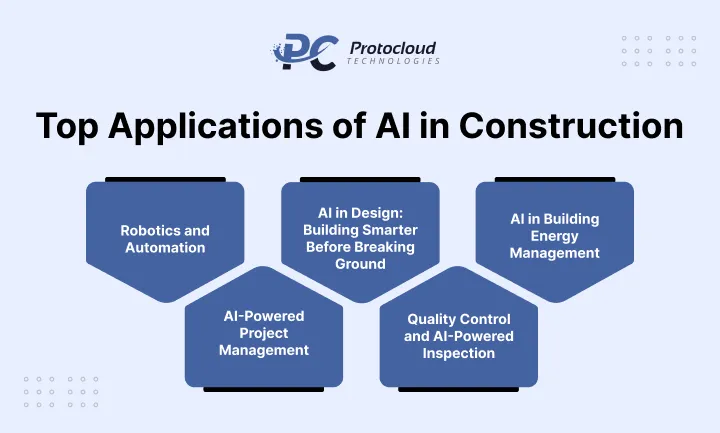
AI in construction is not just one technology. It appears in many forms throughout the construction workflow.
01. Robotics and Automation
AI-powered robots are handling tasks that used to require humans. Welding. Bricklaying. Painting. All done with high accuracy by machines that never tire and never lose focus.
Some robots are equipped with cameras that capture job-site images autonomously. Others, like ZenRobots, are designed to sort and manage waste from building demolitions, a task that is both dangerous and tedious for human workers.
In prefabricated construction, AI robotics is already automating the production of entire building panels off-site.
02. AI-Powered Project Management
Manual, repetitive project management tasks are a major source of delays and errors. AI-guided workflows are solving that.
Using algorithms such as genetic algorithms (GAs) and artificial neural networks (ANNs), AI construction software can solve complex optimization problems, including cost reduction, resource allocation, and waste minimization.
AI-powered scheduling systems can automatically generate optimized project timelines, factoring in dozens of variables and constraints simultaneously. The result is fewer delays, fewer cost overruns, and less human error across the board.
03. AI in Design: Building Smarter Before Breaking Ground
Here is something that surprises most people. AI is not just useful on the job site. It is changing how buildings are designed.
Narrowly focused AI tools can take spatial and programmatic inputs and automatically generate optimized floor plans. They can reorganize layouts dynamically and suggest design improvements in seconds.
Autodesk’s Forma is one of the best examples. One of their customers used it during the conceptual design phase, cutting their overall design time by 50% to 66%. That is not a small improvement. That is a transformation.
04. Quality Control and AI-Powered Inspection
Catching defects early is far cheaper than fixing them after the fact. AI-powered drones and cameras use computer vision to track construction progress in real time and spot anomalies the moment they appear.
Even more impressive: AI can now start predicting quality issues before they occur. The technology is still developing, but early results show real promise in forecasting structural defects and construction failures before they become visible.
05. AI in Building Energy Management
Once a building is up, AI keeps optimizing it. AI-powered HVAC systems learn occupancy patterns and automatically adjust heating and cooling. Smart lighting systems dim or brighten in response to natural light and room usage. AI-based energy optimization continuously monitors all building systems and identifies inefficiencies. The result is dramatically lower energy bills and a smaller carbon footprint, without sacrificing occupant comfort.
Challenges Holding Back AI Adoption in Construction
AI in construction is not without its hurdles. Here are the four biggest challenges companies face right now.
01. Integration With Legacy Systems
Most construction firms use older equipment and software. Getting AI to work with legacy systems often requires significant retrofitting and investment.
02. Data Privacy and Cybersecurity
More connected systems mean more exposure to cyber threats. AI infrastructure security is a growing concern across the industry.
03. High Upfront Costs
AI hardware, software licensing, and integration work are not cheap. For smaller firms, the initial investment can be a real barrier.
04. Skills Gaps
Many facility teams simply do not have the training to manage AI-driven systems. Closing that gap takes time and money. None of these challenges is permanent. But they are real, and any business looking to adopt AI in construction needs a clear plan to address them.
The Future of AI in the Construction Industry
The trajectory is clear. Experts project that the artificial intelligence in the construction market will grow at 35.2% annually. That is extraordinary growth, and it means AI will touch every part of the construction industry within the next decade.
Here is what to expect going forward.
01. Deeper Human-AI Collaboration
AI will not replace construction workers. But it will fundamentally change what they do. Workers will increasingly use AI-powered software, drones, and autonomous vehicles as everyday tools. AI handles the repetitive, data-heavy tasks. Humans handle judgment, relationships, and complex problem-solving.
This collaboration will reduce accidents, improve risk monitoring, and help teams deliver projects faster and cheaper.
02. Disruption of Traditional Business Models
AI is set to challenge the way construction companies operate. Repetitive labor, especially in large-scale projects, will increasingly be automated. That will allow human workers to focus on more complex, higher-value tasks.
Business models built around accepting cost overruns and delays as normal will not survive. AI-enabled firms that deliver on time and on budget will win.
03. Smarter, More Sustainable Buildings
The buildings of the future will manage themselves. AI-driven facility operations will continuously optimize energy use, predict maintenance needs, and adjust environmental conditions in real time. AI-powered predictive maintenance will catch problems before they cause outages or breakdowns.
The result: buildings that cost less to run, last longer, and provide a better experience for everyone inside them.
Conclusion: AI in Construction Is Not the Future, It Is Now
Here is the bottom line.
AI in construction is not some distant concept. It is happening right now on job sites around the world. It is reducing costs. It is saving lives. It is making buildings smarter, more efficient, and more sustainable.
Companies that adopt AI construction technology early will have a significant competitive edge. Those who wait will find themselves falling further behind.
The smart move is to start exploring AI-powered construction solutions today, whether that means investing in AI safety tools, upgrading to an AI-driven project management platform, or integrating smart building systems into your next development. The future of construction is intelligent. And it is already here.
Ready to explore AI solutions for your construction business? Start by auditing which parts of your workflow cost the most time and money, those are your best candidates for AI-powered improvement.
Frequently Asked Questions
What is AI in construction?
AI in construction refers to the use of artificial intelligence technologies, including machine learning, computer vision, and predictive analytics,to improve how buildings are designed, built, and managed. Applications range from AI-powered project management software to autonomous robots and smart building systems.
How does AI improve construction site safety?
AI improves safety by using computer vision to monitor workers and equipment in real time. It can detect missing PPE, identify dangerous machine-human interactions, and alert supervisors to hazards before accidents occur. Companies like Wipro and Protex AI have already deployed these systems with strong results.
What are AI-driven smart building management systems?
AI-driven smart building management systems use sensors, IoT devices, and AI algorithms to automatically control building functions like HVAC, lighting, security, and energy use. Unlike traditional automation, AI systems learn from data and continuously optimize building performance without manual input.
What are the biggest challenges of AI adoption in construction?
The main challenges include integrating AI with legacy systems, high upfront implementation costs, cybersecurity risks posed by connected systems, and skills gaps within facility management teams. Addressing these challenges requires a phased adoption strategy and investment in staff training.
How fast is the AI construction market growing?
The AI in the construction market is expected to grow at an annual rate of 35.2%, driven by demand for cost reduction, safety improvements, and operational efficiency. This rapid growth signals that AI will become a standard part of construction workflows within the next several years.