Introduction
Let’s be honest when something feels off with your body at 11 PM, the first instinct is to Google it. And that usually ends in a spiral of worst-case diagnoses. That’s the gap a well-built symptom checker app fills.
Instead of panic, it gives users real guidance calm, structured, and medically grounded.
But building one that people actually trust? That takes more than a slick UI. Here’s everything you need to know about symptom checker app development from features to architecture to AI.
What Is a Symptom Checker App?

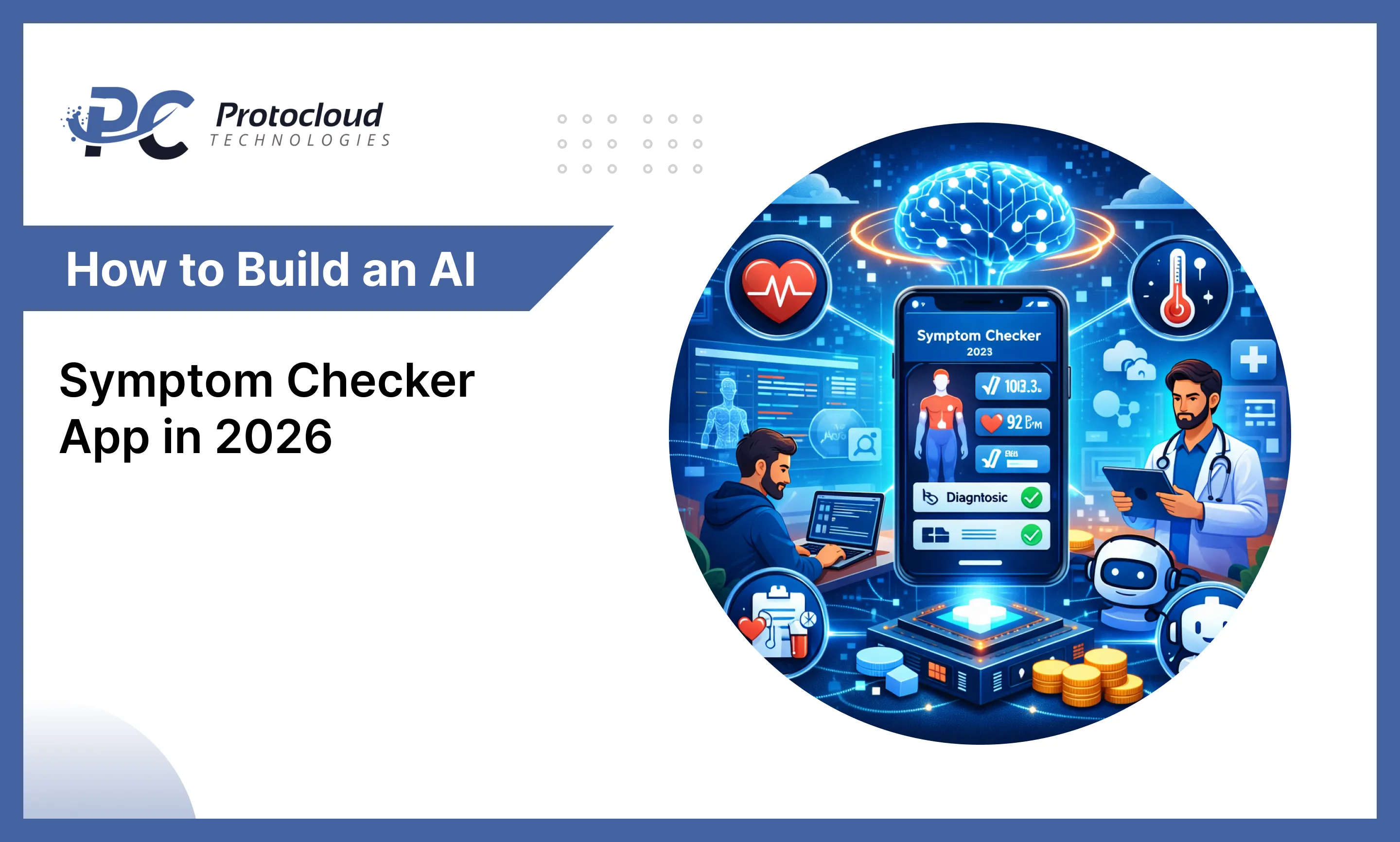
A medical diagnosis app is a digital health tool that helps users make sense of what their body is telling them. Users enter symptoms, and the app:
- Identifies possible causes based on medical data
- Assesses how serious the situation might be
- Recommends the right next step ER, doctor, or rest
- Connects them to care if needed
Modern AI symptom checker tools use NLP, machine learning, and evidence-based medical datasets to do this reliably. The keyword here is reliably a wrong recommendation isn’t just a bad user experience, it’s a safety issue.
Must-Have Features for a Reliable Symptom Checker App
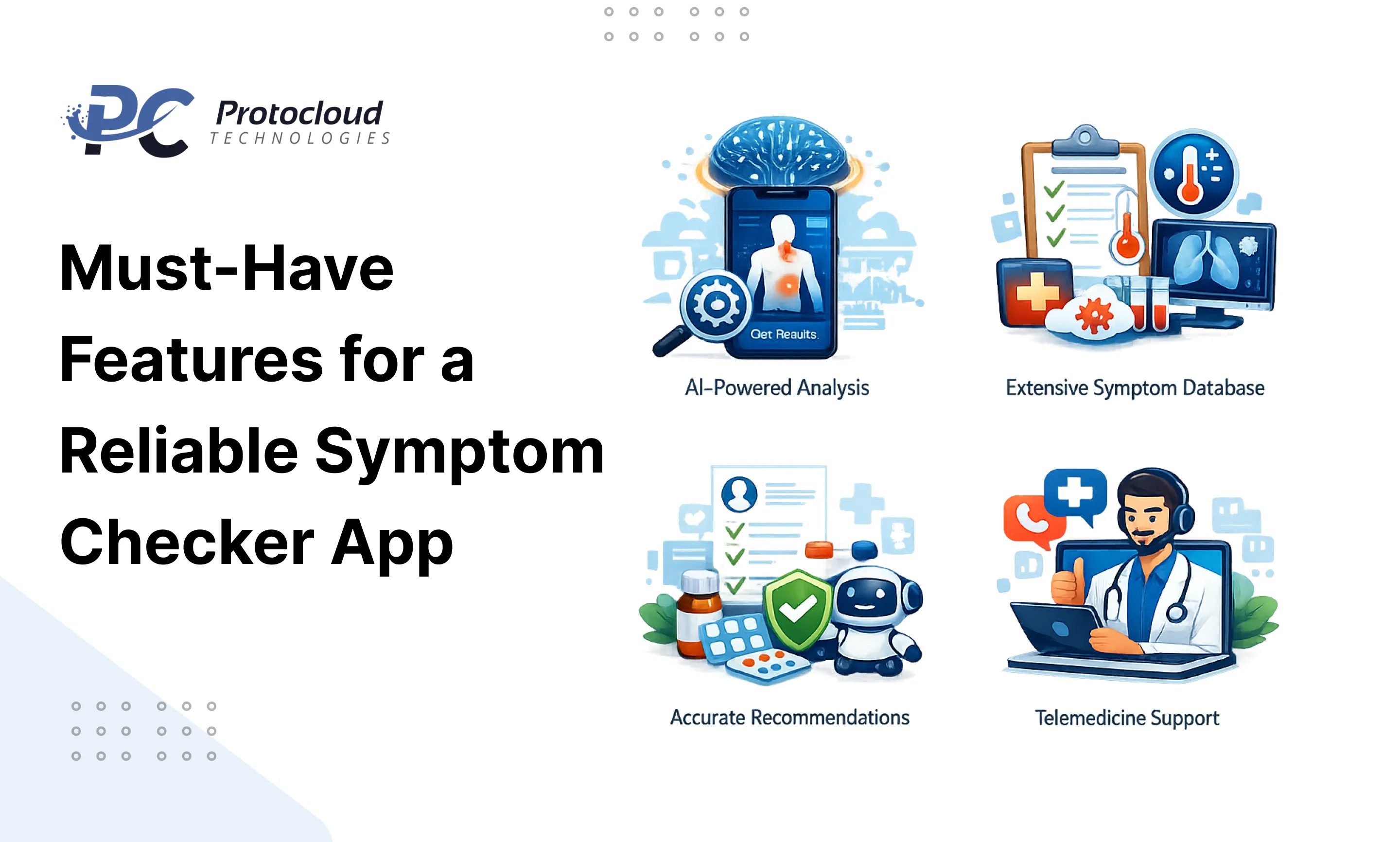
Smart Symptom Input
Users don’t describe symptoms in clinical terms. They say things like “I’ve felt dizzy since this morning” or “my chest hurts when I breathe.” A good symptom checker tool handles that naturally.
- Text and voice input for accessibility across user types
- Dynamic follow-up questions that dig deeper based on initial input
- NLP in healthcare (models like BioBERT) to interpret free-text accurately
- Multi-language support for wider reach
AI-Powered Diagnosis Engine
The AI diagnosis engine is the brain of the whole app. It needs to do far more than keyword matching.
- Match symptom combinations to likely medical conditions
- Assign a risk score based on severity indicators
- Recommend the right medical department (cardiology, ENT, ortho, etc.)
- Flag when confidence is low and prompt further questions
Evidence-Based Medical Database Integration
No AI model is reliable without the right data behind it. Medical database integration is non-negotiable for accuracy.
- ICD-10 integration and SNOMED CT integration for standardized condition mapping
- Clinical guidelines from verified medical sources
- Global and regional disease datasets
- Historical anonymized patient case data
Triage and Risk Assessment
A strong patient triage system categorizes the situation clearly no vagueness, no overreaction.
- Emergency — seek immediate care
- Urgent — see a doctor today
- Non-urgent — schedule an appointment
- Self-care — manage at home with guidance
Getting this right is what separates a trustworthy AI triage app from a dangerous one.
Doctor Integration and Appointment Scheduling
The best healthcare app features don’t stop at a diagnosis. They close the loop.
- In-app doctor appointment booking
- Telemedicine app development integration for instant consultations
- Lab test ordering and result tracking
- Prescription access where legally permitted
User Health Profile and History Tracking
Personalization makes the app smarter over time and more useful to the individual.
- Stores past symptoms and conditions
- Tracks chronic diseases, allergies, and medications
- Feeds into the AI for personalized healthcare app recommendations
System Architecture of a Symptom Checker App

A solid healthcare system architecture is what keeps the app fast, secure, and scalable.
Frontend (User Interface)
- Mobile-first design for Android and iOS
- Clean, calm symptom input interface
- Real-time results dashboard
- Symptom checker UX design built around anxious, non-technical users
Backend Architecture
- API gateway to manage requests
- AI engine processing symptom data
- Medical app backend for data routing and logic
- Secure medical database storage
AI and Analytics Layer
- NLP in healthcare for interpreting user input
- Diagnosis prediction models
- Clinical rules engine
- AI risk scoring model for triage output
Cloud Infrastructure
- Scalable hosting via AWS, Azure, or Google Cloud
- High uptime and fast compute for real-time results
- Large-scale healthcare cloud infrastructure for medical datasets
Security and Compliance Layer
This is where trust is made or lost.
- HIPAA compliant app standards for US-based deployments
- GDPR healthcare app compliance for European users
- HL7 FHIR integration for interoperability
- End-to-end medical data encryption
Integration Layer
- EHR EMR integration with hospital systems
- Wearable health device connectivity
- Telemedicine and pharmacy platform connections
AI Models Behind Smart Symptom Checker Apps

AI healthcare models power the core intelligence of the app. In practice, most apps use a hybrid not one model alone.
NLP Models
Used to understand how users describe symptoms in everyday language.
- BERT healthcare and BioBERT medical for clinical text understanding
- GPT healthcare models for conversational symptom intake
- MedPaLM AI for complex medical reasoning
Probabilistic Models
Used for ranking possible conditions and scoring risk.
- Bayesian networks for conditional probability
- Logistic regression for risk classification
Machine Learning Models
AI systems learn from medical data to help predict possible health conditions.
- Decision trees for rule-based symptom pathways
- Random forest and gradient boosting for pattern recognition
Deep Learning Models
Used in complex or edge-case diagnosis scenarios.
- LSTM networks for sequential symptom patterns
- Transformer-based models trained on clinical notes
- Neural networks that improve accuracy with more data
How to Build a Symptom Checker App: Step-by-Step
Step 1: Define Your Clinical Scope
Don’t try to build everything at once. A focused scope pediatrics, mental health, or primary care triage leads to better accuracy and lower risk. Narrow beats broad every time in healthcare AI solutions.
Step 2: Bring In Clinical Collaboration Early
This is the step most tech teams skip and it’s the most important one. Licensed doctors and clinical advisors need to:
- Define symptom pathways and decision trees
- Set risk thresholds and triage logic
- Review AI outputs for safety before launch
- Flag edge cases that algorithms miss
Step 3: Train Your AI Model Responsibly
Model training for a health diagnosis tool requires high-quality, anonymized clinical data and a clear ethical framework.
- Use verified datasets (not scraped web content)
- Train the model to express uncertainty not fake confidence
- Build in follow-up questioning when confidence is low
Step 4: Design for Anxious Users
Healthcare UI/UX deserves more attention than it usually gets. Users using this app are often stressed or scared. The design should feel:
- Calm and reassuring, not clinical and cold
- Easy to navigate in one hand on a phone
- Clear at every step about what’s happening and why
Step 5: Validate Before You Launch
Pilot testing isn’t optional in AI medical diagnosis development. Before public release:
- Compare AI outputs against clinician-reviewed outcomes
- Measure accuracy, safety, and edge-case performance
- Fix blind spots and bias before users encounter them
- Set up continuous monitoring post-launch
AI Symptom Checker App Development Cost Breakdown
No two builds cost the same. It depends on how deep the clinical logic goes, which systems you’re connecting, and how much compliance work is involved. Here’s how the tiers break down.
MVP —> $50K to $120K
This is the right entry point if you want to validate your idea before going all-in. You get basic symptom input, simple AI models, and limited integrations no EHR, no full telehealth. The triage logic is there, but it’s not built for clinical-grade environments. Think of it as a working prototype that’s live enough to test with real users and start collecting meaningful feedback.
Mid-Level —> $120K to $250K
This is where most serious healthcare app development projects land. You’re getting stronger AI models, structured data pipelines, and basic EHR integration. NLP layers improve diagnosis accuracy, and the UX is refined enough for actual patient-facing deployment. It’s a real product, not just a proof of concept.
Enterprise Grade —> $250K to $500K+
Built for hospital networks, insurers, or large telemedicine app development platforms. This tier includes full clinical logic, multi-label prediction, HIPAA compliant app standards, and HL7 FHIR integration for cross-system interoperability. Audit logs, access controls, and regulatory documentation are all part of the build not afterthoughts.
Ongoing and Hidden Costs You Need to Plan For
This part gets skipped in early budget conversations more than it should. The build is one investment. Keeping it accurate, compliant, and connected is another and it doesn’t stop.
AI model retraining cost is real. Medical guidelines evolve, new conditions emerge, and a model trained on last year’s data starts drifting. Medical knowledge base updates, compliance audits, and healthcare cloud infrastructure cost spikes during high-demand periods like flu season are all recurring expenses. And every external API or hospital system you’ve integrated needs ongoing maintenance when those systems update on their end.
The honest rule of thumb? Budget 20–30% of your build cost annually for upkeep. That’s not padding that’s the cost of running a serious digital health app.
What Drives Enterprise AI Symptom Checker App Development Cost
If your quote feels high, here’s why and most of it is legitimate.
Clinical Data Acquisition
Clean, labeled clinical data is expensive to source and even more expensive to maintain. Medical dataset cost includes licensing verified datasets, and clinical data acquisition from ICD-10 or SNOMED CT sources requires expert review at every stage. Medical data labeling is slow work you can’t automate your way out of it entirely when clinical accuracy is on the line.
AI Model Training and Tuning
NLP model cost in healthcare is higher than general-purpose NLP because the model needs to understand clinical language, not just conversational text. Multi-label prediction where a symptom maps to several possible conditions costs more than single-condition matching. Add probabilistic layers and deep learning components, and the training bill grows fast.
Compliance Infrastructure
HIPAA compliant app cost covers audit trails, encryption, role-based access controls, and everything that keeps patient data protected. GDPR healthcare compliance cost applies if any part of your user base is outside the US. These aren’t optional line items they’re what makes the app legally deployable in regulated markets.
System Integration
Healthcare API integration cost varies based on what you’re connecting to. Telehealth platforms, hospital EHR systems, wearable devices each adds complexity. Legacy hospital systems are the hardest. They often need a custom FHIR or HL7 translation layer because they don’t expose clean modern APIs.
AI Symptom Checker App ROI: Where the Returns Come From
A well-built AI triage app pays for itself faster than most healthcare technology investments. Here’s where the returns actually show up.
Direct Operational Returns
Reduced triage time is the clearest win. Staff handle fewer intake calls, consultation queues move faster, and automated case routing improves patient flow without adding headcount. Telemedicine ROI improves specifically when a structured symptom intake layer prepares the doctor before the session even begins saving 5 to 10 minutes per call adds up fast at scale.
Revenue Model Options
There are several ways to monetize a healthcare app:
- B2B healthcare software licensing to hospital networks or insurers
- Freemium healthcare app model basic triage free, advanced features paid
- Telemedicine referral revenue model earn per consultation connected
- Healthcare SaaS pricing model for recurring enterprise contracts
Real-World Use Cases Driving Demand
These aren’t hypothetical. AI symptom checker tools are already deployed across care systems globally.
Pre-Diagnosis Triage for Hospitals
Hospitals use these tools at the first point of contact often before a patient reaches a clinician. The system collects symptoms, checks severity, and assigns a priority level. A patient reporting chest pain gets flagged as high risk and routed to urgent care. Low-risk cases move to general consultation queues. Mayo Clinic uses similar AI triage tools to guide patients to the right care path at intake.
Virtual Assistants in Telehealth Platforms
The telehealth virtual assistant app model is one of the clearest applications. A symptom checker sits before the booking or consultation step, gathering structured input and preparing a case summary. When the doctor joins, key details are already there. Babylon Health built its model around exactly this and the result is shorter sessions and better-prepared clinicians.
Chronic Disease Monitoring
Patients with ongoing conditions use these tools between visits to log symptoms and track changes over time. The system detects patterns and flags shifts that may need attention. Ada Health does this well a diabetes patient logging fatigue and dizziness over several days triggers an alert suggesting a follow-up. That’s the chronic disease monitoring app AI model working as intended.
Insurance Risk Assessment
Insurers use symptom data as part of claim review and underwriting. The system flags unusual patterns for closer review before approval. UnitedHealth Group uses AI to review health data during claim processing it’s a real and growing application of insurance risk assessment AI in healthcare.
Challenges That Quietly Inflate Your Budget
Every team hits these. Knowing them early saves real money later.
Accuracy vs. Ease of Use
Long questionnaires improve results, but users quit halfway. Short flows feel easy, but miss key details. The fix is designing adaptive flows start with a few core questions, add follow-ups only when the initial input signals risk. Urgent paths stay detailed; simple cases stay short.
Healthcare AI Data Bias
Models trained on data from limited regions or demographics perform unevenly in the real world. The fix is sourcing data from diverse groups and testing outputs across different user segments before release not after.
Healthcare Compliance Challenges
Systems that suggest medical action face strict regulatory review. The mistake most teams make is treating compliance as a final-stage task. Building audit logs, validation reports, and documentation alongside development not at the end is what keeps timelines from blowing out.
Legacy System Integration
Older hospital platforms don’t support clean APIs. Adding a FHIR or HL7 translation layer early avoids complete rewrites when the integration breaks later. It’s a cost upfront that saves a much larger one down the road.
Future Trends Shaping Costs by 2030
The future of AI symptom checkers isn’t just better diagnosis it’s deeper integration and less manual work at every stage.
Agentic AI Healthcare Systems
The next wave isn’t a tool that answers a query it’s one that completes a workflow. A user shares symptoms, the system asks follow-ups, checks past records, and books a consultation if needed. All in one sequence, without manual handoffs.
Predictive Health Analytics
Predictive health analytics shifts care from response to prevention. Small pattern shifts fatigue, sleep changes, minor symptom clusters trigger early alerts. The goal is catching issues before they become urgent.
Voice and Multimodal Input
More users prefer speaking over typing. Voice-enabled healthcare apps will handle text, voice, and images in a single flow. Describe your symptoms, upload a photo, answer a follow-up all in one session.
Automated Triage
First-level screening will run without manual review. The automated triage system assigns risk, guides next steps, and flags urgent cases before a clinician is ever involved.
Why Protocloud Technologies for AI Symptom Checker App Development
Most teams can build a working model. The real challenge starts after launch when systems face real users, uneven data, and strict compliance checks. Protocloud builds AI healthcare solutions with these conditions in mind from day one, not as an afterthought.
How Protocloud Addresses Core Challenges
Data quality is the first place most medical diagnosis app projects break down. Protocloud uses structured pipelines to clean, label, and validate data continuously so the model keeps improving after launch, not just before it. When it comes to clinical accuracy, every output follows traceable logic, and critical cases go through a human validation layer before reaching the user.
Integration is handled with early planning rather than late scrambling. Whether it’s EHR systems, telehealth platforms, or connected devices, the team maps out FHIR and HL7 compatibility at the architecture stage not during QA. Compliance is built in from the start too, with audit logs, access controls, and data protection aligned to global healthcare software development standards before a single line of production code ships.
Delivery Scale and Outcomes
The numbers tell a straightforward story:
- 500+ digital health platforms delivered
- 450+ healthcare clients served across global markets
- 10+ years of dedicated HealthTech project experience
- 300+ connected medical devices successfully integrated
System Performance and Impact
Real-world performance matters more than demo metrics. Protocloud’s deployed AI healthcare app systems maintain 99.9% uptime for critical infrastructure, deliver up to 45% improvement in hospital operational efficiency, achieve 90%+ clinical data accuracy, and hit 95% patient satisfaction scores across live deployments.
That’s not marketing language those are the numbers that matter when a hospital network or insurer is evaluating whether to trust a system with patient triage.
Final Word
AI symptom checker app development cost is really a question of scope and seriousness. A lean MVP to test your idea? Achievable under $120K. A clinical-grade system with compliance, integrations, and real AI depth? Plan for $250K and up plus ongoing investment every year.
The teams that see the best returns aren’t the ones who spent the least. They’re the ones who planned honestly, built with clinical input from day one, and treated maintenance as part of the product not an afterthought. That mindset is what turns a medical diagnosis app from a working tool into a trusted one.
FAQs
1. What features should an AI symptom checker app include in 2026?
An AI symptom checker app should include symptom analysis, AI-powered health recommendations, chatbot support, telemedicine integration, user health records, multilingual support, wearable device integration, and strong data privacy features like HIPAA or GDPR compliance.
2. How much does it cost to develop an AI symptom checker app in 2026?
The development cost of an AI symptom checker app in 2026 can range from $20,000 to $150,000 or more depending on app complexity, AI model training, healthcare integrations, security requirements, and platform support (Android, iOS, or web).
3. Which technologies are used to build an AI symptom checker app?
Popular technologies include Python, TensorFlow, OpenAI APIs, NLP models, cloud platforms like AWS or Google Cloud, React Native or Flutter for mobile apps, and healthcare APIs such as FHIR and HL7 for medical data integration.
4. Is an AI symptom checker app accurate for medical diagnosis?
AI symptom checker apps can provide preliminary health assessments and guidance, but they should not replace professional medical diagnosis. Accuracy depends on the quality of medical datasets, AI training models, and continuous updates from healthcare experts.
5. How can AI symptom checker apps ensure patient data security?
AI healthcare apps can ensure security through end-to-end encryption, secure cloud storage, multi-factor authentication, HIPAA/GDPR compliance, regular security audits, and role-based access control to protect sensitive patient information.