Have you noticed how travel feels different lately? It is smoother. It is faster. This is because AI in tourism is fundamentally changing the global travel infrastructure. It isn’t just about making things “faster”; it is about making your journey deeply personalized and frictionless.
The numbers clearly show how fast digital change is happening. According to Forbes, AI is set to become a $15.7 trillion industry by 2030. Capital is flooding the sector, with experts projecting that specialized investments will hit $500 billion by 2024. This isn’t just a minor trend—the future of AI in tourism is already here, acting as a primary engine for global economic growth.
In the travel industry, we see disruptive tools emerging every day. These smart travel solutions perform tasks that were once considered impossible. They help businesses optimize their yield while ensuring you have a better time. Let’s explore why AI in tourism is the most critical development in modern travel.
The Rise of the AI Travel Industry
The world of travel is moving at breakneck speed. Every major stakeholder, from boutique hotels to global airlines, is racing to integrate artificial intelligence in tourism. The goal is simple: maximize efficiency without losing the human touch. You can now see AI-powered travel solutions at every touchpoint, from initial discovery to the flight home.
Generative AI in tourism is the vanguard of this movement. Think about AI virtual travel assistants like those powered by LLMs (Large Language Models). These aren’t the clunky bots of the past; they provide AI-based travel recommendations that feel intuitive and context-aware. They can cross-reference hotel availability, flight latency, and your personal loyalty points in seconds.
This tech is a massive boon for hospitality staff as well. Automating repetitive queries reduces burnout and lets human agents focus on complex guest needs. When you use AI chatbots for travel, you get high-level support 24/7. This is how AI in tourism maintains high Net Promoter Scores (NPS)—it is fast, smart, and always ready.
Furthermore, AI in tourism empowers companies to engage in “predictive hospitality.” By using AI in travel operations, brands can visualize what travelers want before they even ask. This leads to AI data-driven tourism, which significantly reduces operational waste. For instance, AI predictive maintenance hospitality tools monitor HVAC systems and elevators in hotels, ensuring they stay in peak condition to avoid guest complaints.
Advantages of Leveraging AI in Tourism and Travel
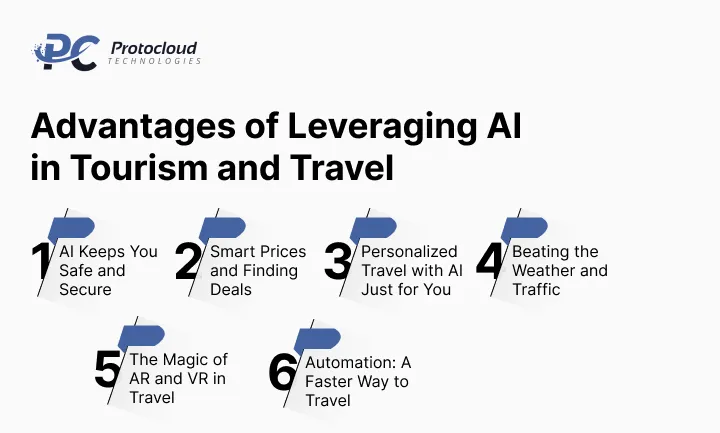
1. AI Keeps You Safe and Secure
Safety is the cornerstone of the travel experience. AI in tourism is making global movement much safer by using high-frequency data to spot risks. These tools use AI-based travel safety and security protocols to monitor high-traffic hubs such as train stations and terminals.
- Better Security: AI risk-assessment travel tools analyze threat levels at airports in real time.
- Faster Check-ins: Facial recognition in airports uses biometric data to move lines faster while virtually eliminating identity theft.
- Stopping Scams: AI fraud detection in travel uses neural networks to catch fake bookings and credit card theft before they are processed.
- Real-time Protection: Machine learning in tourism monitors millions of data points to flag suspicious behavior, protecting your money and identity.
2. Smart Prices and Finding Deals
If you have ever seen a flight price change while your browser was refreshing, you have experienced AI dynamic pricing in travel. This is the science of revenue management. AI in tourism analyzes global demand, fuel costs, and even geopolitical events to set the right price.
AI-based hotel pricing optimization uses similar logic. They analyze historical booking curves and local competitor rates to ensure the price is fair. This is known in the trade as AI revenue optimization travel. It helps businesses stay profitable during low seasons while ensuring travelers pay a fair price during peak holiday seasons.
This system never sleeps. It processes real-time AI travel updates to adjust costs dynamically. This ensures the AI in the airline industry can maximize “load factors” (seat occupancy). It is a vital part of the digital transformation in tourism, moving from static pricing to a living, breathing marketplace.
3. Personalized Travel with AI Just for You
Mass tourism is being replaced by “Niche Tourism.” Personalized travel with AI ensures your itinerary is as unique as your DNA. The system analyzes your digital footprint—your past stays, your search behavior, and even your public social preferences—to generate AI-based travel recommendations.
AI in tourism can identify the exact boutique hotel that fits your aesthetic. It can build an AI-based itinerary planning that accounts for your walking speed and coffee preferences. These AI travel planning tools remove the “analysis paralysis” of having too many options.
Think of it as a multilingual AI travel assistant living on your smartphone. This AI concierge service tool understands the nuance of your request. Whether you need a vegan-friendly bistro in Kyoto or a quiet museum in Paris, it creates an AI-enhanced customer journey that feels curated rather than computer-generated.
4. Beating the Weather and Traffic
In the past, a sudden storm could ruin a multi-thousand-dollar trip. Today, AI-based travel weather predictions use hyper-local satellite data to give you “street-level” updates. AI in tourism provides these insights directly to your device, often before the local news even reports it.
If a flight is likely to be delayed, AI in tourism can automatically suggest alternative routes. This applies to ground transport too, via AI-based traffic prediction. By rerouting you around congestion, these tools ensure you spend your vacation on the beach, not in a taxi.
- Stay Informed: Receive AI real-time travel updates regarding gate changes or rail strikes.
- Avoid Delays: AI in tourism identifies logistical bottlenecks before they cause a “domino effect” of cancellations.
- Travel Happy: Smart tourism technology removes the anxiety of the unknown.
5. The Magic of AR and VR in Travel
AI in tourism is the engine behind Augmented and Virtual Reality. VR travel experiences act as a “try before you buy” feature. You can virtually walk through a suite in the Maldives from your living room in New York to ensure it meets your expectations.
AR in travel industry tools is even more interactive. Using AI-powered tour guides, you can point your phone at an ancient Roman ruin and see it reconstructed in 3D on your screen. Augmented reality in tourism bridges the gap between history and the present, making the future of AI in tourism an educational and immersive adventure.
6. Automation: A Faster Way to Travel
The ultimate goal of AI in tourism is the “frictionless journey.” AI in travel and hospitality is now automating the “boring” administrative back-end. This includes AI booking automation and instant VAT tax processing.
AI in hotel management systems can now handle check-outs and room service requests without a single phone call. From the AI in the airline industry to local tour operators, every link in the chain is being connected. This automated travel management means you spend less time in queues and more time making memories. It is the gold standard of modern discovery.
Key AI Use Cases in Travel and Tourism
- Hotel Search and Booking AI: In travel and tourism, AI uses Bayesian filters and neural networks to rank hotels. These smart hotel booking algorithms learn from your clicks. An AI hotel booking system doesn’t just show you rooms; it shows you the right rooms.
- AI Itinerary Planning: Modern AI in travel industry tools use “Constraint Satisfaction” logic. They provide AI-generated travel itinerary recommendations tailored to your specific budget, time, and energy levels.
- Predictive Analytics in Travel: AI in travel and tourism helps managers avoid “overbooking” disasters. AI demand forecasting for tourism allows for better AI resource allocation in travel, making the industry more resilient.
- Facial Recognition in Travel Industry: AI facial recognition at airports is now part of “Single Token” travel. It enables AI check-in automation, allowing you to walk from the curb to the gate without ever pulling out a passport.
- AI Chatbots for Travel: These travel customer support chatbots use Natural Language Processing (NLP). They offer AI-powered customer service travel that understands slang and different accents perfectly.
AI Real World Examples and Case Studies
- Expedia Chatbot AI: The benchmark for AI in travel and tourism. The Expedia AI booking assistant integrates with platforms like ChatGPT to plan trips conversationally. It has drastically reduced the “search-to-book” time for millions of users.
- Marriott International AI Pricing: By using AI dynamic pricing for hotels, Marriott can optimize yield across thousands of properties. This AI room tariff optimization ensures they remain competitive while maximizing their RevPAR (Revenue Per Available Room). It is the peak of AI revenue management tourism.
- AI Travel Case Studies: Major airlines like Delta and Lufthansa are using AI in travel and tourism to predict jet-engine maintenance needs, demonstrating that AI is a critical safety and investment tool.
Investing in an AI-Powered Travel Platform
- AI Travel Platform Development: For entrepreneurs, AI in travel and tourism is a high-growth sector. Building an AI-powered travel platform development requires a deep stack of data and API integrations.
- AI Development Cost for the Tourism Industry: The AI travel platform typically costs $100,000 to $300,000 for an MVP (Minimum Viable Product).
- Key Cost Factors: High costs usually stem from hiring data scientists and securing permissions for AI-intelligent travel assistants to access global GDS (Global Distribution System) data.
- AI Maintenance and Updates Travel Platform: To maintain AI in travel and tourism effectiveness, you must invest in “model retraining” to ensure the AI doesn’t become biased or outdated.
Emerging AI Trends in Travel and Tourism
- AI Virtual Assistants Travel Industry: We are moving toward “Voice-First” search.
- AI Robotics in Tourism: In Japan and Singapore, robots handle concierge and room delivery, showcasing the power of AI automation in the travel industry.
- AI Image Recognition Tourism: You can now take a photo of a landmark and have an AI instantly book a tour for you.
- Blockchain and Green Travel AI Solutions: AI is being used to calculate the carbon footprint of every flight, helping travelers make eco-friendly choices.
- AI Health and Safety Travel: Post-pandemic, AI data-driven decision-making tourism tools monitor crowd density to ensure social distancing and hygiene standards.
How Protocloud Technologies Builds AI-Powered Travel Solutions
Artificial Intelligence is no longer a future concept in the travel industry—it is already transforming how people explore the world. From personalized recommendations and smart pricing to real-time updates and automated bookings, AI is creating faster, safer, and more seamless travel experiences.
As the industry continues to evolve, businesses that adopt AI-powered solutions will gain a clear competitive advantage. AI not only improves customer experience but also enhances operational efficiency, reduces costs, and enables data-driven decision-making at every level.
This is where Protocloud Technologies plays a key role. With expertise in building intelligent, scalable, and customized AI development solutions, Protocloud helps travel businesses innovate, automate, and deliver exceptional user experiences.
FAQs
1. How is AI used in travel and tourism?
AI in travel and tourism helps companies deliver better, faster service. It suggests hotels and flights based on your interests. It helps with trip planning. It answers questions through chatbots. It also sets smart prices and improves safety. This makes travel easier and more personal.
2. What is the future of AI in tourism?
The future of AI in tourism looks bright. AI will handle more parts of your trip automatically. It will make booking simple. It will improve safety. It will give better travel suggestions based on what you like. In short, travel will become smoother and more enjoyable.
3. What is the role of AI in the travel and tourism industry?
AI helps travel companies work faster and smarter. It improves customer service. It reduces mistakes. It helps businesses make better decisions using data. Most importantly, AI helps companies deliver a better experience to travelers.