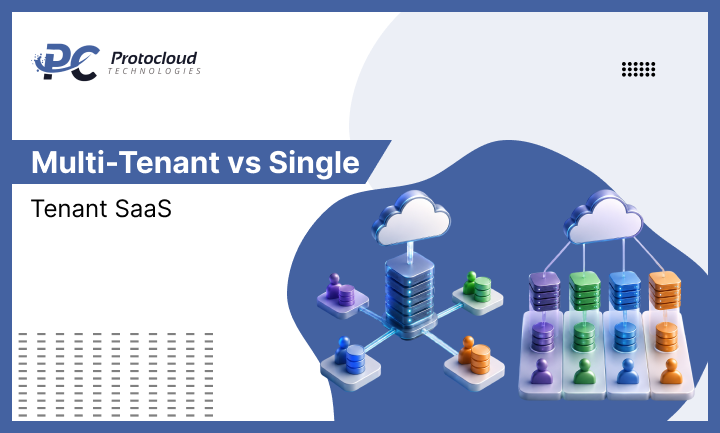
Which architecture is right for your product?
You’re building a SaaS product. Things are going well. Then someone on your team asks the question you’ve been quietly avoiding:
“Should we give each customer their own environment, or just have everyone share one?”
This is the multi-tenant vs single-tenant question and it matters more than most early-stage teams realise. Get it wrong and you’ll either burn through infrastructure budget unnecessarily or lock yourself out of the enterprise deals you’ve been working toward.
The good news: once you understand the two models, the decision usually becomes pretty clear. This guide walks you through both in plain English, explains the real-world tradeoffs, and helps you figure out which one fits where your product is today and what a hybrid approach looks like when you eventually need both.
Multi-Tenant Architecture
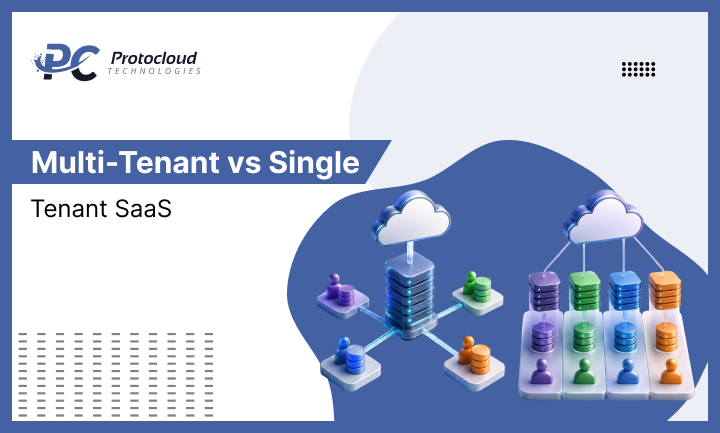
In a multi-tenant setup, all your customers share the same application and the same database. Each customer is called a “tenant”. Their data is kept separate from everyone else’s using unique tenant IDs and security rules but the underlying infrastructure is shared.
The best analogy is an apartment building. Everyone lives in the same building and shares the same utilities. But each flat is private your neighbours can’t walk into your place.
This is the model most SaaS products are built on, and for good reason. When a new customer signs up, they’re just another tenant in the same system. No new server to spin up. No new database to configure. No new deployment to run. They’re in and using the product within minutes. That speed of onboarding is a real competitive advantage, especially when you’re in a growth phase and signing customers quickly.
Maintenance is also much easier. When you ship a new feature or push a bug fix, it’s live for every customer at once. You don’t have to coordinate separate rollouts across dozens of environments or worry about customers running very different versions of your software, a support and QA nightmare that single-tenant teams deal with constantly.
From a cost perspective, shared infrastructure is dramatically cheaper per customer than running separate setups. Your database server is doing real work for every tenant simultaneously, instead of sitting mostly idle in a dedicated environment.
The main risk is what engineers call the “noisy neighbour” problem. If one customer is hammering your database with heavy queries, it can slow things down for everyone else on the same system. With good architecture, rate limiting, and auto-scaling, this is manageable but it’s something you need to design for upfront, not bolt on later.
The other challenge is customisation. Because all customers share the same codebase, it’s hard to offer deep, per-client customisation without making your codebase increasingly messy. Most multi-tenant products handle this with feature flags and configuration settings rather than custom code for each customer.
Multi-tenant works best when you…
- Want to grow fast and keep infrastructure costs low
- Serve customers with broadly similar needs startups, SMBs, teams
- Release updates frequently and want everyone on the latest version
- Have a small engineering team that can’t manage dozens of separate environments
- Are still finding product-market fit and need to move quickly
Single-Tenant Architecture
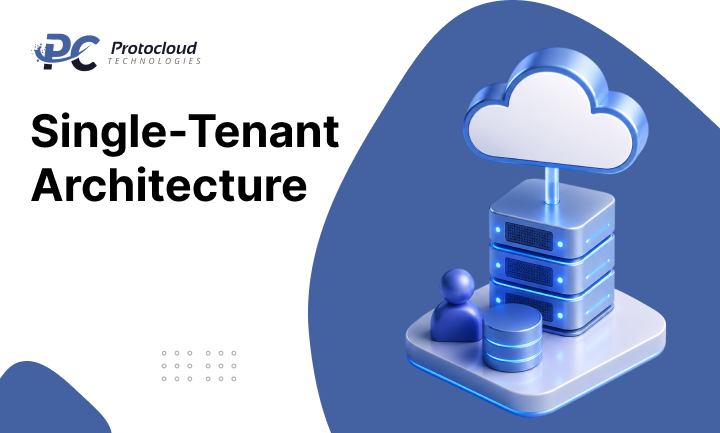
In a single-tenant setup, every customer gets their own dedicated application, their own database, and their own infrastructure. Nothing is shared between customers. Each one lives in a completely isolated environment that belongs entirely to them.
Think of it as owning a private house instead of an apartment. No shared walls. No shared utilities. What’s yours is entirely yours.
This model costs much more to run. But for the right type of customer, it’s not negotiable.
A hospital can’t have patient records sitting in the same database as a competitor’s data , even if they’re logically separated. A bank can’t accept “we use tenant IDs to keep your data separate” as a satisfying security answer. For organisations in healthcare, finance, government, and large enterprises generally, physical data isolation is a hard requirement. Not a preference. Not something they’ll waive for the right sales pitch.
Single-tenancy also opens the door to deep customisation. Because each customer’s environment is completely isolated, you can modify it, configure it, or extend it without touching anything else. Enterprise clients often come with long, specific requirements, custom workflows, unusual integrations, branded interfaces, data residency restrictions and single-tenancy is what makes those requests feasible without a lot of painful compromises.
The downside is operational complexity, and it compounds as you grow. Every new customer needs a full deployment. Every update needs to be pushed to every customer’s environment separately. If you have 200 enterprise clients, you’re managing 200 separate systems. Without strong automation and a mature DevOps practice, this becomes a serious engineering burden that can slow down the whole company.
Single-tenant works best when you…
- Serve large enterprise clients with strict compliance or security requirements
- Operate in regulated industries healthcare, finance, government, legal
- Need to offer meaningful per-client customisation of the product
- Have customers who require data hosted in a specific region or on dedicated infrastructure
- Are selling to organisations where data isolation is part of the procurement process
The Key Differences at a Glance
Here’s how the two models compare across the factors that matter most when you’re making this decision:
| Factor | Multi-Tenant | Single-Tenant |
| Cost | Lower: Shared infrastructure | Higher: dedicated per customer |
| Security | Strong with good engineering | Strongest : fully isolated |
| Scalability | Easy: one platform for all | Harder: new setup per customer |
| Customisation | Limited: shared codebase | Full : each environment is independent |
| Maintenance | Simple : update once | Complex : update each separately |
| Performance | Possible: noisy neighbour issues | Stable: dedicated resources |
Best For Startups, SMBs, fast-growth Enterprise, healthcare, finance, govt
So, Which One Should You Pick?
For most early-stage SaaS companies, multi-tenancy is the right starting point. It’s cheaper, easier to maintain, and lets you move fast. You can onboard new customers without any manual work, ship updates without coordination overhead, and keep your infrastructure simple while you’re still figuring out what your customers actually need. The vast majority of successful SaaS companies from project management tools to CRMs to developer platforms started on shared infrastructure and grew from there.
If you’re building for enterprise from day one or you’re in a regulated industry, single-tenancy may be unavoidable from the start. Some enterprise procurement teams will flat-out reject a shared infrastructure model regardless of how well your security is engineered. In those cases, the conversation ends before it really begins unless you can offer dedicated environments.
What about a hybrid approach?
This is actually where a lot of mature SaaS companies end up. They run a multi-tenant environment for the majority of their customers and offer single-tenant deployments as a premium option for enterprise clients who specifically need it.
It sounds complicated, but modern cloud infrastructure makes it much more manageable than it used to be. AWS, Google Cloud, and Azure all have tooling that makes it relatively straightforward to provision isolated environments on demand. Kubernetes, Terraform, and infrastructure-as-code pipelines mean you can script the creation of an entire isolated environment and run it repeatedly. The key is building your deployment pipeline to support both models from the start retrofitting this capability later is genuinely painful and takes a long time.
Tools Worth Knowing About
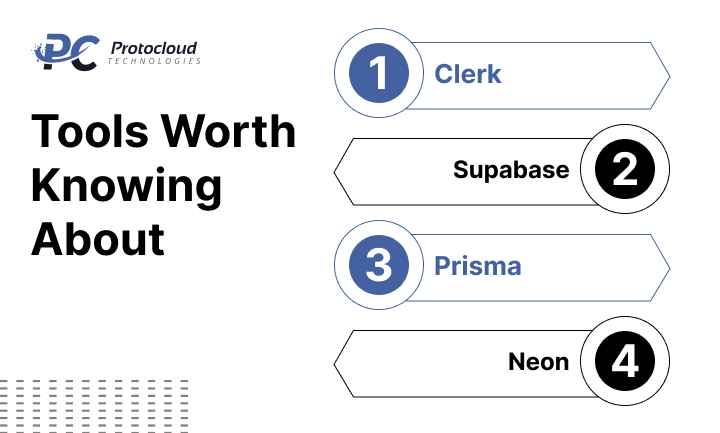
You don’t have to build tenant isolation from scratch. A strong ecosystem of tools has emerged specifically to solve the hard parts of multi-tenant architecture authentication, data isolation, and database management.
These are the ones most commonly used by production SaaS teams.
Clerk
Clerk handles authentication and user management for multi-tenant apps. It supports organisations, role-based access control, and multi-tenant login flows out of the box. If you’re building a B2B SaaS product, it removes weeks of authentication work and handles the tricky edge cases like a user belonging to multiple organisations cleanly.
Supabase
Supabase is built on PostgreSQL and uses its Row-Level Security feature to enforce tenant isolation at the database level. You write policies once, and the database guarantees that users can only access rows that belong to their own tenant even if your application code has a bug. That’s a powerful safety net.
Prisma
Prisma is a database toolkit and ORM that makes it much easier to write tenant-aware queries. It works well with both shared database setups and database-per-tenant models. If your backend is Node.js, it’s probably the cleanest way to manage multi-tenant data access without the queries getting hard to reason about.
Neon
Neon offers serverless PostgreSQL with database branching. It lets you give each tenant their own isolated database without the infrastructure cost of running a dedicated server for each one. You can spin up a new branch per customer in seconds, which is particularly useful for platforms that want single-tenant-style data isolation without paying single-tenant-level infrastructure bills. It’s one of the more interesting new tools in this space.
The Bottom Line
Multi-tenant: lower cost, easier to scale, the right default for most SaaS products. Single-tenant: stronger isolation, better for enterprise and regulated industries. Hybrid: what most mature platforms eventually end up doing.
The architecture decision you make now will shape your costs, your customers, and your engineering culture for years. There’s no shame in starting with multi-tenancy and evolving from there, most successful SaaS companies have done exactly that. Shopify, Slack, and HubSpot all started with shared infrastructure and added enterprise tiers as they grew.
What matters is that you understand the tradeoffs clearly before you commit. Because unpicking a deeply embedded architectural decision later is one of the most painful, expensive, and time-consuming things you can do to an engineering team and one of the most avoidable: talk to your customers. Understand their compliance needs. Then pick the model that fits and build it properly.
FAQ
Can you switch from multi-tenant to single-tenant later?
Yes, but it’s a significant engineering project. Most companies don’t do a full migration instead, they add a single-tenant tier as a premium option for enterprise clients while keeping existing customers on the shared platform. The key is keeping your tenant context clean in the data model from day one, which makes the eventual split much less painful.
Is multi-tenant less secure than single-tenant?
Not inherently. A well-built multi-tenant system with proper row-level security, tenant ID enforcement, and strict access controls can be extremely secure. The difference is that in multi-tenancy, security is an engineering problem you have to solve deliberately. In single-tenancy, physical isolation does a lot of that work for you by default. Both can be secure but they require different types of effort.
What do enterprise customers usually ask for?
Most enterprise security and procurement teams ask about data residency (where our data is stored), physical isolation (whether our data is on separate infrastructure), compliance certifications (SOC 2, ISO 27001, HIPAA, FedRAMP), and custom SLAs. Single-tenant architecture makes it significantly easier to satisfy all of these without long, complicated conversations.
What’s the fastest way to get started with multi-tenancy?
Use Clerk for authentication, Supabase or Prisma for your database layer with row-level security, and design every table with a tenant_id column from the very beginning. Retrofitting tenant isolation into an existing schema is a real headache doing it right from the start takes almost no extra time and saves a huge amount of pain later.