Let me be straight with you. A few years ago, the idea of using machine learning in your business felt like trying to fly a commercial jet with no pilot training. You had the destination in mind. You just didn’t know how to get there. The headlines kept saying AI was the future, but every time you looked closer, the price tag was enormous, the timelines were exhausting, and the talent was almost impossible to find. So most businesses did what they always do with complicated things. They waited.
But the game has changed. Automated machine learning, or AutoML, has quietly removed most of those barriers. And right now, your competitors are no longer waiting. In this blog, we will walk through what AutoML really means for your business, how it works in plain language, and why ignoring it in 2025 is a risk you simply cannot afford to take.
What Is Automated Machine Learning, Really?
At its core, automated machine learning is exactly what it sounds like. It automates the hard parts of building AI models. The parts that used to require a PhD or a team of expensive specialists. Things like choosing the right algorithm, cleaning messy data, selecting the best features, and tuning the model until it actually works. AutoML does all of that for you, in the background, often in a fraction of the time.
Think of it like this. Traditional machine learning was like hiring a master chef to cook every meal from scratch. AutoML is like having a smart kitchen that understands what you want, finds the best recipe, and prepares it perfectly, every single time. You still decide what you are hungry for. The system handles the rest. And according to MarketUS, the AutoML market is growing at 48.30% annually and is expected to reach $231.54 billion by 2034. That is not a trend. That is a transformation.
Who Benefits the Most from Machine Learning Automation?
Here is the honest answer: almost everyone. But AutoML for enterprises is particularly powerful. Large organizations sit on mountains of data but often lack the internal talent to turn it into insight. Machine learning automation closes that gap fast. Your marketing team can build a customer churn model. Your finance team can flag suspicious transactions. Your supply chain manager can predict stock shortages. No coding needed at all. That is the real promise of AI for business in 2025.
Breaking Down the Old Barriers to Machine Learning
Before AutoML arrived, businesses faced three big walls.
First, data. Traditional ML models needed massive amounts of clean, well-organized data. Most companies had data, but it was scattered, inconsistent, and messy. Second, infrastructure. Setting up the hardware and software required a serious investment. For smaller firms, this was simply not on the table—third, expertise. Building and maintaining ML models required people who understood complex statistics, multiple programming languages, and model optimization techniques. Finding those people was hard. Keeping them was even harder.
Enterprise AI solutions built on AutoML tackle all three of these problems head-on. Automated data preprocessing addresses the issue of messy data. Cloud-based platforms eliminate the infrastructure cost. And intuitive interfaces mean your existing team, your analysts, your operations managers, your domain experts, can build models without becoming data scientists overnight.
7 Real Benefits of AutoML That Actually Matter to Your Business
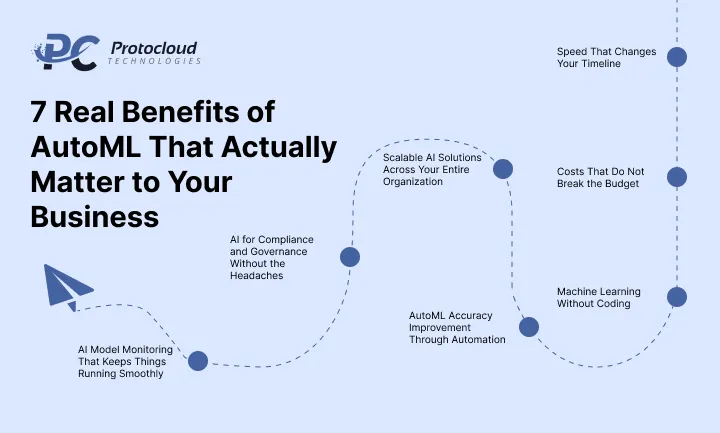
Let us get specific, because vague promises do not help you make decisions. Here are the AutoML benefits that directly impact how your business runs and grows.
Speed That Changes Your Timeline
With traditional ML, you were looking at six months to a year before your model was ready. With AI automation platforms, you can deploy in weeks. Sometimes days. That means you capture opportunities faster, test ideas quicker, and start seeing ROI almost immediately. In a market that moves fast, speed is not a luxury. It is survival.
Costs That Do Not Break the Budget
AI cost reduction is one of the biggest reasons businesses are switching to AutoML. You do not need to hire a full data science team for every project. You do not need expensive on-premise infrastructure. Cloud-based machine learning tools let you pay for what you use. Your existing analysts can do more. Your budget goes further. And your finance team stops having panic attacks every time someone mentions AI.
Machine Learning Without Coding
This is the one that people still cannot quite believe. No-code AI tools and low-code machine learning platforms mean that AI for business analysts is no longer science fiction. A person who has never written Python in their life can now build, test, and deploy a predictive model. The AI democratization happening right now is not just about access to technology. It is about giving the people who understand your business the tools actually to use it.
AutoML Accuracy Improvement Through Automation
AI hyperparameter tuning is one of the most tedious parts of model development. It means testing hundreds or thousands of variable combinations to find the combination that makes the model most accurate. Humans doing this manually get tired, make mistakes, and miss combinations. AutoML does not. It systematically tests everything and finds configurations that a human team would take weeks to discover. The result is consistently better models.
Scalable AI Solutions Across Your Entire Organization
Once you build one model, the process becomes repeatable. Scalable AI solutions mean you can standardize workflows, apply the same approach across departments, and grow your AI capabilities without growing your headcount at the same rate. That is a serious competitive advantage as your business scales.
AI for Compliance and Governance Without the Headaches
Modern AutoML platforms come with built-in explainability features. That means you can actually understand why your model made a decision. In regulated industries like healthcare, finance, and insurance, this is not optional. Explainable AI builds trust with stakeholders and satisfies compliance teams. And AI risk management tools built into these platforms mean you catch problems before they become regulatory issues.
AI Model Monitoring That Keeps Things Running Smoothly
Models drift over time. The world changes, your data changes, and a model that was accurate six months ago might be misleading today. AI model monitoring built into AutoML platforms automatically detects this drift and triggers retraining when needed. This is what AI lifecycle automation looks like in practice. No manual check-ins. No scrambling when a model goes wrong. Just consistent, reliable performance.
AutoML Use Cases Across Industries: Where Real Results Are Happening
Numbers and theory are one thing. But what you really want to know is whether this works in the real world. Here are some industry examples that show exactly how AutoML use cases are playing out today.
AI in Healthcare: Diagnosing Faster and Smarter
The University of Rochester Medical Center deployed AutoML to power AI-driven ultrasound imaging. The results were not marginal. Ultrasound charge capture increased by 116%, and scanning sessions grew by 74%. AI in healthcare is not about replacing doctors. It is about giving them better tools to work faster and more accurately. When AI handles the pattern recognition, clinicians can focus on patients.
AI for Fraud Detection in Financial Services
Capital One used AutoML to automate credit risk modeling and fraud detection. AI in finance enables faster experimentation, better fraud pattern recognition, and quicker adaptation to new threats. AI for fraud detection, powered by automated machine learning, is already protecting millions of customers and reducing losses that were once written off as unavoidable costs of doing business.
AI in Retail and Supply Chain Optimization
Walmart uses AutoML for inventory management and AI for demand forecasting. For a company operating at Walmart’s scale, even small improvements in forecast accuracy translate to hundreds of millions of dollars saved in waste and lost sales. AI in retail and AI in supply chain optimization are quickly becoming table stakes for any organization that moves physical goods. And ecommerce AI solutions built on AutoML are making the same capabilities available to businesses that are nowhere near Walmart’s size.
Choosing the Right AutoML Platform for Your Business
Not all AutoML platforms are built the same. Each has its strengths, and the right one for your business depends on your existing infrastructure, your team’s skills, and your specific goals. Here is a straight look at the major players.
Google Cloud AutoML is an excellent choice if your organization already lives in the Google ecosystem. It integrates naturally with other Google services and handles natural language and image processing particularly well. If you are already using Google Workspace and BigQuery, this one makes a lot of sense.
Amazon SageMaker Autopilot shines when you need enterprise-level scalability, and you are already running workloads on AWS. Its model explainability features are strong, helping bridge the gap between your data science team and business stakeholders who need to trust and act on AI recommendations.
Microsoft Azure AutoML is a standout for organizations with mixed technical teams. The integration with Power BI and Office 365 means your analysts can surface model outputs in tools they already use every day. If collaborative, cross-functional AI initiatives are a priority, Azure is worth a serious look.
IBM Watson AutoAI is built for organizations where compliance, bias detection, and responsible AI practices are non-negotiable. Its fairness monitoring is some of the best in the industry. The price point puts it more firmly in the large enterprise category, but if regulatory rigor is your main concern, it delivers.
Challenges You Will Actually Face During AutoML Adoption
AI adoption challenges are real, and nobody does you any favors by pretending they are not. Here is what to expect and how to handle it honestly.
AI data quality solutions are the starting point for almost every AutoML implementation. If your data is a mess, your model will reflect that. Garbage in, garbage out is not just a cliché in this field. Investing in AI data preprocessing before you start building models will save you enormous amounts of time and frustration down the line.
Legacy system compatibility is another real friction point. Your new AutoML tools need to talk to your existing databases, CRM systems, and data warehouses. AI integration solutions and well-designed APIs can handle most of this, but you need to plan for it upfront rather than treating it as an afterthought.
Team resistance is often the most underestimated challenge. When you introduce AutoML, some people will worry about their jobs. Others will be skeptical that it actually works. Honest communication, clear demonstrations of value, and involving domain experts in the process rather than imposing it on them go a long way toward building genuine organizational buy-in.
AI Implementation Strategies: How to Start Without Getting Overwhelmed
The biggest mistake businesses make is trying to do everything at once. AI implementation strategies that actually work start small and build momentum. Pick one problem. A specific, measurable business problem that you know costs you time or money. Run a pilot with one of the cloud-based machine learning platforms. Measure the result. Then scale what works.
AI for customer behavior prediction is a common and highly effective starting point. You likely already have the data, the business case is clear, and the results are measurable quickly. Once you have one win on the board, the conversation within your organization about AI-powered business growth becomes much easier.
AI for operations optimization is another high-ROI starting point for many businesses. Whether that is automating a scheduling process, predicting equipment failures before they happen, or optimizing logistics routes, these are problems where automated machine learning delivers visible, measurable results fast. And visible results build the organizational confidence you need to keep going.
The Bottom Line: AutoML Is Not the Future Anymore
Here is the thing. Automated machine learning is not something on the horizon. It is here, it is working, and organizations across every industry are using it to solve real problems and grow their businesses. 71% of large enterprises are already running automated ML. The question is not whether AutoML for enterprises is worth exploring. It is whether you can afford to be part of the 29% that is still waiting.
The barriers that once kept machine learning out of reach for most businesses are gone. The tools are accessible. The costs are manageable. The talent gap is bridgeable. What you need now is not more information. You need a first step. Pick a problem, pick a platform, and start. The AI-driven decision-making happening inside your competitors right now started the same way.