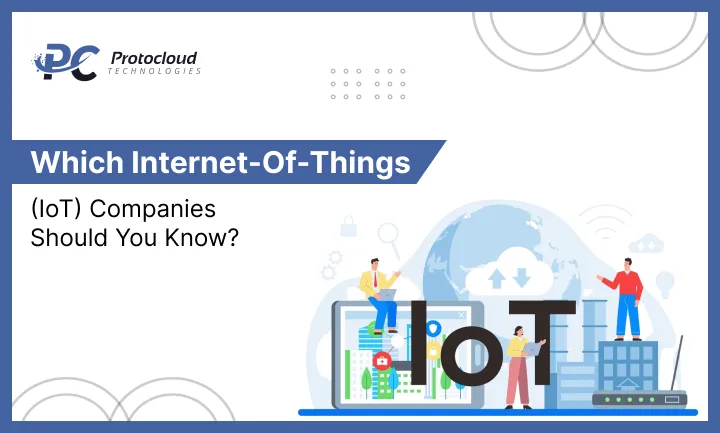
IoT devices have been around for a while, but recent advancements have made them more popular and widely used than ever. Today, you’ll find them everywhere—from smart homes and connected cars to healthcare and manufacturing. And with the growth of edge computing, their impact is only increasing, as devices can now process data locally, making operations faster, safer, and more efficient.
The world is getting smarter every single day. We aren’t just talking about phones and laptops anymore. Today, our cars, refrigerators, and even factory machines are talking to each other. This giant web of connected things is what we call the Internet of Things. If you are looking for an IoT companies list, you’ve probably realised that this industry is moving fast. Every major tech giant is racing to provide the best Internet of Things services to help businesses grow.
Choosing the right partner from the many top IoT companies in the world can feel like a big task. Some focus on the hardware, like the chips inside a device, while others focus on IoT cloud services that store and analyse all that data. Whether you are a small business owner or a tech enthusiast, understanding who the main IoT platform providers are will help you see where the future is headed. In this guide, we will break down the biggest names in the game and what makes them special.
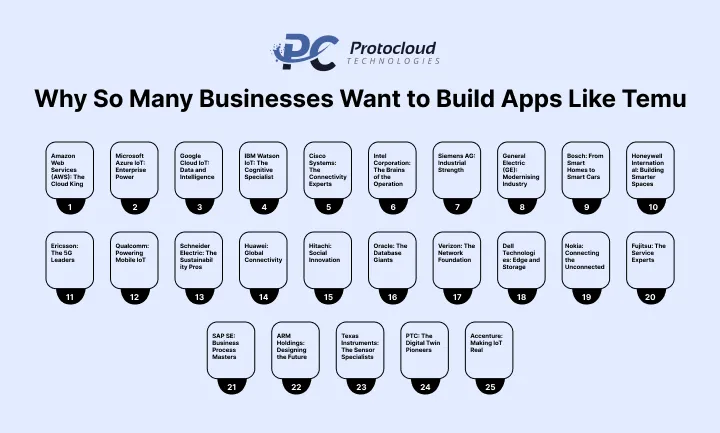
1. Amazon Web Services (AWS): The Cloud King
AWS is a major name in cloud IoT platforms. Since starting in 2006, they have built a system that is incredibly easy to scale. If you start with ten devices and grow to ten million, AWS can handle it. Their best IoT platform tools enable deep integration with IoT machine learning, so your devices don’t just collect data—they learn from it.
- Secure and scalable IoT platform: Keeps your data safe as you grow.
- Device management: Easily keep track of every sensor in your network.
- Data ingestion and analytics: Moves data quickly from the device to the cloud.
2.Microsoft Azure IoT: Enterprise Power
Microsoft isn’t just about Windows. Their Azure platform is one of the top enterprise IoT solutions on the market. They focus heavily on IoT security solutions, ensuring that big companies can connect their hardware without fear of leaks. They are also leaders in IoT edge computing solutions, which enable devices to process data locally rather than sending everything to a remote server.
- Real-time data ingestion: See what’s happening the second it occurs.
- Edge computing: Faster processing for local devices.
- Azure AI integration: Smart tools that predict when a machine might break.
3. Google Cloud IoT: Data and Intelligence
Google is the master of data, so it makes sense that they are a top choice for IoT data analytics. Their IoT technology company’s branch offers tools that make it easy to connect devices and then use Google’s famous AI to analyse the data. They provide some of the most scalable IoT platforms for developers who want to build apps that think.
- Device registry: A simple way to manage thousands of “things.”
- AI and ML services: Use the same smarts that power Google Search for your IoT.
- Global scale: High-speed connections, no matter where your devices are located.
4. IBM Watson IoT: The Cognitive Specialist
IBM has been around for over a century, and they bring that experience to its industrial IoT companies’ work. Their Watson AI is famous for being able to “reason.” In the IoT world, this means IBM helps with IoT predictive maintenance solutions. They can tell a factory owner that a part is going to fail before it actually does, saving millions of dollars.
- Predictive maintenance: Fixing things before they break.
- Blockchain integration: Adding an extra layer of trust to data.
- Cognitive analytics: Understanding “why” things are happening, not just “what.”
5. Cisco Systems: The Connectivity Experts
Cisco is the backbone of the internet, so they are naturally among the best providers of IoT connectivity solutions. They focus on the “plumbing”—the routers and switches that keep everything talking. For businesses that need IoT network solutions, Cisco provides the hardware that ensures a constant, secure connection.
6. Intel Corporation: The Brains of the Operation
Every smart device needs a brain, and Intel makes the best ones. As one of the premier IoT hardware providers, Intel designs the chips that power everything from smart streetlights to industrial robots. They are a core part of the IoT ecosystem companies because, without their processors, the “things” wouldn’t be very smart.
7. Siemens AG: Industrial Strength
When it comes to IoT solutions for manufacturing, Siemens is a giant. They focus on “MindSphere,” which is an industrial-grade system. They help factories become “Smart Factories” by leveraging IoT automation solutions to accelerate production and reduce waste.
- Industrial-grade connectivity: Built for tough environments like mines or plants.
- Real-time monitoring: Watching every gear turn from a remote dashboard.
- Energy management: Helping big plants use less power.
8. General Electric (GE): Modernising Industry
GE was one of the first to talk about the “Industrial Internet.” They provide IoT solutions for energy management and aviation. Their focus is on high-stakes machinery such as jet engines and power turbines. By using IoT solution providers such as GE, airlines can track fuel use in real time.
9. Bosch: From Smart Homes to Smart Cars
Bosch is everywhere. You might know them for dishwashers, but they are a top IoT development company in the auto industry. They provide IoT solutions for smart homes and connected cars. If your car can steer itself or park automatically, there’s a good chance Bosch tech is inside.
10. Honeywell International: Building Smarter Spaces
Honeywell is a leader in IoT solutions for building automation. They make the sensors that control heat, cooling, and security. Their IoT services provider team helps office buildings become more efficient and safer for the people inside.
11. Ericsson: The 5G Leaders
Ericsson is all about the “G.” With the rollout of 5G, they have become one of the most important IoT infrastructure providers. 5G is the secret sauce that makes smart IoT platforms work because it is much faster than 4G. Ericsson provides the towers and technology that enable millions of devices to stay connected simultaneously.
- Connectivity management: Handling the signals for millions of sensors.
- 5G integration: Making sure data moves at lightning speed.
- Managed services: Taking care of the network so the business doesn’t have to.
12. Qualcomm: Powering Mobile IoT
Qualcomm makes the modems and chips that allow your devices to connect to cellular networks. They are a key member of IoT innovation companies because they continually find ways to make chips smaller and more power-efficient. This is great for IoT smart devices development, where battery life is everything.
13. Schneider Electric: The Sustainability Pros
Schneider focuses on the planet. They use IoT solutions for smart cities and buildings to reduce energy consumption. Their IoT integration services help companies pinpoint where they are wasting electricity, which benefits both the bottom line and the environment.
14. Huawei: Global Connectivity
Huawei is a massive player in IoT cloud computing services. They offer a wide range of IoT hardware and software solutions, especially in Asia and Europe. Their platforms are designed to be “all-in-one,” helping cities manage everything from traffic lights to water meters.
15. Hitachi: Social Innovation
Hitachi uses big data analytics from the IoT to solve social problems. They work on IoT solutions for transportation, making trains run more on time and helping cities plan better layouts. They are a great example of IoT digital transformation services that actually improve people’s daily lives.
16. Oracle: The Database Giants
Oracle is famous for storing data. Their IoT analytics platforms are built to handle massive amounts of information. For large companies, Oracle provides IoT platforms for enterprises that plug directly into their existing business software.
- Real-time data processing: Handling data the moment it’s created.
- Enterprise integration: Making sure your IoT data talks to your accounting and sales data.
- Machine learning: Finding patterns in billions of data points.
17. Verizon: The Network Foundation
Verizon isn’t just for cell phones; they are a major IoT connectivity platform provider. They provide the “pipe” through which data travels. They are also leaders in IoT deployment solutions, helping companies establish their first nationwide connected networks.
18. Dell Technologies: Edge and Storage
Dell provides the heavy-duty hardware needed to store IoT data. They focus on IoT device management platforms that enable IT teams to keep their hardware up to date and secure. Dell is a big name in IoT system integration, helping different types of hardware work together.
19. Nokia: Connecting the Unconnected
Nokia has moved from phones to infrastructure. They are a top IoT communication technologies company. They help factories and mines build their own private wireless networks so they don’t have to rely on public cell towers.
20. Fujitsu: The Service Experts
Fujitsu provides consulting services to IoT companies. They don’t just sell you a tool; they help you figure out how to use it. They are experts in IoT lifecycle management, helping a project go from a simple idea to a fully working system.
21. SAP SE: Business Process Masters
SAP helps companies run their business. Their IoT software platforms connect the physical world to the digital boardroom. When a shipping container moves, SAP’s IoT big-data analytics automatically updates inventory levels.
22. ARM Holdings: Designing the Future
ARM doesn’t usually build the chips; it designs them. Almost every smartphone and IoT device uses an ARM design. They are the ultimate partner for IoT technology companies because their designs use very little power.
23. Texas Instruments: The Sensor Specialists
Texas Instruments (TI) makes the tiny parts that feel the world. Their sensors detect heat, light, and motion. As one of the top IoT hardware providers, they give engineers the tools to build the next generation of smart gadgets.
24. PTC: The Digital Twin Pioneers
PTC is famous for “Digital Twins.” This is a digital version of a physical machine. By using their IoT platforms for industry, a company can test a machine in a computer simulation before ever building it in the real world.
25. Accenture: Making IoT Real
Accenture is the top name in IoT managed services. They are a consulting firm that helps the world’s biggest companies start their IoT innovation solutions. If a company wants to change how it works through technology, it calls Accenture for its expertise in IoT consulting.
- Strategy and implementation: Planning the project from start to finish.
- Digital transformation: Helping old companies learn new tech tricks.
- Ongoing support: Making sure the system keeps running year after year.
How to Choose the Right IoT Partner
Looking at this list of IoT companies can be overwhelming. The best way to choose is to look at your specific needs. Are you building a smart home product? Look at Bosch or Amazon. Are you running a giant factory? Siemens or IBM might be better.
Most successful projects use a mix of these companies. You might use Intel chips, a Cisco network, and AWS cloud storage. The IoT ecosystem companies are designed to work together to make our lives easier and our businesses more efficient. As Internet of Things companies continue to innovate, we can expect even more amazing tools that help us save time, save money, and stay safe.
Frequently Asked Questions
What is the Internet of Things (IoT)?
The Internet of Things (IoT) is a network of everyday devices connected to the internet that can communicate and share data with each other. This includes smart home gadgets like thermostats and security cameras, connected vehicles, fitness trackers, and industrial sensors. These devices help make daily tasks simpler, safer, and more efficient.
What products and services do IoT companies offer?
IoT companies provide a wide range of solutions such as industrial sensors, connectivity management systems, automation software, fleet and asset tracking, smart home devices, security systems, predictive maintenance tools, mesh networks, and cloud-based monitoring platforms.
How does IoT improve industrial operations?
IoT enhances industrial performance through predictive maintenance. By using sensors to gather real-time data and AI to analyze it, businesses can identify potential equipment failures before they happen—reducing downtime, saving costs, and improving overall efficiency.