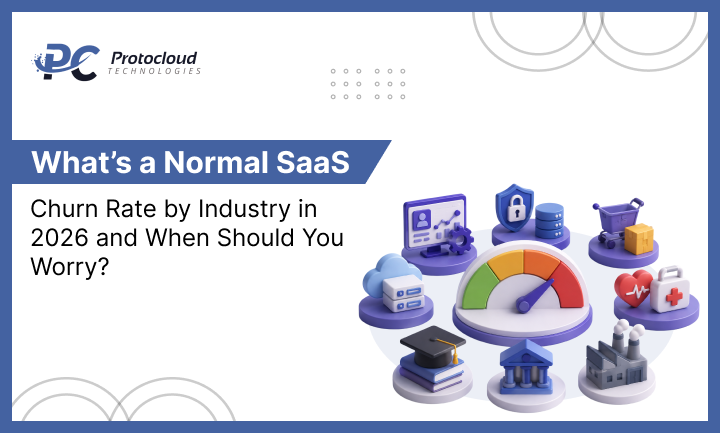
Is 5% Churn Bad?
“Is 5% churn bad?” I get asked this constantly. And the answer is always the same:
It depends.
A 5% monthly SaaS churn rate can seriously damage your growth. But a 5% annual churn rate means you are actually doing better than many SaaS companies.
Here’s the problem:
Most people talk about SaaS churn benchmarks without adding context.
You hear things like:
“Good SaaS churn is under 5%.”
But 5% of what?
Monthly?
Yearly?
B2B SaaS churn rate?
Enterprise SaaS churn?
SMB SaaS churn?
Those details matter a lot.
This guide breaks down real churn rate in SaaS benchmarks with proper context. You will learn where your business stands and whether your churn rate is actually a problem.
Here’s the quick answer if you are in a hurry:
- B2B SaaS average: 3.5%–5% annual churn is solid
- SMB-focused products: 5%–7% annual churn is realistic
- Enterprise SaaS: Under 3% annual churn is achievable
- Monthly churn: Anything above 2%–3% monthly is usually a warning sign
Let’s dive in.
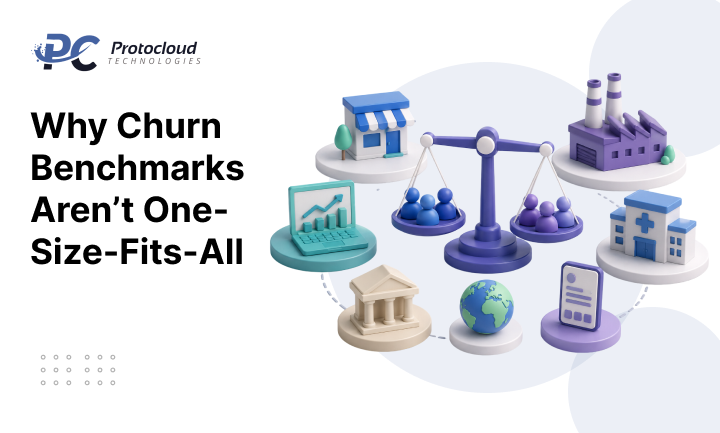
Why Churn Benchmarks Aren’t One-Size-Fits-All
Before comparing your numbers with industry averages, you need to understand one thing:
There’s no one-size-fits-all churn rate in SaaS. What counts as an acceptable churn rate SaaS metric depends on your business model.
A small startup usually has higher SaaS customer churn than a mature enterprise company.
Why?
Because startups are still figuring things out. They are testing features. They are improving onboarding. They are still finding product-market fit.
Meanwhile, established SaaS companies often have:
- Long-term contracts
- Strong customer trust
- Advanced features
- Higher switching costs
That naturally lowers churn. This is why comparing your startup’s churn with a giant enterprise platform makes no sense. The real goal is not perfection. The main goal is to keep improving your SaaS customer retention over time.
What Actually Affects Your Churn Rate
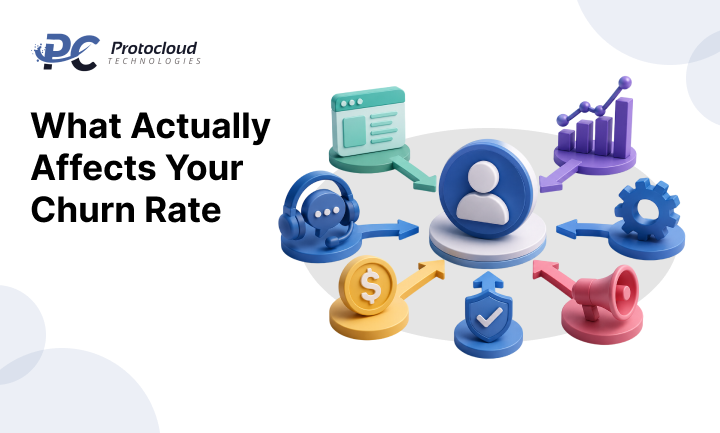
Many founders panic when they see higher churn numbers. But before you worry, look at what is actually causing it. In most cases, several factors influence customer churn analysis.
01. Pricing Model Matters
Monthly subscriptions churn much faster than annual plans. In fact, monthly billing often churns 2–3 times more. Why? Because customers can cancel anytime. Annual plans create commitment.
That is why many SaaS businesses offer yearly discounts. It improves SaaS revenue retention and creates more stable recurring revenue metrics.
If your business only offers monthly billing, do not compare yourself with companies heavily using annual contracts.
That is not a fair comparison.
02. Customer Segment Matters
Who you sell to changes everything. Selling to startups? Expect higher churn. Many startups fail or close down within the first few years. That is often not your product’s fault.
Selling to enterprises? Then expectations become very different. Enterprise customers expect:
- White-glove onboarding
- Dedicated support
- Reliability
- Security
- Custom workflows
That is why enterprise SaaS churn behaves differently from SMB SaaS churn.
03. Product Maturity Matters
Early-stage products usually experience higher churn. That is normal. You are still improving your product. You are still learning what users truly need.
You may still be missing features competitors already have.
This happens to almost every growing SaaS company. Do not compare your early-stage product with mature SaaS company benchmarks.
04. Acquisition Channel Matters
Where your customers come from also affects churn. Customers from:
- Content marketing
- SEO
- Referrals
Usually stay longer. But users from paid ads sometimes churn faster. Why?
Because some paid traffic brings low-intent users. So if your SaaS subscription churn increases after scaling paid campaigns, the issue may actually be customer acquisition and churn alignment.
Sometimes the real problem is not churn. Sometimes you are simply attracting the wrong customers. Fixing acquisition quality often improves customer retention SaaS performance automatically.
A Good Churn Rate Is Always a Moving Target
Here’s the truth: A “good” churn rate is not fixed forever. It changes based on:
- Business stage
- Customer type
- Pricing structure
- Industry
- Product maturity
Instead of obsessing over random internet benchmarks, focus on one thing:
Consistent improvement. If your churn trends improve quarter after quarter, you are moving in the right direction. That matters more than comparing yourself with giant SaaS brands.
At-a-Glance SaaS Churn Benchmarks for 2026
Here are some general SaaS churn benchmarks for 2026.
| Company Profile | Acceptable Monthly Churn Rate | Acceptable Annual Churn Rate |
| Early-Stage SaaS | 5% – 7% | 46% – 61% |
| SMB-Focused SaaS | 3% – 5% | 31% – 50% |
| Mid-Market SaaS | 2% – 3% | 22% – 31% |
| Enterprise SaaS | 1% – 2% | 11% – 22% |
These numbers are not strict rules. They are general benchmarks. Your real goal should always be improving your own SaaS retention benchmarks over time.
Gross vs. Net Churn: Understanding Revenue Loss and Revenue Growth
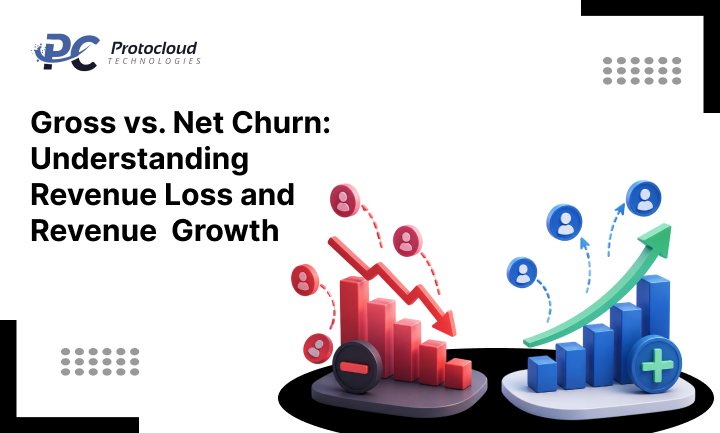
Not all SaaS revenue churn is the same. This is where many businesses get confused. There are two important metrics:
- Gross churn
- Net churn
Both matter. But both measure different things. Let’s make it simple.
Think of your recurring revenue like water inside a bucket. Gross churn measures the leaks. Net churn measures the leaks plus the new water being added back.
Gross Churn: The Truth About Revenue Loss
Gross churn measures the revenue lost from cancellations and downgrades. It gives the clearest view of how much business you are losing. This metric only focuses on losses.
It does not include upgrades or expansion revenue. That makes gross revenue churn a strong indicator of customer satisfaction problems.
A high gross churn rate may signal:
- Weak onboarding
- Poor customer experience
- Low product engagement
- Weak product-market fit
Here is a simple churn calculation SaaS example: Suppose your company starts the month with $100,000 in Monthly Recurring Revenue. If customers cancel and you lose $5,000 in revenue, your SaaS MRR churn becomes 5%.This metric helps you identify customer retention problems early.
Net Churn: The Bigger Revenue Picture
Now let’s talk about net churn SaaS metrics. Net churn includes expansion revenue from existing customers. This includes:
- Upgrades
- Add-ons
- Cross-sells
For example:
A customer upgrades from a basic plan to a premium plan. Another customer buys more seats. Another adds extra features. That new revenue offsets churn losses. This is where negative net churn becomes possible.
Negative net churn happens when expansion revenue becomes larger than lost revenue. That means your existing customers are spending more money over time. Even if some customers leave, your revenue still grows.
This is one of the strongest signs of healthy SaaS growth metrics.
Why SaaS Churn Benchmarks by Company Size Matter
Broad churn averages can be misleading. Two companies may both have a 5% churn rate. But the meaning behind that number could be completely different. Think about it this way:
A speedboat and a cargo ship both float. But you would never compare their fuel usage. The same idea applies to SaaS churn rate benchmarks.
An early-stage startup still finding product-market fit naturally experiences more churn. Meanwhile, enterprise SaaS businesses often have:
- Long-term contracts
- Deep software integrations
- Dedicated onboarding teams
- High switching costs
This creates stronger customer retention and SaaS performance. That is why SaaS churn by ARR matters so much.
01. Benchmarks for Startups and SMB-Focused SaaS
If your business serves startups or SMBs, expect higher churn. That is how the market works.
Smaller businesses often have:
- Tighter budgets
- Faster decision-making
- Higher failure rates
- More price sensitivity
As a result, SMB customer churn usually stays higher.
02. Early-Stage Startup SaaS Churn Rate
Companies under $1M ARR often see monthly logo churn between 5% and 7%. This sounds scary. But during the early stage, your main focus is learning. You are testing positioning. You are refining onboarding. You are improving your product.
Losing customers during this stage is common. It helps you identify gaps in your SaaS customer lifecycle.
03. SMB SaaS Churn Benchmarks
Once your SaaS business grows beyond the earliest stage, churn usually improves. For SMB-focused SaaS companies under $10M ARR, a healthy monthly churn rate SaaS benchmark falls between 3% and 5%.
This becomes a volume game. The goal is making customer acquisition and churn work together profitably. If your acquisition engine grows faster than your churn, your business still scales.
04. Mid-Market and Enterprise SaaS Churn Benchmarks
Everything changes when companies move upmarket. Mid-market and enterprise clients behave differently. These customers invest heavily in setup, training, and integrations.
That creates strong “stickiness.” In simple terms:
Leaving your software becomes painful. That naturally lowers enterprise customer retention risks.
05. Mid-Market SaaS Churn
For companies earning between $10M and $50M ARR, median monthly logo churn often falls between 1.5% and 2.5%. Annual gross revenue churn usually lands around 10%–15%.
At this stage, customer relationships become more stable. Customers rely deeply on your platform.
06. Enterprise SaaS Churn Benchmarks
Enterprise SaaS companies often experience less than 1% monthly churn.
Annual churn typically stays under 10%. Why?
Because enterprise customers face huge switching costs. They train teams. They build workflows. They integrate software into multiple systems.
Replacing all of that takes time and money.
This is why enterprise SaaS churn benchmarks look dramatically lower than startup numbers.
2026 SaaS Churn Rate Benchmarks by Company Size
Here’s a quick breakdown of SaaS churn benchmarks 2026 by ARR and target market.
| Company ARR | Target Market | Median Monthly Logo Churn | Median Annual Gross Revenue Churn |
| Under $1M | Startups / SMB | 5% – 7% | 20% – 24% |
| $1M – $10M | SMB / Mid-Market | 2.5% – 5% | 15% – 20% |
| $10M – $50M | Mid-Market | 1.5% – 2.5% | 10% – 15% |
| $50M+ | Enterprise | Under 1% | Under 10% |
These numbers are guideposts. Not strict rules. The most important thing is improving your own SaaS retention analysis over time.
Gross Churn vs Net Churn
Many founders only track one churn number. That is a mistake. You need to understand both:
- Gross churn
- Net churn SaaS metrics
Gross churn measures lost revenue from cancellations or downgrades. Net churn includes expansion revenue. That includes:
- SaaS upgrade revenue
- Add-ons
- Cross-sells
- Seat expansions
This is where negative net churn becomes powerful. If expansion revenue exceeds lost revenue, your business still grows even when customers leave. Strong SaaS expansion revenue can completely change the health of your company.
How to Measure Your Churn Rate Accurately
Now let’s talk about measurement. Because bad data creates bad decisions.
Many SaaS businesses make one big mistake: They rely on one blended churn number. But there’s a catch. That number often hides serious problems.
Your Secret Weapon: Cohort Analysis SaaS
Cohort analysis SaaS tracking gives much deeper insights. Instead of analyzing all customers together, you group them by signup date.
For example:
- January customers
- February customers
- March customers
This helps identify hidden churn patterns. Maybe your February cohort churned faster. That could point to:
- A bad onboarding update
- A buggy feature release
- Poor acquisition quality
- Pricing confusion
This is why SaaS cohort analysis is one of the most important SaaS analytics tools available.
Red Flags You Should Never Ignore
Not all churn is equal. Some churn problems are much more dangerous. Here are major warning signs.
High-Value Customer Churn
Losing enterprise customers hurts badly. One lost enterprise account may equal dozens of SMB customers. Track high-value customer churn carefully.
New Customer Churn
If users leave within 30–90 days, your onboarding probably has problems. This often signals SaaS onboarding churn issues.
Power User Churn
Power users deeply understand your product. If they leave, your core value proposition may be weakening. This is a serious SaaS performance metrics warning sign.
Sudden Cohort Spikes
If one customer group churns much faster, investigate immediately. There is usually a specific reason behind the spike.
How Often Should You Calculate Churn?
For most SaaS businesses, monthly tracking works best. Monthly SaaS churn tracking helps you:
- Spot issues early
- Monitor trends
- Improve SaaS retention strategies faster
Annual reporting helps leadership. But operational teams need monthly data.
Can a Churn Rate Be Too Low?
Surprisingly, yes. Very low churn can sometimes mean your pricing is too cheap. Or maybe your business is avoiding new markets and taking fewer risks.
Sometimes slight churn is healthy during aggressive SaaS growth strategy phases.
What Should You Do if Churn Is High?
Do not panic. Start diagnosing the problem.
Separate Voluntary vs Involuntary Churn
Some users choose to leave. Others fail payments accidentally. Fixing failed payments can quickly reduce SaaS revenue leakage.
Analyze Churn by Cohort
Check if specific signup groups churn more. This helps identify onboarding or acquisition problems.
Talk to Churned Customers
This is one of the most valuable steps. Send surveys. Schedule calls.Ask direct questions. Honest feedback improves churn management SaaS efforts faster than guessing.
Final Thoughts
SaaS churn benchmarks by company size give much better insights than broad industry averages. A startup SaaS churn rate should not be compared with enterprise SaaS churn benchmarks.
Different business stages create different realities. The real goal is not achieving “perfect” churn. The real goal is continuous improvement.
Track your numbers carefully. Use SaaS analytics. Study customer behavior. Improve onboarding. Strengthen customer success.
And most importantly:
Keep learning why customers stay or leave. That is how strong SaaS businesses grow long-term.
FAQs
What is a good SaaS churn rate?
A good SaaS churn rate depends on company size and target market. Enterprise SaaS companies usually maintain lower churn than SMB-focused SaaS businesses.
What is cohort analysis in SaaS?
Cohort analysis groups customers based on signup periods. It helps businesses identify churn patterns more accurately.
What is negative net churn?
Negative net churn happens when expansion revenue becomes larger than lost revenue from cancellations.
How often should SaaS companies calculate churn?
Most SaaS businesses should track churn monthly to monitor customer health and retention trends effectively.
Why is enterprise SaaS churn lower?
Enterprise customers face higher switching costs because of contracts, integrations, training, and operational dependencies.