Introduction
Software as a Service (SaaS) is a model that delivers software applications via the cloud, hosted by a service provider, and accessible online through web browsers or mobile apps. Popular examples include Google Workspace, Microsoft 365, Salesforce, Zoom, Slack, Dropbox, and Shopify.
As businesses accelerate digital transformation and adopt cloud-first strategies, the SaaS business model has become the preferred choice for delivering scalable, on-demand software. With a rapidly expanding market, it’s clear why businesses are investing in SaaS application development to stay competitive.
Understanding Custom Software Development
Custom software development refers to building applications, platforms, or systems designed specifically around your business’s unique requirements. Unlike off-the-shelf SaaS solutions, every feature and workflow is built to match your processes and strategic goals.
Custom software solutions can range from simple internal automation tools to complex ERP software development or CRM development systems that connect multiple departments. The entire architecture is shaped around how your business actually works not how a generic platform assumes it does.
When Does SaaS Replacement Make Sense?
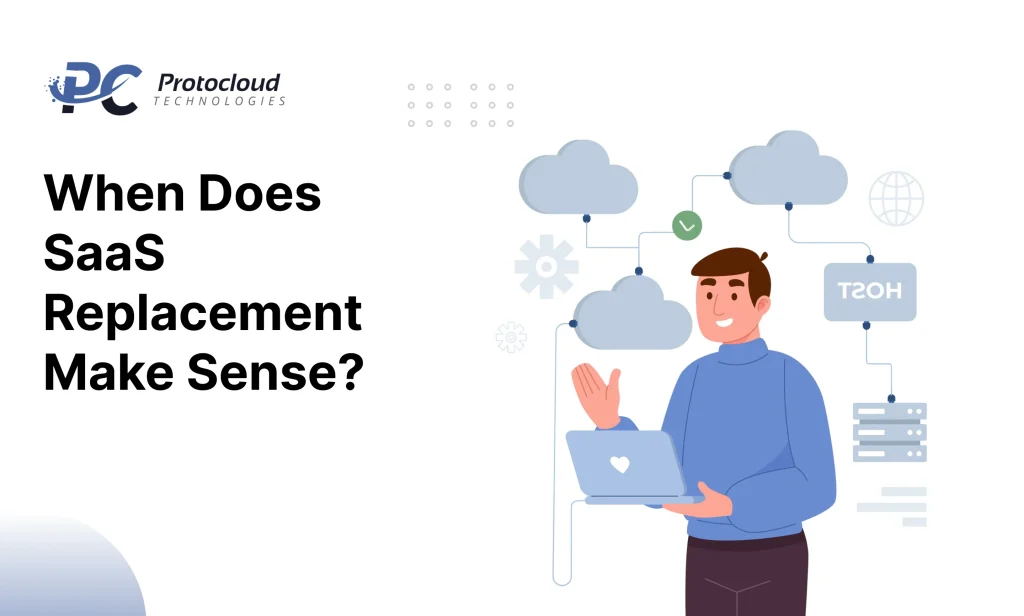
Understanding the right triggers helps organizations time their SaaS migration strategy smartly while maximizing operational and financial benefits.
Escalating Renewal Costs and Vendor Lock-In
Enterprise vendors implement 15–25% annual price increases through base adjustments and feature unbundling. SaaS hidden costs like API overages, compliance add-ons, and integration fees quietly stack up. Meanwhile, software vendor dependency limits your strategic agility when providers change direction or restructure pricing.
Workflow Mismatches and SaaS Customization Limitations
Standardized SaaS platforms can’t accommodate every business’s unique processes. Financial services need jurisdiction-specific workflows. Healthcare requires compliant patient management. Manufacturing coordinates global supply chains with regional demands. When teams build daily workarounds just to function, that’s a clear sign that workflow customization software built specifically for you is the smarter path.
AI Differentiation and Competitive Intelligence Needs
AI-powered SaaS runs on generic models trained across all customers limiting effectiveness and exposing proprietary data risks. Custom AI software development using your own organizational data delivers AI business solutions and copilots that reflect your actual institutional knowledge and priorities.
Total Cost of Ownership Tipping Points
Organizations typically reach custom software development breakeven within 24–36 months, while building owned intellectual property. A real TCO SaaS vs custom analysis must include integration maintenance, SaaS renewal cost increases, and the opportunity cost of working around platform limitations every single day.
How Much Does SaaS Replacement Really Cost? A Complete Investment Breakdown
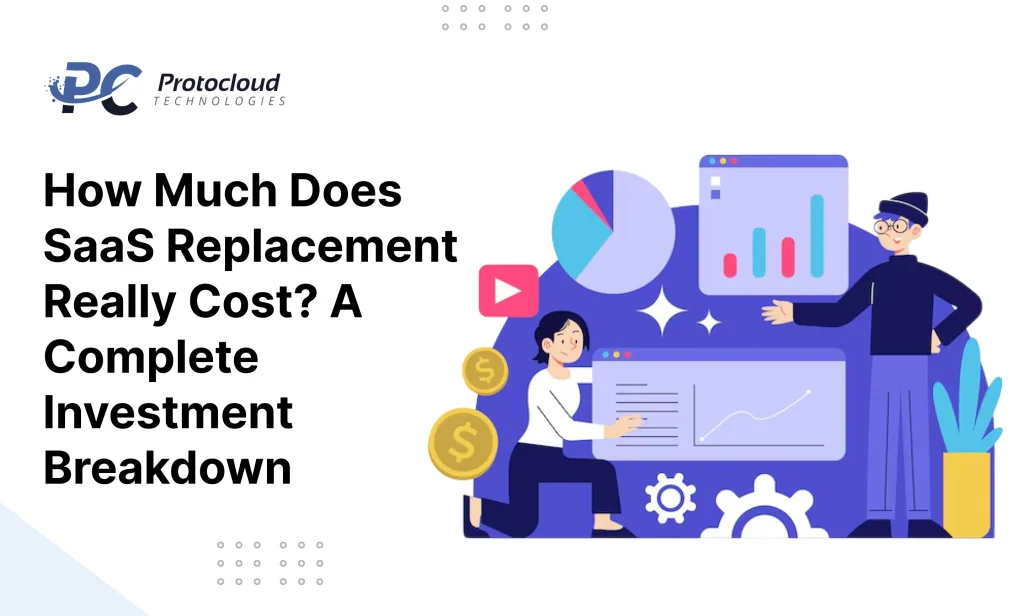
Let’s be honest. Most businesses know they are overpaying for SaaS tools. But when it comes time to replace them, nobody really knows what it costs. You search online, and you get vague estimates or sales pages that tell you nothing useful.
This guide changes that.
Whether you are a startup exploring a minimum viable product or an enterprise ready for a full SaaS transformation, this breakdown gives you real numbers, real timelines, and real clarity. No fluff. Just straight answers.
What Actually Drives SaaS Replacement Cost?
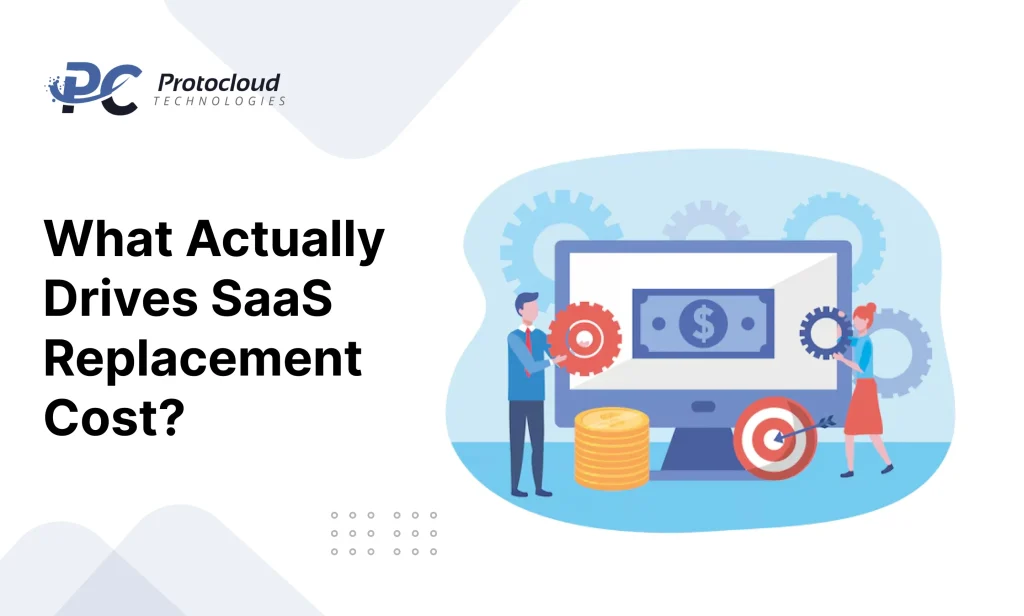
Before jumping into tiers, you need to understand what makes the price go up or down. The SaaS replacement cost is never just about writing code. It is about how complicated your business really is underneath the surface.
Workflow complexity is the biggest driver. It accounts for 30 to 40 percent of your total development effort. A simple approval process is easy to rebuild. But multi-department workflows with conditional logic, parallel approvals, and exception handling? That takes serious time and expertise.
After that, integration depth is the second major factor. If you need ERP integration services, CRM integration services, or legacy system connectivity, expect 20 to 30 percent added to your base cost. Real-time data synchronization between systems like Salesforce and SAP is not a small job.
Then comes data migration. Years of historical records, GDPR compliance software requirements, HIPAA compliant software standards all of these extend timelines and add complexity that most teams underestimate.
Finally, AI. If you want AI workflow automation, LLM integration, or RAG architecture built into your platform, that adds 25 to 40 percent to the total. But it also delivers the biggest long-term value.
Tier 1: MVP SaaS Replacement – Build Fast, Validate Early
Timeline: 3–6 Months
This is the smartest starting point for most companies. A SaaS MVP replacement is not about rebuilding everything. It is about solving your biggest pain point as fast as possible.
Think of replacing a Workday approval module with a custom HR tool. Or replacing SharePoint with a cleaner document management system. These are targeted, focused builds that get your team off a tool that is not working, without massive risk or budget commitment.
MVP software development at this level supports 50 to 500 users. The technical architecture is intentionally simple proven frameworks, cloud deployment, secure authentication, and basic integrations. The custom software development cost here is the most accessible entry point, and most organizations reach cost parity with their old SaaS subscription within 12 to 18 months.
What Makes an MVP the Right Choice?
- You have outgrown one specific SaaS feature, not the whole platform
- Your workflows are relatively straightforward
- You want to test ownership before committing to a bigger transformation
- Your timeline and budget are tight
Scalable MVP software means you are not throwing away what you build. A well-architected MVP becomes the foundation for your next phase.
Tier 2: Core Platform Replacement – Go Beyond Feature Parity
Timeline: 6–12 Months
This is where the real transformation begins. Core platform replacement means you are replacing an entire SaaS system, not just one module. A common example is replacing ServiceNow with a custom IT service management platform that includes advanced business workflow automation, AI-powered routing, and deep enterprise system integration.
The enterprise software development cost at this tier reflects the added complexity. You move from standard frameworks to microservices architecture, message queues, and custom AI applications built on your own organizational data.
API integration solutions, Salesforce integration, and SAP integration services are the most common requirements here. Each integration adds one to two months of testing alone. Budget for it from day one.
Companies completing Tier 2 replacements report 40 to 60 percent efficiency improvements. That number is not marketing. It comes from removing workarounds, automating repetitive approvals, and having a system that actually fits the way your team works.
Tier 3: Enterprise SaaS Replacement – Take Full Control of Your Technology Ecosystem
Timeline: 12–18+ Months
This is not a software project. This is a strategic business decision. Enterprise digital transformation at this level means replacing multiple SaaS platforms with one integrated, internally owned system built entirely around your organization.
A strong example is replacing Datadog with a custom AIOps platform. One that handles infrastructure monitoring, log analysis, intelligent alerting, and includes an AI copilot for business, trained on your own incident history. No vendor can give you that. You have to build it.
The SaaS total cost of ownership comparison becomes very powerful here. Seven-figure annual license fees stop. You start building intellectual property that your company owns permanently.
Enterprise platform development at this tier requires distributed systems design, cloud security architecture, role-based access control, audit logging systems, and advanced MLOps solutions. The enterprise software security standards must match or exceed whatever SaaS you are replacing.
The Right SaaS Replacement Strategy Starts With One Question
Which tier fits where you are today?
If one SaaS tool is slowing your team down, start with an MVP. If your workflows span multiple departments and your current platform cannot keep up, move to a core platform build. If your SaaS bill is growing faster than your business and you are ready to own your stack, enterprise transformation is the conversation to have.
The cloud software replacement path is different for every organization. But the cost of doing nothing renewing licenses, working around limitations, and watching competitors build what you are still renting keeps going up every single year.
SaaS to Custom Software Transition: A Phase-by-Phase Timeline That Actually Works
Most companies do not fail at building custom software. They fail at planning the transition.
Moving from SaaS to custom development touches your workflows, your team, your data, and your budget. When it is planned well, the results are outstanding. When it is rushed, it becomes an expensive mistake.
Here is exactly how a SaaS migration timeline works phase by phase.
Phase 1: Discovery Sprint – Build the Right Foundation First
Duration: 2–4 Weeks
This is the phase most teams want to skip. Do not skip it. The discovery phase in software development covers stakeholder interviews, workflow documentation, integration mapping, and a full TCO analysis comparing your current SaaS costs against custom development investment. Your SaaS transition strategy gets defined here what migrates first, which integrations are critical on day one, and where the real risks live.
A strong technical architecture design and business requirements analysis at this stage prevent expensive surprises later. If a development partner cannot give you a fixed-scope document, a timeline, and a clear cost estimate after discovery, that is a red flag.
What Discovery Should Deliver
- Full project scope with defined features and acceptance criteria
- Integration architecture design for ERP, CRM, and legacy systems
- Risk assessment with mitigation plan
- Total investment estimate with no hidden costs
Phase 2: MVP Build and Core Workflow Implementation
Duration: 2–4 Months
This is where your SaaS replacement implementation begins. The MVP phase is not about building everything. It is about building enough for real users to start working on the new system while development continues.
MVP software development focuses on core authentication, essential workflow automation development, data management, and must-have integrations. Agile MVP development keeps stakeholders involved at every sprint, so misalignments get caught early.
Pilot deployment with a small user group is critical. Real usage surfaces issues no test environment will catch and it builds internal advocates who are already confident in the new system before the wider rollout.
Phase 3: AI Integration and Intelligent Automation
Duration: 1–3 Months
This is where your platform pulls ahead of anything SaaS could offer. AI software implementation here means building on your data, your processes, and your team’s domain knowledge. RAG architecture implementation enables natural language search across internal knowledge. MLOps pipeline development keeps models improving through continuous feedback loops.
Intelligent automation systems handle decision routing, document processing, and exception flagging reducing manual work while improving accuracy. These capabilities belong entirely to you, not shared across a vendor’s entire customer base.
Phase 4: Production Monitoring and Ongoing Governance
Ongoing After Launch
Going live is not the finish line. Production monitoring software tracks performance, security events, and capacity in real time. Software governance framework covers compliance tracking, audit logging, and security patch management non-negotiable in regulated industries.
Phase 5: Scale Rollout and Optimization
Duration: 3–6 Months
Phased rollout strategy keeps disruption minimal. You move department by department, not all at once. User adoption strategy training, change management, clear communication makes the difference between reluctant compliance and genuine buy-in.
Timeline risk management is what separates successful migrations from stalled ones. Integration complexity, legacy system surprises, and slower-than-expected adoption are predictable risks. Plan for them with automated testing frameworks and honest stakeholder communication from day one.
How to Select the Right AI SaaS Solution for Your Business
Choosing the right AI SaaS partner is a strategic choice that can shape your business. There are so many platforms to choose from that finding the right one goes beyond just price and features. It is about making sure the solution fits your specific business goals, operational needs, and long-term plans.
Here are some important things to keep in mind when picking the right AI SaaS development company for your business:
- Identify your specific business needs
- Compare features and pricing
- Check user reviews and case studies
- Test with a free trial or demo
- Ensure the provider offers support and regular updates
- Ask about integration capabilities and training resources
- Evaluate the vendor’s roadmap and reputation
- Look for industry-specific solutions
Real-World AI SaaS Use Cases
Sales & Lead Generation
AI SaaS tools can identify high-quality leads, predict customer intent, and personalize outreach to boost conversions. They rate leads based on engagement levels and suggest sales scripts that match how buyers actually behave. AI sales forecasting and predictive lead scoring give your sales team a real edge every single day.
Marketing Automation
AI marketing automation helps marketers run smarter campaigns by segmenting audiences and generating content automatically. It handles AI A/B testing on its own picking the best-performing content in real time without anyone lifting a finger. AI audience segmentation and AI personalization tools take the guesswork out of every campaign.
Customer Support
AI chatbots and virtual assistants are available around the clock to answer questions, which speeds up response times and keeps customers happier. These conversational AI software tools understand natural language and route complex problems to human agents when needed. 24/7 customer support AI is no longer a luxury it is what customers expect.
Finance
AI financial forecasting tools handle billing, detect fraud, and deliver real-time risk analysis to help decision-makers catch problems before they escalate. AI fraud detection and AI billing automation reduce manual errors while cutting operational costs significantly.
HR
AI recruitment software and resume screening AI take the heavy lifting out of hiring. These tools also track employee engagement, identify skill gaps, and even predict which employees are at risk of leaving. Workforce planning AI helps HR teams build smarter, more resilient teams over time.
Healthcare
AI medical imaging, remote patient monitoring, and EHR AI integration improve both care quality and operational efficiency. AI diagnosis tools help clinicians catch diseases earlier by analyzing patient data patterns that humans might miss entirely.
Future of AI SaaS: What to Expect in the Next 5 Years
AI SaaS trends 2025 point toward interfaces that are easier to use, more personalized experiences, and smarter integrations across every business function. Most AI SaaS platforms will have generative AI SaaS capabilities built in letting users create content, write code, and surface insights instantly.
AI governance and ethics will also become a central focus. As adoption accelerates, businesses will demand responsible AI usage, clearer AI compliance tools, and stronger AI regulation frameworks to protect their data and customers.
Final Thoughts
AI SaaS is not just a tech trend. It is a fundamental shift in how software is built and used. It gives businesses the tools to make better decisions, work more efficiently, and serve customers at a higher level.
Whether you are a startup exploring your first AI SaaS solution or an enterprise scaling intelligent automation tools across departments, now is the time. The businesses investing in AI for digital transformation today are the ones that will lead tomorrow.