Introduction
Imagine asking a doctor a question, and instead of answering from memory alone, they quickly pull out the latest medical journal, read the most relevant paragraph, and then give you a response grounded in that real, current information.
That’s essentially what retrieval augmented generation does for AI. Once you understand it, your perspective on AI will completely change.
If you’ve ever gotten a wrong answer from an AI tool something that sounded confident but turned out to be completely made up then you already understand the problem that RAG in AI was built to fix. This guide breaks it all down in plain language: what it is, how it works, why it matters, and where it’s going.
What Is Retrieval Augmented Generation?
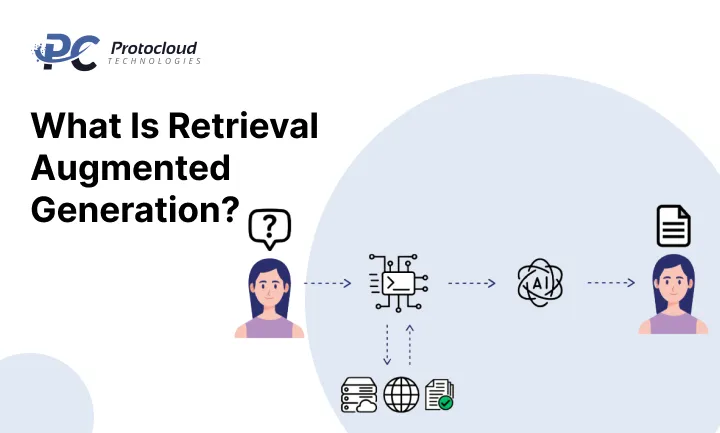
Retrieval Augmented Generation, or RAG, is a technique that combines two things: searching for relevant information from external sources, and then using that information to generate a smarter, more accurate AI response. Instead of relying only on what the model learned during training which could be months or years out of date the RAG model actively fetches fresh, relevant data before answering your question.
Think of it this way. A standard language model is like a student who studied hard before the exam but has no access to notes during it. A RAG model is like that same student, except they can look things up in real time. The result? Better answers, fewer mistakes, and far more reliability.
This is why RAG explained simply comes down to one idea: smarter AI that checks its sources before it speaks.
Why Does the AI Industry Need RAG?
The biggest problem with traditional generative AI is hallucination. That’s the technical term for when an AI confidently gives you wrong information like citing a research paper that doesn’t exist, or stating a law that was never passed.
AI hallucination reduction has become one of the top priorities across the industry. Companies building customer-facing AI tools, legal research platforms, and healthcare assistants cannot afford systems that make things up. A single wrong answer in a medical context can cost a life. A wrong legal citation can lose a case.
Retrieval Augmented Generation directly addresses this by grounding every response in actual, retrieved documents. Instead of guessing, it looks. And that one change looking before answering transforms what AI can do in the real world.
How RAG Works: A Step-by-Step Breakdown
Understanding how RAG works is easier than it sounds. The whole process flows in a logical sequence, and once you see it, it clicks immediately.
Step 1 – Building the Knowledge Library
Before any question gets answered, the system builds a library. Documents, PDFs, databases, APIs all of this external content gets broken into small chunks and processed through an embedding model in RAG. An embedding model converts text into numbers (called vectors) that capture the meaning of the content, not just the words themselves.
These vectors then get stored in a vector database in RAG, which is a special kind of database designed for finding similar meanings at speed. This is what makes semantic search AI possible searching by meaning, not just by keyword.
Step 2 – Processing the User’s Query
When a user types a question, the system doesn’t just pass it straight to the AI. It first converts that question into a vector using a query encoder the same type of mathematical process applied to the documents. Now you have a query vector and a library of document vectors, and the system can compare them.
Step 3 – Retrieving the Right Information
This is the retrieval part of Retrieval Augmented Generation. The AI query retrieval system scans the vector database and finds the chunks of content that are most similar in meaning to the query. This is an AI document search working in real time fast, precise, and semantic.
Step 4 – Augmenting the Prompt
Here’s where prompt augmentation comes in. The retrieved content is added to the user’s original question, creating a richer, context-heavy prompt for the language model. Now the AI doesn’t just see “What are the side effects of Drug X?” it sees that question alongside three paragraphs from a verified medical database that directly address it.
Step 5 – Generating the Final Answer
The LLM with RAG reads both the question and the retrieved context, and then generates a response. Because the AI is working with real, sourced information, the answer is grounded, accurate, and trustworthy. This is context-aware AI at its best.
The Core Components of RAG Architecture
The RAG architecture is built from several interconnected parts, each doing a specific job. Here’s what they are and why they matter. External Knowledge Source is the foundation. This is where all the information lives documents, databases, APIs, company wikis, research papers. Without a strong knowledge source, the entire system is only as good as the data feeding it.
Text Chunking and Preprocessing break large documents into smaller, manageable pieces. This matters because embedding models work better on focused chunks of text than on massive walls of content.
The embedding model is the translator. It converts raw text into vectors that machines can compare and search at scale. The quality of this model directly affects how well the system finds relevant information.
A vector database stores all those embeddings and makes fast similarity searches possible. Databases like Pinecone, Weaviate, and FAISS are commonly used in production systems.
The retriever is the engine that actually fetches the most relevant content based on the user’s query. And the prompt augmentation layer is what combines everything retrieved content plus user query before passing it to the language model.
Finally, the LLM is the generator. It reads everything and produces a fluent, human-readable response. The optional updater component keeps the knowledge base refreshed, ensuring the system always has access to the latest information.
The Real Benefits of Using RAG in AI
The advantages of AI with RAG go far beyond just reducing hallucinations. Let’s look at what makes this approach so compelling for businesses and developers alike. Improved accuracy is the most obvious benefit. When AI responses are grounded in retrieved facts, they’re simply more correct. This builds trust, reduces support escalations, and improves user experience across every touchpoint.
Real-time AI data retrieval means the system is never stuck in the past. Unlike a model that was trained in 2023 and hasn’t been updated since, a RAG-powered system can pull from data that was added yesterday. This is critical in fast-moving industries like finance, healthcare, and law. Cost-effective AI solutions are another major advantage. Retraining a large language model costs enormous amounts of money and compute. AI without retraining is possible with RAG because you just update the external data source. The model stays the same; only the knowledge library changes.
Scalable AI systems are easier to build with RAG because you can expand the knowledge base without rebuilding the core model. Whether you’re serving a startup or an enterprise, the architecture scales cleanly and perhaps most importantly, RAG enables enhanced transparency and trust. Because the system retrieves from real sources, it can cite those sources. Users can see where the information came from and verify it themselves.
Where RAG Is Being Used Right Now
RAG applications are showing up across nearly every major industry, and the use cases keep expanding. Here’s where the technology is making the biggest impact today.
Customer Support That Actually Helps
AI chatbot with RAG is transforming how companies handle customer queries. Instead of a bot that gives scripted, outdated responses, businesses now have AI for customer support that retrieves answers directly from the latest product documentation, help articles, and policy updates. The result is faster resolutions and happier customers without requiring a human agent for every question.
Legal Research at a New Level
Legal AI tools built on RAG help lawyers find relevant case precedents, statutes, and legal opinions in seconds rather than hours. AI in legal research doesn’t just save time it improves the quality of case preparation. Attorneys can focus on strategy while the AI handles the groundwork of document search and summarization.
Healthcare Decisions Backed by Evidence
AI in healthcare with RAG retrieves the latest clinical guidelines, drug interaction data, and treatment protocols before generating a recommendation. Doctors aren’t relying on what the model learned during training they’re getting answers backed by current medical literature. In a field where guidelines change constantly, this matters enormously.
Financial Intelligence in Real Time
AI in finance, powered by RAG, gives analysts access to real-time market reports, earnings summaries, and regulatory updates. This supports faster, better-informed investment decisions. In volatile markets, having the most current information isn’t just an advantage it’s essential.
Personalized Learning in Education
AI in education is another area where RAG shines. Systems can retrieve content from verified academic sources, textbooks, and research papers, then generate personalized explanations tailored to a student’s level. This makes learning more adaptive, accurate, and engaging.
The Challenges That Still Exist
Generative AI with retrieval is powerful, but it’s not perfect. Being honest about the challenges is part of giving you a complete picture.
Latency is a real issue. Adding a retrieval step takes time, and in real-time applications, even a second or two of delay can hurt user experience. Engineers are actively working on optimizing retrieval speed, but it remains a design challenge.
The quality of retrieval is another concern. If the retriever pulls irrelevant or low-quality documents, the final answer suffers. Garbage in, garbage out the principle applies here just as much as anywhere in software. Building and maintaining a high-quality AI knowledge base requires real effort and ongoing attention.
Bias is also inherited from external sources. If the documents in the knowledge base contain biased or outdated perspectives, the AI will reflect that. This means organizations need to be thoughtful about what goes into their data pipelines and how often it gets reviewed.
The Future of AI and RAG
The future of AI is moving toward systems that are accurate, explainable, and adaptable. Retrieval Augmented Generation sits right at the center of that evolution.
As domain-specific AI models become more common, RAG will be the backbone that allows them to stay current without constant retraining. Dynamic AI systems that pull from live data sources will replace the static, baked-in knowledge of older models. AI data pipelines will become more sophisticated, feeding richer and more diverse information into retrieval systems.
Advanced AI systems of the near future won’t just generate text they’ll retrieve, verify, cite, and explain. Users will expect their AI tools to behave more like a knowledgeable colleague than a magic eight-ball. RAG makes that possible.
For businesses, this means enterprise AI solutions built on RAG will become the standard not the exception. The ability to deploy AI automation tools that are accurate, transparent, and easy to update will give organizations a significant competitive edge.
Final Thoughts
Retrieval Augmented Generation is one of those technologies that, once you understand it, you wonder how AI ever managed without it. It solves real problems hallucinations, outdated knowledge, lack of transparency in a practical, scalable way.
Whether you’re a developer building the next AI product, a business leader evaluating AI tools, or just someone who wants to understand why AI sometimes gets things wrong and how that’s being fixed, RAG is worth knowing. It’s not just a technical upgrade. It’s a step toward AI that actually earns your trust.
And in the end, that’s what the future of AI has to be about.