Let’s be honest for a second. When was the last time you waited three days for a parcel without checking your phone at least once? In 2026, patience isn’t just wearing thin—it has effectively disappeared. Customers today expect speed, absolute transparency, and real-time updates that are accurate to the meter. If your logistics business is still held together by frantic phone calls, messy spreadsheets, and “best guess” delivery windows, you aren’t just trailing behind. You are actively losing your market share to competitors who have built smarter, automated systems.
This shift is why businesses of every scale—from hyperlocal startups to global enterprise retailers—are investing in custom delivery app solutions. Whether you are looking to optimize an existing fleet or launch a brand-new “Uber for X” service, this guide walks you through the process step by step. We will strip away the confusing technical jargon and focus on what actually moves the needle: business models, core features, development phases, and realistic cost expectations.
What Is a Courier Delivery App?
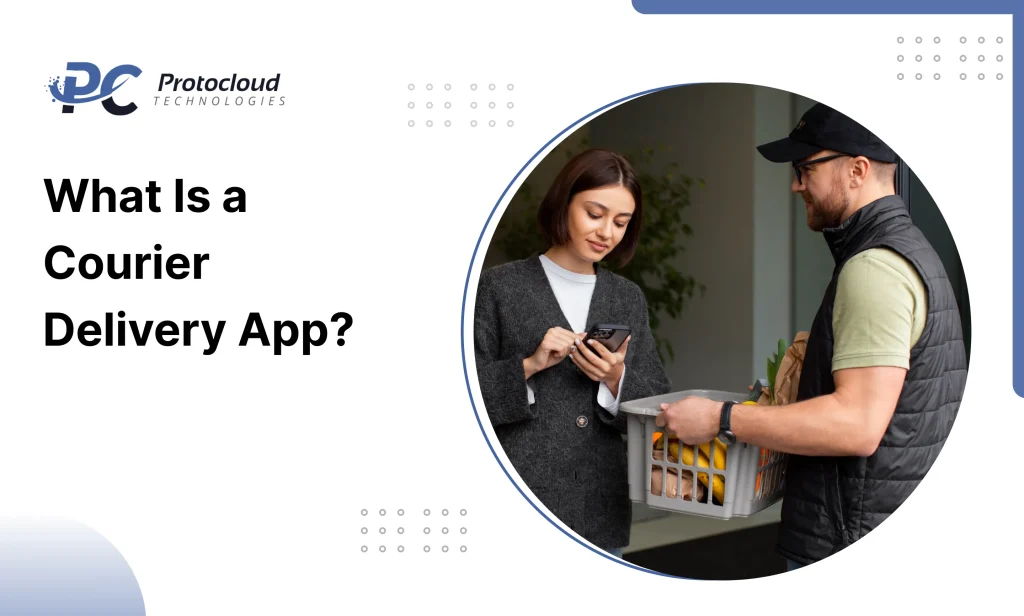
At its surface, a courier delivery app is a digital bridge. It connects three distinct groups: customers who need items moved, delivery agents who perform the physical labor, and business owners who oversee the entire ecosystem.
However, beneath that simple interface, the technology is doing an incredible amount of heavy lifting. A professional-grade parcel delivery app isn’t just a booking tool; it is a complex engine driven by:
- Real-time GPS Tracking: Precise location data for every moving part.
- Automated Dispatching: Algorithms that assign the right job to the right driver at the right time.
- Route Optimization: Software that calculates the most fuel-efficient and time-sensitive paths.
- Logistics Automation: Systems that handle invoicing, notifications, and data logging without human intervention.
In 2026, these aren’t “premium” features. They are the baseline. When these elements work in perfect harmony, the delivery experience feels invisible to the customer—things simply show up exactly when they were promised.
Choosing Your Path: 4 Major Delivery App Models
Before a single line of code is written, you must define your delivery app business model. This decision dictates your feature set, your revenue streams, and your technical architecture. If you pick the wrong model, you’ll find yourself rebuilding your entire backend six months after launch.
01. Peer-to-Peer (P2P) Courier Apps
The P2P model is essentially “crowdsourced” delivery. It connects individuals who need to send a package with those already traveling in that direction.
- Best For: Hyperlocal, urgent, or non-standard shipments.
- Revenue: Usually a commission or “platform fee” on every successful delivery.
- Key Challenge: Maintaining trust and security when the “couriers” are not professional employees.
02. Business-to-Customer (B2C) Apps
This is the new standard for modern retail. B2C apps enable brands—from local pharmacies to global fashion houses—to deliver products directly to consumers’ doorsteps.
- Best For: E-commerce brands, food outlets, and grocery chains.
- Revenue: Increased sales volume, delivery fees, and enhanced brand loyalty.
- Key Challenge: Managing high-volume peaks (like holidays) while maintaining consistent delivery speeds.
03. Business-to-Business (B2B) Logistics Apps
B2B apps handle the “heavy lifting” of the economy. They facilitate the movement of goods between wholesalers, manufacturers, and retailers.
- Best For: Supply chain management, industrial parts, and bulk inventory.
- Revenue: Long-term contracts and high-volume service agreements.
- Key Challenge: Complexity. These apps require deep integration with inventory systems and must support multi-stop, heavy-freight routing.
04. On-Demand and Aggregator Models
On-demand apps focus on “instant” fulfillment (think 30-minute delivery). Meanwhile, courier aggregator apps act as marketplaces where users can compare rates and speeds from multiple logistics providers (such as DHL, FedEx, and local couriers) in one place.
- Best For: Same-day services and price-sensitive consumers.
- Key Challenge: Real-time API synchronization with multiple third-party logistics (3PL) partners.
How It Works: Simple Step-by-Step Flow
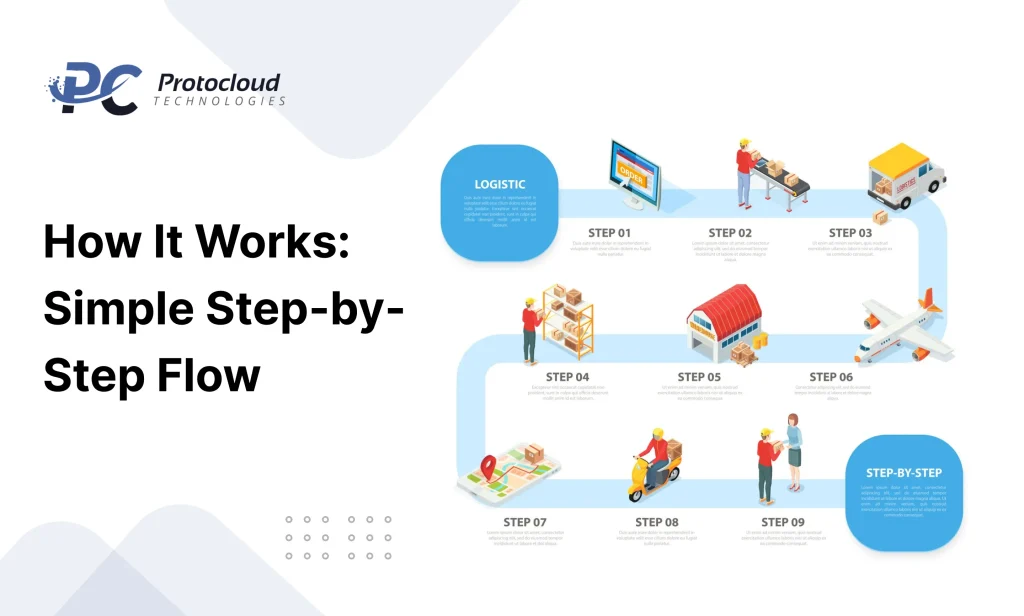
A successful delivery app functions like a well-oiled machine. While the user only sees a few buttons, the backend follows a rigorous logical flow:
- Placement & Payment: The user enters the pickup and drop-off coordinates. The app calculates a “fare estimate” based on distance, traffic, and package weight. The user pays via a secure gateway (UPI, Credit Card, or Wallet).
- Smart Matching: The system polls nearby drivers. Using a “First-Accept” or “Proximity-Based” algorithm, it assigns the task to the most logical agent.
- The Pickup: The agent receives the digital manifest. To ensure security, many modern apps now use a QR code or an OTP (One-Time Password) exchange at the pickup point.
- Optimized Transit: As the agent moves, the app provides turn-by-turn navigation that avoids traffic congestion. Simultaneously, the customer sees a live “pulsing” icon on their map.
- Proof of Delivery (PoD): Upon arrival, the agent captures a digital signature, a photo of the delivered parcel, or another OTP. This instantly triggers a “Delivery Successful” notification and an electronic invoice.
The Strategic “Why”: Why Invest Now?
If you are on the fence about the ROI of a custom app, consider these four pillars of business growth:
01. Capturing Growing Market Demand
The “Delivery Economy” is no longer a niche; it is the primary way people consume. By 2026, even traditional “brick-and-mortar” businesses are expected to provide a digital delivery option. If you don’t own the platform, you are likely paying 20-30% commissions to third-party aggregators. Building your own app brings those margins back to your bottom line
02. Operational Efficiency
Manual dispatching is prone to human error. An automated system never forgets an order, never sends a driver to the wrong side of town, and never loses a receipt. This level of courier service automation typically reduces operational overhead by 15-25% within the first year.
03. The Data Goldmine
When you run your business through an app, every click is a data point. You can see which neighborhoods are most active, which times of day are slowest, and which drivers are your “top performers.” This courier app analytics allows you to make decisions based on cold, hard facts rather than “gut feelings.”
04. Scalability
A manual business is hard to scale because you have to hire more coordinators for every few drivers you add. A digital platform is different. Whether you have 10 drivers or 10,000, the software architecture remains largely the same. You can expand into new cities with a fraction of the traditional “boots on the ground” effort.
The Feature Set: Building the “Triple-Threat” Platform
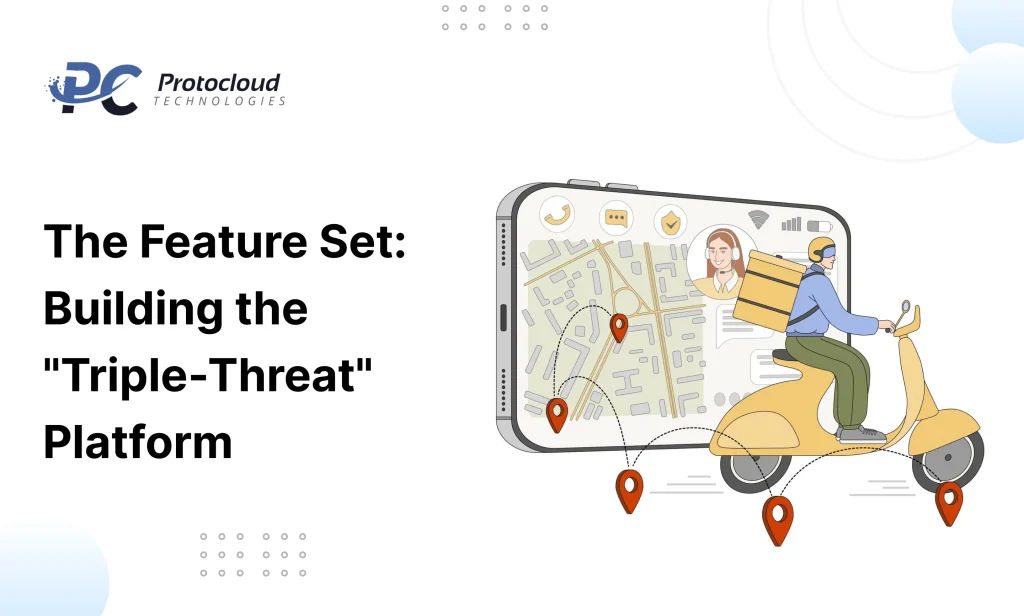
A complete courier management system consists of three distinct software products working together.
The User Panel (The Customer Experience)
The goal here is “frictionless interaction.” If the app is hard to use, customers will simply call a competitor.
- Smart Address Entry: Integration with Google Places API for one-tap address selection.
- Multiple Service Levels: Options for “Standard,” “Express,” or “Scheduled” delivery.
- Real-time Tracking: A high-refresh map view showing the courier’s progress.
- In-App Support: A chat bubble to resolve issues without leaving the app.
The Agent Panel (The Driver Interface)
Drivers are often working in high-stress, fast-paced environments. Their interface must be “glanceable.”
- One-Tap Job Accept/Reject: Simple toggles to manage availability.
- Navigation Integration: Native links to Google Maps, Waze, or Apple Maps.
- Earnings Dashboard: A clear view of daily, weekly, and monthly payouts.
- Performance Metrics: Ratings and feedback to encourage high-quality service.
The Admin Dashboard (The Command Center)
This is a web-based portal used by your office team to manage the “macro” view of the business.
- Fleet Management: View every active driver on a single “God-view” map.
- Dynamic Pricing: The ability to implement “surge pricing” during high-demand periods.
- User/Agent Management: Verifying driver documents and handling customer disputes.
- Revenue Analytics: Detailed reports on profit margins, fuel costs, and delivery times.
The 5-Stage Development Process
Building a high-performance app is a marathon, not a sprint. At Protocloud Technologies, we emphasize a structured lifecycle to ensure the final product is both stable and profitable.
Phase 1: The Discovery & Strategy Phase
We don’t start with code; we start with questions. Who is your target user? What are the biggest “invisible losses” in your current workflow? During discovery, we create a “Product Requirement Document” (PRD) and a basic prototype. This ensures everyone is aligned on the MVP (Minimum Viable Product) scope before the expensive work begins.
Phase 2: UI/UX Design (User-Centric Approach)
In 2026, “pretty” isn’t enough. The design must be functional. We focus on “thumb-zone” navigation (placing buttons where they are easy to reach) and high-contrast visuals for drivers who might be looking at their screens in bright sunlight. We build “wireframes” first, then high-fidelity designs, and finally an interactive mockup.
Phase 3: The Engineering Phase (Backend & Frontend)
This is where the magic happens.
- The Backend: We typically use robust frameworks such as Node.js or Laravel to handle complex logic and database management.
- The Frontend: For mobile, React Native or Flutter are the top choices in 2026 because they allow us to build for both iOS and Android simultaneously without compromising on performance.
- APIs: We integrate third-party “superpowers”—Stripe for payments, Twilio for SMS, and Firebase for real-time notifications.
Phase 4: Rigorous Quality Assurance (QA)
A delivery app with a “buggy” map is a liability. Our QA team performs:
- Unit Testing: Checking individual features.
- Stress Testing: Seeing how the app handles 5,000 users at once.
- Geolocation Testing: Ensuring the GPS coordinates stay accurate even in “dead zones.”
- Security Audits: Protecting user payment data and personal information.
Phase 5: Deployment & Evolution
Once the app hits the App Store and Google Play, the real work begins. We monitor the “crash logs” and user feedback. Successful apps are never “finished”—they evolve. Post-launch, we often add advanced features such as AI-driven route optimization or multi-language support based on market response.
Financial Planning: Cost Estimation for 2026
The most common question we hear is: “How much will this cost?” While every project is unique, we can categorize the investment into three tiers based on complexity and scale.
01. The “Startup” MVP ($8,000 – $20,000)
This is designed for market validation. It includes the essential “book and track” features with a clean, standard UI. It is perfect for a local business looking to digitize its first 5-10 drivers.
- Timeline: 8–12 weeks.
- Focus: Core functionality and stability.
02. The “Growth” Platform ($20,000 – $50,000)
This is the “sweet spot” for established businesses. It includes advanced features like multiple payment gateways, customized branding, agent wallets, and a robust admin suite. It is built to handle thousands of orders per month without breaking a sweat.
- Timeline: 4–6 months.
- Focus: User retention and operational automation.
03. The “Enterprise” Solution ($50,000 – $90,000+)
For companies aiming for a national or international scale. This tier includes AI-powered logistics, predictive analytics (predicting delays before they happen), multi-currency support, and deep integrations with existing ERP or Warehouse Management Systems.
- Timeline: 6–12 months.
- Focus: Global scalability and maximum efficiency.
Technical Trends to Watch in 2026
To truly future-proof your investment, you should be aware of the technologies currently reshaping the logistics landscape:
- AI Route Optimization: Gone are the days of “shortest distance.” In 2026, AI calculates the “shortest time” by analyzing historical traffic patterns, weather reports, and even local event schedules.
- Blockchain for Transparency: For high-value B2B shipments, blockchain provides an unalterable “chain of custody,” ensuring that every hand that touched the parcel is recorded.
- Eco-Friendly Routing: Many apps now offer a “Green Delivery” option that prioritizes bike couriers or electric vehicles to help businesses meet their ESG (Environmental, Social, and Governance) goals.
- Contactless Everything: From biometrics to “Safe-Place” photo confirmations, the emphasis is on high-security, low-touch interactions.
Summary: Your Next Move
The courier and delivery industry is moving at a breakneck pace. The gap between businesses that use a professional app and those that don’t is widening every day. Building a custom delivery app is a significant investment. Still, it pays for itself through increased efficiency, higher customer retention, and the ability to scale your business without limits.
The most successful projects don’t start with the biggest budgets—they start with the clearest vision.
- Identify your niche (e.g., Are you the fastest? The most reliable? The most affordable?).
- Focus on the user experience (make it easy to say “yes”).
- Partner with experts who understand the unique challenges of “Last Mile” logistics.
The technology is ready. The market is waiting. The only question left is: are you ready to build the future of your delivery business?
About the Author
At Protocloud Technologies, we specialize in turning complex logistics challenges into streamlined mobile experiences. With a focus on high readability, SEO-optimized content, and “Brian Dean-style” conversational clarity, we help businesses build the tools they need to dominate their market. Whether you need a 2000-word deep dive or a custom-coded React Native application, we are here to help you bridge the gap between “concept” and “completion.”