A business gets hit by a cyberattack every 39 seconds. In India, the average data breach now costs over ₹17.9 crore. And that number is still rising. So for CIOs, CTOs, and CISOs, the real question is not if your enterprise will be targeted. It’s how fast you can stop the threat when it arrives.
That’s where AI-powered cybersecurity comes in.
What You’ll Learn in This Guide
- What AI cybersecurity actually means
- The top 6 benefits for enterprise leaders
- How AI detects and responds to threats
- AI vs traditional security side by side
- How AI helps you stay DPDPA compliant
- What an AI-powered SOC looks like in India
- How to pick the right cybersecurity partner
What Is AI-Powered Cybersecurity?
Think of traditional security tools like a bouncer with a list. If your name’s on the list, you’re a threat. If it isn’t, you’re free to move ahead.
AI works differently. Instead of checking a list, it learns what normal looks like across your network, your users, and your devices. The moment something seems suspicious, it takes action even against threats it has never encountered before.
This matters a lot in 2026. Attackers are now using AI too. They’re sending automated phishing emails, creating malware that rewrites itself, and even faking CFO voice calls. Fighting AI-driven attacks means you need AI-driven defence.
6 Reasons Enterprise Leaders Are Choosing AI Security
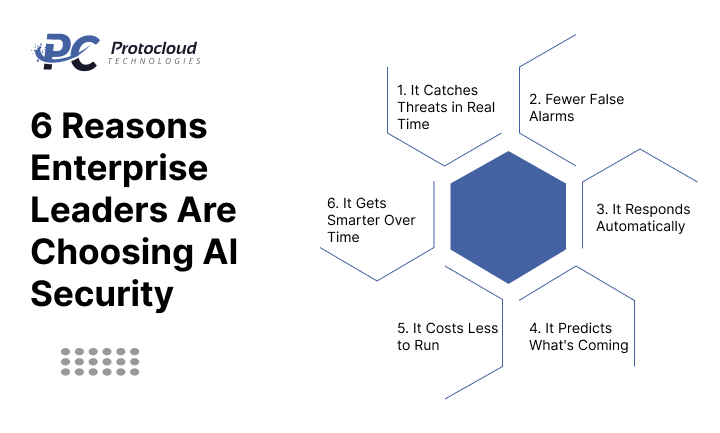
01. It Catches Threats in Real Time
AI scans millions of data points every second across endpoints, networks, and cloud. Threats that would take a human analyst hours to spot are caught in milliseconds.
02. Fewer False Alarms
Traditional tools cry wolf constantly. Security teams get buried in thousands of alerts most of them harmless. AI learns your environment and cuts the noise. Your team only sees what actually matters.
03. It Responds Automatically
When a threat is confirmed, AI doesn’t wait for someone to open their laptop. It isolates the affected system, blocks the attacker, and locks down compromised accounts all within seconds.
04. It Predicts What’s Coming
AI doesn’t just react. By studying global threat data and your own history, you can spot attack patterns before they hit you.
05. It Costs Less to Run
India has thousands of unfilled cybersecurity jobs. AI handles the high-volume, repetitive monitoring work so you don’t need a massive team to stay protected.
06. It Gets Smarter Over Time
Every blocked attack teaches the system something new. It keeps learning without you having to update rules manually.
How AI Threat Detection Actually Works
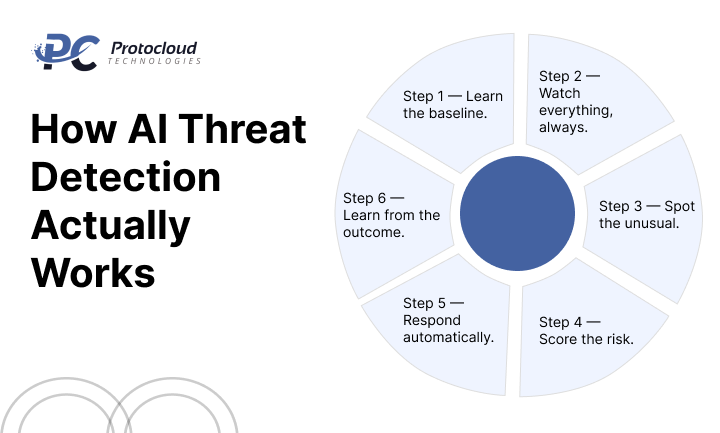
AI security isn’t one tool. It’s a layered process that runs across your entire stack. Let’s break it down step by step:
Step 1 — Learn the baseline.
In the first 2–4 weeks, the AI maps what “normal” looks like. Normal logins. Normal traffic. Normal file access.
Step 2 — Watch everything, always.
Once it knows normal, it monitors 100% of activity 24 hours a day, 7 days a week. Every login, every API call, every file download.
Step 3 — Spot the unusual.
A user logging in from two cities at once? A server sending data out at 2 AM? A huge file download on a Sunday? The AI flags it immediately.
Step 4 — Score the risk.
Not every anomaly is an attack. The AI scores each alert based on how serious it is, how sensitive the asset is, and the context around it. Low-risk alerts are filtered. High-risk ones go straight to your team.
Step 5 — Respond automatically.
For real threats, pre-set playbooks kick in isolating systems, blocking IPs, revoking credentials, preserving forensic evidence.
Step 6 — Learn from the outcome.
Your analysts review what happened, confirm or adjust the response, and feed that back into the model. It keeps getting sharper.
AI vs Traditional Cybersecurity: A Quick Comparison
| What It Does | Traditional Security | AI-Powered Security |
| Detecting threats | Only known threats | Known and unknown threats |
| Response time | Minutes to hours | Seconds to minutes |
| False positives | high — alert fatigue is common | Low — AI filters the noise |
| Scales with growth | Gets noisier as data grows | Gets smarter as data grows |
| Staffing needed | Large analyst teams | AI handles routine work; humans focus on complex cases |
The question for most enterprise leaders isn’t whether to move to AI security. It’s how fast and where to start.
DPDPA Compliance: How AI Makes It Manageable
India’s Digital Personal Data Protection Act (DPDPA) 2023 is now in full force. Non-compliance can result in penalties of up to ₹250 crore per violation, and company executives may also face personal liability.
Here’s how AI security supports your compliance directly:
Know your data DPDPA requires you to know what personal data you hold, where it lives, and who can access it. AI scans and classifies this automatically a task that would take human teams months.
Detect breaches fast. DPDPA has strict breach notification timelines. AI detects breaches in real time and can trigger notifications automatically even if the breach happens at midnight.
Track every access to AI logs who accesses personal data, when, and from where. Unusual access gets flagged instantly. The audit trail is ready whenever a regulator asks.
Automate compliance reports. No more scrambling before an audit. AI platforms generate dashboards and reports in real time giving your CISO and legal team a live view of your compliance posture.
Monitor data usage. DPDPA requires that personal data be used only for the purpose it was collected. AI can monitor this at scale something that’s nearly impossible to do manually.
If your enterprise is in BFSI, healthcare, fintech, or IT services, DPDPA compliance isn’t a box to tick once a year. AI makes it a continuous, automated process.
Why Indian Enterprises Need a Local Approach
Global cybersecurity vendors build for a global market. But Indian enterprises face challenges that are specific to India.
India-specific threats are real. India ranks among the highest in the world for phishing. Ransomware is actively targeting Indian BFSI and manufacturing companies. UPI fraud and deepfake executive impersonation are growing fast. Your security needs to reflect this.
India’s regulatory stack is unique. Beyond DPDPA, you need to meet RBI cybersecurity frameworks, SEBI regulations, and CERT-In’s 6-hour incident notification window. A vendor who doesn’t know these requirements creates gaps.
The skills shortage is a real constraint. India has thousands of unfilled cybersecurity roles. AI helps lean teams do more but the solution still needs to be designed with India’s talent landscape in mind.
Value matters. Mid-market Indian enterprises need enterprise-grade protection at prices that make commercial sense. Cloud-native AI solutions deliver this in a way that traditional on-premises stacks simply can’t.
What a Good AI-Powered SOC Looks Like
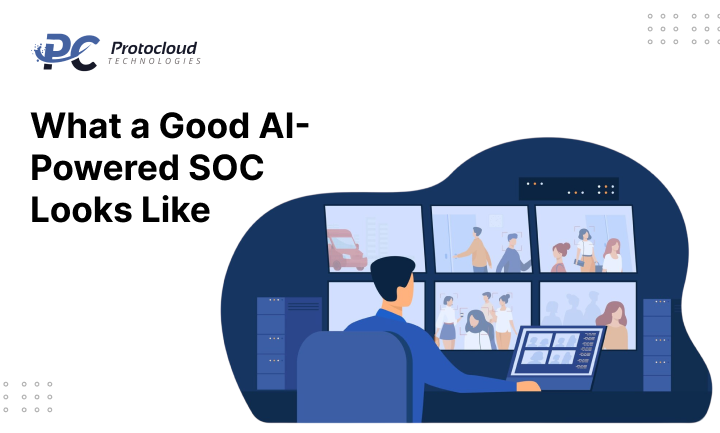
A modern Security Operations Centre (SOC) isn’t a room full of analysts watching screens. It’s an AI-first operation where technology handles the volume, and people handle the judgment.
A quality AI-powered SOC in India should deliver:
- 24/7 monitoring across cloud, on-premises, and hybrid environments
- Mean Time to Detect (MTTD) under 15 minutes for serious incidents
- Automated containment in seconds for confirmed threats
- Proactive threat hunting searching for attackers who may already be inside
- CERT-In support incident documentation within India’s 6-hour window
- Board-ready monthly reports on risk posture, incidents handled, and improvements made
When you’re evaluating providers, don’t accept marketing claims. Ask for actual metrics.
How to Choose the Right Cybersecurity Partner
Use this checklist when evaluating vendors:
01. Do they know India’s regulations?
Can they map their solution to DPDPA, CERT-In, RBI, and SEBI requirements? If they can’t, move on.
02. Will it integrate with what you already have?
Siloed tools create blind spots. Make sure the platform works with your existing SIEM, endpoint tools, cloud environment, and identity management systems.
03. Run a proof of concept first
Deploy the solution for 30–60 days before signing anything. Measure real MTTD, false positive rates, and analyst time saved. Numbers don’t lie.
04. Look at the human team behind the AI
What certifications do they hold? What happens when AI confidence is low? AI is a powerful tool but human judgement still matters.
05. Understand the pricing model
Good AI security should reduce your total cost over time. Get clarity on licensing, per-user or per-endpoint fees, and how costs scale as your organisation grows.
06. Ask for references in your sector
BFSI, manufacturing, healthcare, and IT services all have different risk profiles. Talk to other companies in your space who’ve used the solution.
The Bottom Line
The threat landscape in 2026 is moving faster than any traditional security programme can handle. AI-driven attacks automated phishing, self-rewriting malware, deepfake social engineering are no longer limited to nation-state hackers. Mid-tier criminal groups are using them against Indian enterprises right now.
For CIOs, CTOs, and CISOs, the message is clear: AI-powered cybersecurity isn’t a future investment. It’s an immediate need.
The organisations building AI-first security today are the ones that will stay ahead as threats keep escalating.
Frequently Asked Questions
What’s the difference between AI and traditional cybersecurity?
Traditional tools work from a list of known threats. If the threat isn’t on the list, it gets through. AI learns what normal behaviour looks like and spots anything unusual, even threats that have never been seen before. It also responds automatically in seconds, not hours.
How does AI help with DPDPA compliance?
AI automates the four hardest parts of DPDPA: finding and classifying personal data, detecting breaches in real time, monitoring and logging all data access, and generating compliance reports. For enterprises handling large volumes of personal data, it makes compliance something you maintain every day not just before an audit.
Can mid-sized Indian enterprises afford AI cybersecurity?
Yes. Cloud-native AI platforms have made this accessible at subscription prices that mid-market companies can absorb. And because AI reduces the need for large analyst teams, the total cost of ownership is often lower than traditional security.
How long does deployment take?
Most platforms can be deployed in 2–4 weeks. The AI then spends another 2–4 weeks learning your baseline. Full automated response capability is usually active within 30–60 days of going live.
Protect Your Enterprise with Protocloud Technologies
Protocloud Technologies is India’s trusted partner for AI-powered cybersecurity. We combine deep AI security expertise with a thorough understanding of India’s regulatory landscape DPDPA, CERT-In, RBI, and SEBI.
Whether you’re a CIO building your 2026 security roadmap, a CISO responding to a growing threat landscape, or an IT Director ready to modernise your SOC we have the expertise, technology, and local context to protect what matters most.