Introduction
IOS app development company in the UK finding the right one is where most businesses quietly go wrong. Not because they make obviously bad choices, but because they focus on the wrong things entirely. They compare hourly rates, chase the flashiest portfolio, and sign a contract before they’ve asked a single hard question. Six months later, they’re wondering why their app feels nothing like what they imagined.
UK demand for iPhone app development services has grown sharply over the last few years. Apple users in Britain spend more per app than almost any other market globally, which means getting your iOS product right is not optional. It is the difference between real traction and an expensive lesson.
This guide covers everything you actually need to know. What iOS development involves, how to evaluate companies properly, what realistic budgets look like, and why the right iphone app development company will save you far more money than they cost you.
What Is iOS App Development and Why Does Your Business Need It?
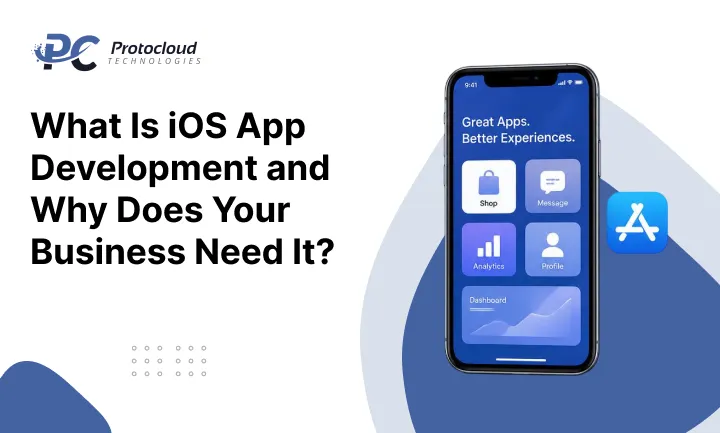
Let’s get something clear upfront. iOS app development is not just building an app for the iPhone. It is an entire ecosystem covering Swift code, Xcode build environments, App Store compliance, Apple Watch extensions, and iCloud syncing. Native iOS development means your app is built specifically for Apple’s platform, not ported over from Android or wrapped in a web view.
The result is faster performance, stronger security, and an experience that feels like it genuinely belongs on the device.
What Sets iOS App Development Apart from Other Platforms
Android development uses Kotlin and runs across hundreds of different device configurations. iOS development uses Swift and targets a tightly controlled set of Apple hardware. That controlled environment is actually an advantage. Fewer compatibility issues, more predictable behaviour, and tighter integration with Apple native features like Face ID, ARKit, and HealthKit.
Cross platform app development tools like React Native or Flutter can cover both platforms at once, but for complex products, nothing matches native iOS development for raw performance and platform feel.
Why UK Businesses Prefer Native iOS App Development
Here is a pattern worth paying attention to. In the UK, iPhone ownership skews heavily toward higher income demographics. A fintech startup, a luxury retail brand, or a healthcare platform will find that their core users are overwhelmingly on iOS. Building natively for that audience is not just a preference. It is a strategic decision that the data supports.
iOS App Market Share in the UK in 2026
Apple holds roughly 50 to 52 percent of the UK smartphone market, compared to the global average of around 27 to 28 percent. That gap matters enormously when you are deciding where to invest first. For most UK focused consumer products, iOS is the right starting point.
Key Skills to Look for Before Hiring an iOS App Development Company in the UK
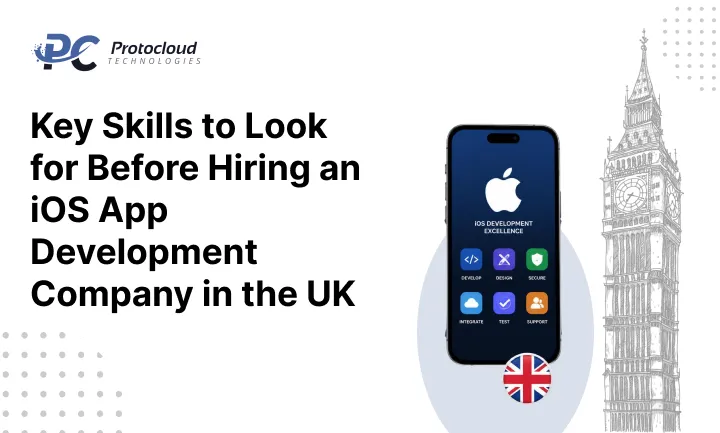
When you are evaluating an iOS app development services provider, it is easy to get dazzled by a polished portfolio. The actual technical depth matters far more. Here is what to look for beyond the surface.
Proficiency in Swift & Objective-C
Swift has become the go-to programming language for building modern iOS applications. Any serious team should be writing clean, idiomatic Swift rather than patching legacy Objective-C code everywhere. Request code samples or links to their GitHub repositories to evaluate their development quality and experience. If they cannot show you Swift code with proper use of async/await, Combine, or SwiftUI, treat that as a warning sign.
Experience with Apple Human Interface Guidelines
Apple’s HIG is essentially the rulebook for how iOS apps should look and behave. Teams that ignore it build apps that feel clunky and frequently get rejected from the App Store. Good iOS developers reference HIG naturally in design conversations. It should not be something you have to prompt them about.
App Store Submission & Compliance Expertise
App Store rejection happens more often than most people expect. Apple’s review process has strict requirements around privacy labels, data collection disclosures, and in-app purchase implementations. A team with genuine submission experience knows how to get your app through the first time without the back and forth.
UI/UX Design Capabilities for iOS
iOS UX design is not generic mobile design. It involves understanding iOS specific patterns including navigation controllers, tab bars, gesture handling, and how users mentally map Apple’s ecosystem. Ask whether they have dedicated iOS designers or whether they simply hand off Figma files to developers and hope for the best.
Third-Party API & SDK Integration Experience
Most real world apps connect to something external. Payment gateways, maps, analytics platforms, health data, social logins. Strong teams handle these integrations without creating security vulnerabilities or performance problems. Ask specifically about their experience with Apple Pay, HealthKit, or MapKit.
Post-Launch Support & Maintenance
iOS updates every year and Apple occasionally deprecates APIs with very little notice. A team that disappears after launch leaves you in a difficult position when a new iOS version breaks something important. Get clarity on their maintenance terms before anything is signed.
How to Hire an iOS App Development Company in the UK — Step by Step
Knowing how to hire an iOS app development company in the UK properly is a process, not a single decision. Here is a sequence that consistently produces better outcomes.
Define Your App Requirements & Business Goals
Before approaching any company, write down what your app needs to do, who it is for, and what success looks like in six months. Vague briefs produce vague proposals. The more specific you are upfront, the more accurately companies can scope and price your project.
Research and Shortlist Top iOS App Development Agencies
Begin by exploring platforms like Cluth, Goodfirms and using focused searches to find iOS app development agencies in the UK. Look for companies with at least three to five relevant case studies covering apps in your industry or with similar complexity. Get yourself down to four or five serious options before you start having real conversations.
Evaluate Their Portfolio & Case Studies
Download and actually use the apps they have built. You will immediately feel whether the team cares about user experience or just about shipping features. Check whether those apps are still live and being maintained. Abandoned apps tell you something important about how a company operates after the invoice is paid.
Check Client Reviews & Testimonials
Clutch reviews tend to be the most reliable because they are independently verified. Look specifically for reviews that mention communication style, how the team handled unexpected problems, and whether deadlines were met. One honest account of how a difficult situation was managed tells you far more than five five-star ratings with no detail.
Request a Proposal & Compare Quotes
A well structured proposal breaks down costs by phase. Discovery, design, development, testing, and deployment should each have their own line. If a company gives you a single total number with no breakdown, ask them to itemise it. You are not just comparing price here. You are comparing how clearly and honestly they think about your project.
Sign an NDA & Finalise the Contract
Always sign an NDA before sharing detailed business logic or proprietary concepts. The contract itself should clearly state who owns the code (you should), how payment milestones work, how many revision rounds are included, and what the exit terms look like for both sides.
How Much Does It Cost to Hire an iOS App Development Company in the UK?
The honest answer to how much does iOS app development cost in the UK depends almost entirely on what you are building. A focused MVP with five or six screens sits in a completely different bracket from a feature-rich platform with real-time data, complex backend logic, and multiple third-party integrations.
UK based iOS app development agencies generally charge between £80 and £150 per hour. Offshore teams with UK project management, like Protocloud Technologies, can deliver comparable quality at £25 to £60 per hour. Most projects fall within these ranges.
Simple MVP or prototype: £15,000 to £30,000 Mid-complexity app covering e-commerce, booking, or healthcare: £30,000 to £80,000 Enterprise or complex platform: £80,000 to £200,000 and above
Factors Affecting the Cost to Build an iOS App in the UK
Understanding the cost of iOS app development means understanding what actually drives the numbers up or down. Here are the variables that matter most.
App Complexity & Feature Set
Every feature adds development time. Real-time messaging, video streaming, AI recommendation engines, offline functionality each one multiplies the effort involved. Prioritise ruthlessly for your first version. Features can always be added in the next release. Rebuilding a bloated v1 is much more expensive.
UI/UX Design & Prototyping Requirements
Custom animations, branded design systems, and interactive prototyping all add to cost. They also add real value. Generic looking apps get deleted quickly. A proper design phase adds roughly 15 to 20 percent to total project cost but has a significant positive impact on user retention.
Third-Party Integrations & API Connections
Every connection to an external system payment processors, mapping services, CRMs, external databases requires careful scoping, testing, and sometimes licensing fees. More integrations mean more surface area for bugs and a longer QA process.
Development Team Size & Engagement Model
Fixed price contracts suit well scoped projects. Time and materials works when requirements are likely to evolve. Dedicated team models make more sense for longer term products. Each model carries different cost implications and risks. Choose based on how clearly defined your requirements actually are.
Testing, QA & Security Compliance
Cutting corners on QA is the most expensive decision you can make. A buggy App Store launch generates negative reviews that stick around for a long time. Budget at least 15 to 20 percent of your total development time for testing. For healthcare or fintech applications, a proper security audit is not optional.
Ongoing Maintenance, Updates & App Store Management
Expect to spend roughly 15 to 20 percent of your original development cost each year on maintenance. Annual iOS releases typically require compatibility updates, and keeping your App Store listing optimised with current screenshots, descriptions, and keywords is ongoing work that is easy to underestimate.
Benefits of Hiring an iOS App Development Company in the UK
Working with a proper iOS app development agency UK rather than piecing together a team of freelancers comes with real practical advantages worth understanding.
Access to Skilled Swift & Xcode Developers
Strong agencies employ developers who genuinely specialise in iOS. They follow Swift Evolution proposals, contribute to open source iOS projects, and know the platform deeply enough to push back when a feature idea will not work the way you are imagining it. That kind of honesty saves significant time and money.
Timezone & Real-Time Communication Advantages
When your development team works hours that overlap with yours, problems get solved the same day. Waiting 24 hours for a response on a critical bug while a sprint is running is a serious workflow problem. UK compatible timezones mean your team is reachable at the moments that actually matter.
Complete Adherence to UK GDPR and Data Protection Regulations
Any app collecting user data in the UK must comply with UK GDPR. Teams experienced in the UK market understand data minimisation principles, consent flows, and privacy policy requirements without needing a legal review for every product decision. That knowledge built into the development process is genuinely valuable.
Faster Time-to-Market Using Agile Development
Agile iOS development means shipping in sprints, collecting real user feedback early, and adjusting course before the entire budget is committed. Building everything in isolation for twelve months and then launching is how genuinely good ideas become very expensive failures.
Long-Term Partnership & Dedicated Support
The best agency relationships function more like an extended internal team than a vendor arrangement. When your agency genuinely understands your business, your users, and your product roadmap, the decisions they make on your behalf are better ones.
Freelancers vs iOS App Development Agencies in the UK — Which Is Right for You?
The freelance iOS developer vs agency UK question comes down to one thing. How much risk can your project realistically absorb?
| Factor | Freelancer | iOS App Development Agency |
| Cost | Lower upfront, unpredictable total | Fixed or milestone pricing, predictable |
| Reliability | Single point of failure | Dedicated team with built-in redundancy |
| Scalability | Difficult to scale quickly | Resources can be added on demand |
| IP Ownership | Can be ambiguous without a strong contract | Clear ownership terms built into contract |
| Communication | Direct but with limited availability | Project manager plus structured updates |
| Accountability | Limited post-project support | Ongoing SLA and maintenance plans |
Freelancers work well for small, tightly scoped tasks. A specific feature addition, a UI update, or a known bug fix. For full product development requiring design, iOS engineering, backend work, and QA together, an agency almost always delivers more consistent and reliable results.
iOS Development vs Android Development — Key Differences Explained
The iOS vs Android development comparison is one of the first decisions new app builders face. Here is what genuinely matters.
Language: iOS uses Swift or Objective-C. Android uses Kotlin or Java. These are entirely separate codebases. A native iOS app cannot run on Android without being rebuilt from scratch.
Device fragmentation: iOS targets Apple’s controlled set of hardware. Android runs across thousands of device and screen configurations from dozens of manufacturers, which makes thorough testing significantly more complex and time consuming.
App Store policies: Apple’s App Store has a stricter review process than Google Play. Submissions take longer initially, but the overall quality bar across the platform is higher as a result.
Development cost: iOS projects typically run 10 to 20 percent faster than equivalent Android work due to lower fragmentation and more consistent APIs. Android projects require more extensive device testing to cover the range of configurations in use.
UK audience: With approximately 50 percent iOS market share in Britain, starting with iOS is the right call for most consumer facing UK products.
Why Protocloud Technologies Is the Best iOS App Development Company in the UK
Protocloud Technologies has built its reputation as a trusted iOS app development company in the UK on a straightforward foundation. Deep technical expertise combined with genuine business understanding.
Their team works across Swift, SwiftUI, Xcode, and React Native, covering both fully native iOS development and cross platform app development where that approach better suits the project. Every engagement begins with a proper discovery phase that maps business goals to technical decisions, rather than jumping straight into building.
As an established iphone app development company, Protocloud has delivered iOS products across fintech, healthcare, e-commerce, and enterprise applications. Their portfolio reflects real product complexity rather than a collection of simple showcase projects.
For businesses looking for an iOS app development company for startups in the UK, Protocloud offers engagement models that flex with your stage of growth, from a tight MVP build to a full long-term product team.
How Protocloud Technologies Uses AI-Powered Features to Build iOS Apps
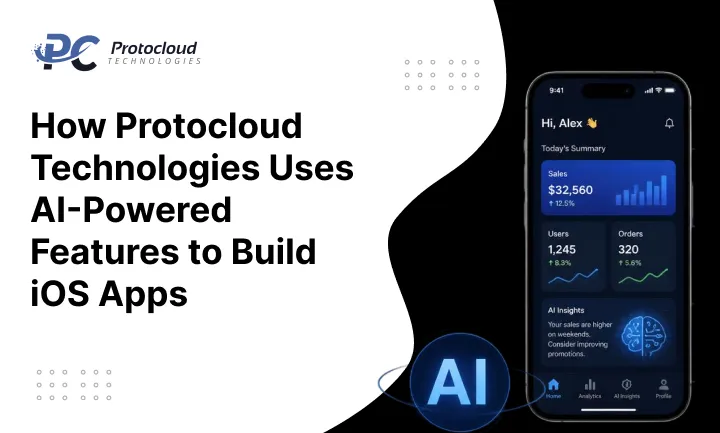
Building AI powered iOS apps well requires more than connecting a third-party API and calling it intelligent. Protocloud integrates AI as a functional layer that improves real user outcomes, not as a feature checkbox on a sales deck.
AI-driven UX personalisation analyses user behaviour patterns to inform dynamic content ordering and feature surfacing, so the app adapts to what each individual user actually does rather than serving everyone an identical experience.
Intelligent testing automation uses AI assisted test generation to surface edge cases that manual QA consistently misses. The practical result is fewer critical bugs reaching production and a cleaner App Store launch.
Predictive analytics built on Apple’s Core ML framework enables real-time on-device predictions without routing sensitive data through external servers. For healthcare and finance applications, that architectural decision is not optional.
LLM powered features including natural language interfaces, contextual search, and smart recommendations are integrated natively into the iOS layer using models from OpenAI, Anthropic, or custom fine-tuned solutions depending on the product requirements.
The result is iOS apps that behave intelligently in ways users notice and appreciate, not just apps with a chat window added at the end.
Conclusion
Finding the right iOS app development company in the UK is not about finding the cheapest option or the most impressive looking website. It is about finding a team that will make consistently good decisions with your budget and your product.
Start with clarity before you approach anyone. Know what you are building, who it is for, and what success looks like. Evaluate teams on their technical honesty, their communication quality, and the real world apps they have shipped. Set a realistic budget and plan for the life of the product, not just the launch day.
Protocloud Technologies brings the iOS app development services and the product judgment your app deserves. Ready to build your iOS app with a team that takes it as seriously as you do? Contact Protocloud Technologies today for a free consultation.
Frequently Asked Questions
How much does it cost to develop an iOS app in the UK?
Simple iOS apps start around £15,000 for a focused MVP. Mid-complexity apps covering e-commerce, booking systems, or healthcare typically run £30,000 to £80,000. Enterprise platforms with complex integrations can exceed £200,000. The biggest cost driver is feature complexity, followed closely by the engagement model you choose.
How long does it take to build an iOS app?
A focused MVP with a dedicated team typically takes three to four months. A fully featured app with complex backend integrations usually runs six to nine months. The discovery and design phases, usually four to six weeks, are not time you can cut. Skipping them adds delays and rework later.
What is the difference between iOS and Android development?
iOS uses Swift and targets Apple’s tightly controlled hardware. Android uses Kotlin and runs across thousands of device configurations. They require entirely separate native codebases. iOS development is generally faster due to lower fragmentation. Android requires more extensive cross-device testing to reach the same quality bar.
Should I hire a freelancer or an iOS app development agency in the UK?
For small, well defined tasks a freelancer can work well. For building a complete product that requires design, engineering, backend work, and QA working together, an agency delivers more reliable and accountable results. The difference in cost is usually recovered through reduced rework and fewer post-launch problems.
Why choose Protocloud Technologies as my iOS app development partner?
Protocloud brings native iOS expertise across Swift, SwiftUI, and Xcode alongside real commercial experience in fintech, healthcare, and e-commerce. Their flexible engagement models, UK compatible working hours, and genuine AI development capabilities make them a strong fit for startups and established businesses alike.
Do I need a UK-based iOS app development company?
Not necessarily. What actually matters is timezone compatibility, clear communication, and proven technical capability. Many successful UK iOS products are built by teams combining UK facing project management with offshore development, delivering equivalent quality at a more sustainable cost.