We live in a world powered by data. And it’s growing fast. According to the big data trends 2024, the world generated about 402.74 million terabytes per day. That equals nearly 147 zettabytes per year, according to recent global data generation statistics. And this is just the start.
By 2026, experts expect 495.89 million terabytes per day. That’s around 181 zettabytes annually. This surge makes handling massive datasets harder than ever. Capturing data is easy. But managing large datasets, organizing them, and turning them into value? That’s the real challenge.
This is where big data tools, big data analytics tools, and powerful big data software come into play. These big data platforms act as smart big data management tools. They help businesses build strong data strategy tools for smarter growth.
In this guide, we break down the top 10 big data software and the most effective big data solutions available today.
What Are Big Data Analytics Tools?
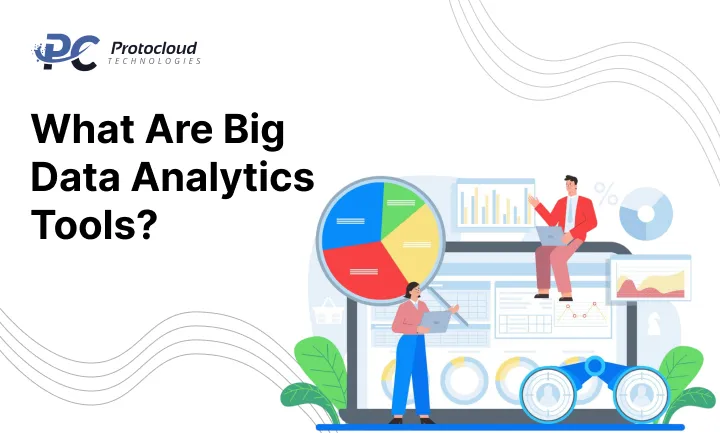
Big data analytics tools are advanced data analytics tools built for scale. Traditional systems fail with massive data. But modern big data technologies and big data frameworks handle it with ease.
These tools collect, store, process, and analyze data using:
- Distributed computing tools
- Parallel processing software
- Machine learning tools
- Stream processing tools
- Advanced analytics software
They support both real-time and batch data processing. They also include powerful data visualization tools for clear insights.
Understanding the Five Vs of Big Data
Every strong big data analytics software focuses on the five Vs of big data:
- Volume – Managing terabytes to petabytes using scalable data storage solutions
- Velocity – Fast processing with smart data processing tools
- Variety – Handling structured and unstructured data
- Veracity – Ensuring data accuracy for reliable enterprise data analytics
- Value – Turning raw data into action with predictive analytics software, data mining tools, and smart business intelligence tools
Modern big data software powers data-driven decision-making. It delivers accurate data insights tools for real growth. With the right scalable data platforms and cloud-based big data tools, companies stay ahead in a competitive market.
Top Big Data Tools 2026
Data keeps growing. So do business demands. That’s why choosing from the top big data tools 2026 is critical. The right solution drives speed, scale, and smart insights. The wrong one slows growth.
This big data tools list covers the top 10 tools shaping big data technologies in 2026. These big data platforms power modern big data software, advanced big data analytics tools, and reliable big data management tools.
Each tool supports strong big data solutions, from data analytics tools to data processing tools and data analysis software. These are trusted enterprise big data tools built for real business impact.
Let’s explore them in depth.
-
Apache Hadoop
Apache Hadoop is one of the most trusted open source big data tools. It processes huge amounts of data by spreading the work across many connected computers. It uses Hadoop HDFS for storage and Hadoop MapReduce for processing.
This tool shines in big-data storage solutions and large-scale batch-processing frameworks. It supports big data, both structured and unstructured, with strong scalability. Major companies like Amazon, Microsoft, and IBM rely on it for big data for enterprise analytics.
Pros:
- Handles huge volumes easily.
- Runs on low-cost hardware.
- Supports parallel processing.
- Works well with other distributed computing frameworks.
Cons:
- Needs technical skills.
- Not ideal for real-time data processing tools.
- Limited built-in security.
- Apache Spark
Apache Spark changed the game. Its Spark in memory processing makes it much faster than traditional systems—up to 100x faster than Hadoop for certain tasks. It supports big data for real-time analytics, ML, graph processing, and more.
It runs on Hadoop, Kubernetes, or the cloud. That makes it perfect for cloud-based big data tools and flexible big data architecture tools. In 2026, Spark remains the de facto standard for unified analytics.
Pros:
- Extremely fast performance.
- Strong support for streaming and batch.
- APIs for Python, Java, Scala, and R.
- Excellent integration with other big data integration tools.
Cons:
- High memory usage.
- Frequent updates may affect stability.
- Depends on external storage.
- Apache Cassandra
Apache Cassandra is a powerful NoSQL database built for scale. It runs as a peer-to-peer system with no single point of failure. This decentralized architecture ensures that even if several nodes go down, your data remains accessible.
Originally developed at Facebook, it now powers mission-critical apps like Netflix and Spotify. It supports distributed database management systems and highly fault-tolerant data systems.
Pros:
- Zero downtime.
- Easy scaling with new servers.
- High-speed writes.
- Flexible schema design.
Cons:
- Complex management.
- No joins or subqueries.
- High storage needs.
- Apache Flink
Apache Flink focuses on real-time speed. It supports both streaming and batch workloads. That makes it ideal for stream processing platforms and smart data processing tools. It enables stateful computing for continuous data streams, which is vital for IoT and fraud detection.
Businesses use it for instant decision-making and big-data ETL processes. Flink’s ability to handle out-of-order data makes it a leader in big data technologies in 2026.
Pros:
- Handles streaming and batch.
- Built-in checkpoints for recovery.
- Low latency.
- Strong APIs.
Cons:
- Needs high computing power.
- Uses external storage.
- Steeper learning curve.
- Databricks
The Databricks platform combines data lakes and warehouses into a single lakehouse. It supports big data for machine learning, AI, and analytics in one place. Built by the creators of Spark, it strengthens machine learning, big data tools, and predictive analytics.
In 2026, Databricks is a top choice for organizations moving toward Generative AI and autonomous analytics.
Pros:
- Unified workspace.
- Supports generative AI.
- Auto-scaling compute.
- Strong team collaboration.
Cons:
- It can be costly.
- Requires Spark knowledge.
- Vendor lock-in risk.
- Qubole
The Qubole data platform simplifies big data in the cloud. It supports Spark, Hive, and Presto. That makes it ideal for big data for cloud computing. It automates scaling and reduces infrastructure stress, allowing data scientists to focus on models rather than servers.
Many teams use it to accelerate data analysis software workflows and optimize cloud operations costs.
Pros:
- Easy ingestion and processing.
- Team-friendly notebooks.
- Cost optimization via spot instances.
- Multi-cloud compatibility.
Cons:
- Heavy computing needs.
- Limited deep customization.
- Performance may vary.
- Apache HBase
Apache HBase runs on Hadoop and supports real-time read/write access. It is modeled after Google’s Bigtable and works well for fraud detection and instant lookups. It handles massive data across servers, making it well-suited for high-performance data processing.
It is the go-to for random, real-time access to your big data stored in HDFS.
Pros:
- Low-latency reads.
- Scales easily.
- Multiple APIs (Java, REST, Thrift).
- Great for real-time use.
Cons:
- Complex setup.
- Limited advanced query features.
- MongoDB
The MongoDB NoSQL database stores data in JSON-like documents. It is flexible and schema-free, enabling rapid iteration during development. It supports modern apps that require large-scale structured and unstructured data.
Many developers use it for fast app growth and scalable big data platforms. In 2026, its “Atlas” cloud service is a dominant force in the industry.
Pros:
- High-speed reads and writes.
- Easy scaling.
- Built-in replication.
- Strong query support.
Cons:
- 16MB document limit.
- High memory usage.
- Limited relational features.
- Apache Storm
Apache Storm handles real-time streams with very low delay. It powers continuous computation and analytics pipelines. Originally open-sourced by Twitter, it now serves many enterprises. It fits perfectly into big data for real-time analytics, where processing every event matters.
Storm guarantees that every message will be processed, making it a reliable part of any big data architecture.
Pros:
- Ultra-low latency.
- Scalable.
- Multi-language support.
- Works with Kafka and Flume.
Cons:
- Complex setup.
- High resource use.
- RapidMiner
The RapidMiner machine learning platform simplifies ML workflows. It uses drag-and-drop tools to make modeling easier, bridging the gap between data science and business. It supports big data for AI applications and advanced analytics.
Teams use it for sentiment analysis and customer segmentation. In 2026, its ability to integrate with Generative AI makes it a must-have for big data for predictive analytics.
Pros:
- No-code ML options.
- Supports all major ML types.
- Handles parallel processing.
- Strong teamwork features.
Cons:
- Advanced features need expertise.
- Paid plans cost more.
- No live ingestion support.
Why Big Data Tools Matter in 2026
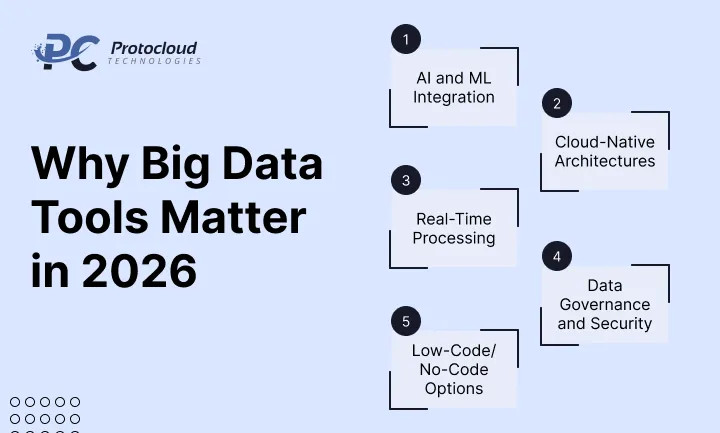
The big data ecosystem 2026 is bigger and smarter than before. Companies create huge amounts of data every second. To manage it well, they depend on powerful big data tools in 2026. This is exactly why big data tools matter today.
Modern businesses need speed. They need accuracy. And they need security. The latest big data trends 2026 focus on smarter systems and faster results. Strong, intelligent analytics platforms help companies turn raw numbers into clear actions. This is the real future of big data analytics.
The right tools also support strong enterprise big data governance. They protect data while helping teams grow. That balance is critical in the fast-moving big data ecosystem in 2026.
- AI and ML Integration
AI and ML integration in big data is now common. Artificial intelligence in big data helps companies spot patterns quickly. Machine learning on big data platforms powers advanced predictive analytics tools that enable better decision-making.
Teams now get automated data insights in minutes. With AI native analytics and generative AI in big data, users can ask questions using natural language query analytics. Systems also automatically perform intelligent data preparation.
This makes big data tools 2026 faster, simpler, and more powerful.
- Cloud-Native Architectures
Most companies use cloud native big data platforms today. These cloud-optimized big data analytics tools scale easily as data grows. Many businesses prefer cloud-based big data solutions because they support scalable big data architectures.
They also reduce costs. That is why they are known as cost-efficient data platforms. This shift is one of the biggest big data trends for 2026.
- Real-Time Processing
Speed drives success. Businesses now rely on real-time data processing tools and robust stream-processing platforms. Modern real-time analytics software delivers full real-time big data analytics.
The old debate between batch and real-time analytics is almost over. Real-time systems dominate the big data ecosystem in 2026 because companies need instant insights.
- Data Governance and Security
Security builds trust. Companies use strong data governance tools to protect information. Data privacy and security in big data help meet legal standards such as GDPR and CCPA compliance, as well as support analytics.
Modern unified data governance platforms enable seamless cross-platform data governance. Tools like Unity Catalog, Databricks, and AWS Lake Formation improve control and transparency. This strengthens overall enterprise big data governance.
- Low-Code/No-Code Options
The democratization of data analytics is growing fast. Low-code big data tools and no-code data analytics platforms enable non-technical users to work with data.
Employees use self-service analytics tools through intuitive data analytics interfaces. This makes powerful analytics simple and accessible.
Choosing the Right Big Data Analytics Tools
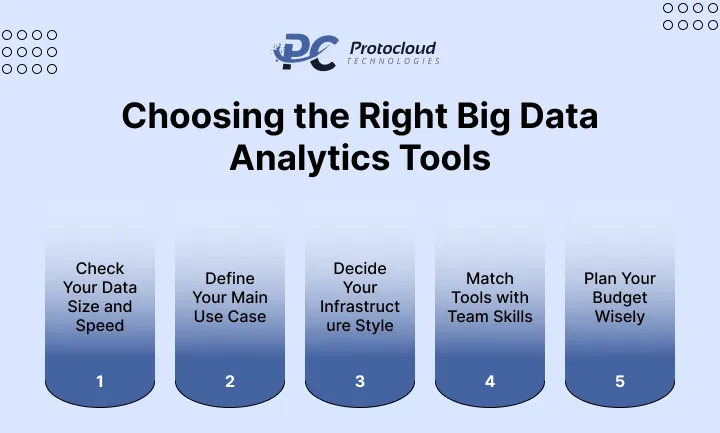
Picking the right big data software doesn’t have to be hard. You need a clear plan. The best choice depends on your data size, speed, use case, team skills, and budget. Let’s understand it step by step easily.
- Check Your Data Size and Speed
Start with your data type.
- Batch processing (TB to PB level): Use Hadoop, Spark, or Snowflake.
- Real-time streaming (millions of events per second): Go with Kafka, Flink, or Druid.
- Interactive analytics and fast queries: BigQuery, Snowflake, or Presto work well.
If your business needs instant insights, choose real-time tools. If you process data daily or weekly, batch tools are enough.
- Define Your Main Use Case
Your goal matters more than the tool name.
- Data warehousing: Snowflake, Redshift, BigQuery
- Stream processing: Kafka, Flink, Spark Streaming
- Search and log analytics: Elasticsearch, ClickHouse
- ML and AI workflows: Databricks, Spark, BigQuery ML
Pick tools that solve your main problem first. Then expand if needed.
- Decide Your Infrastructure Style
Think about where you want to run your system.
- Cloud-native tools: Snowflake, BigQuery, Databricks
- On-premises tools: Hadoop, Cassandra, Elasticsearch
- Hybrid setup: Many modern platforms support both
Cloud saves time. On-prem gives control. A hybrid gives flexibility.
- Match Tools with Team Skills
Your team’s strength is key.
- SQL-focused teams: Snowflake, BigQuery, Redshift
- Engineering-heavy teams: Spark, Flink, Kafka
- Mixed teams (analysts + engineers): Databricks, Tableau
Choose tools your team can use confidently.
- Plan Your Budget Wisely
Budget shapes everything.
- Open-source first (low license cost): Hadoop, Spark, Kafka, Cassandra
- Managed services (higher cost, less maintenance): Snowflake, BigQuery, Databricks
- Hybrid approach: Open-source tools with managed cloud options
Open-source saves money but needs more setup. Managed services cost more but reduce operational work.
Future Trends in Big Data Analytics (2026 and Beyond)
The next wave of big data trends in 2026 focuses on smarter and greener systems. These changes define modern data architecture in 2026 and shape next-generation big data solutions.
- AI-Native Analytics
AI native analytics will continue to grow. With deeper generative AI in big data, businesses will gain faster insights and better automation.
- Lakehouse Architecture Dominance
Lakehouse architecture is becoming the new standard. Many companies use data lakehouse platforms built on the Delta Lake architecture, the Apache Iceberg table format, and the Apache Hudi data lake.
- Real-Time Everything
The move toward real-time continues. Real-time big data analytics will replace many traditional systems.
- Unified Data Governance
Advanced unified data governance platforms support comprehensive cross-platform data governance across tools and teams.
- Green Big Data
Green big data promotes energy-efficient data processing and carbon-aware computing. Companies now focus on building sustainable data infrastructure.
- Data Mesh and Decentralization
Data mesh architecture supports decentralized data ownership and a strong domain-oriented data architecture. This approach changes how organizations manage data.
Conclusion
In 2026, businesses cannot ignore big data. They must rely on skilled experts to manage complex big-data tools such as Hadoop, Spark, and Databricks. These platforms are powerful. They offer strong scalability and real-time processing.
But they are not always simple. Many companies struggle with technical complexity. These systems often need heavy infrastructure and skilled engineers. They can also demand high computing resources.
Security is another concern. Without proper setup, data can become vulnerable. That is why expertise matters more than ever.
In short, big data tools bring huge opportunities. But businesses need the right strategy, the right team, and the right setup to use them successfully.